
BEIJING: Wednesday marked the 77th anniversary of the founding of the Chinese People’s Liberation Army (PLA) Air Force. After more than seven decades of development, the PLA Air Force has steadily advanced toward its strategic goal of “integrating air and space capabilities as well as coordinating offensive and defensive operations.” With domestically developed new warplanes entering service as they are upgraded, the service has built an air combat force with a complete aircraft lineup, clear division of labor and efficient coordination, with modernization and system-based combat capability rising steadily.
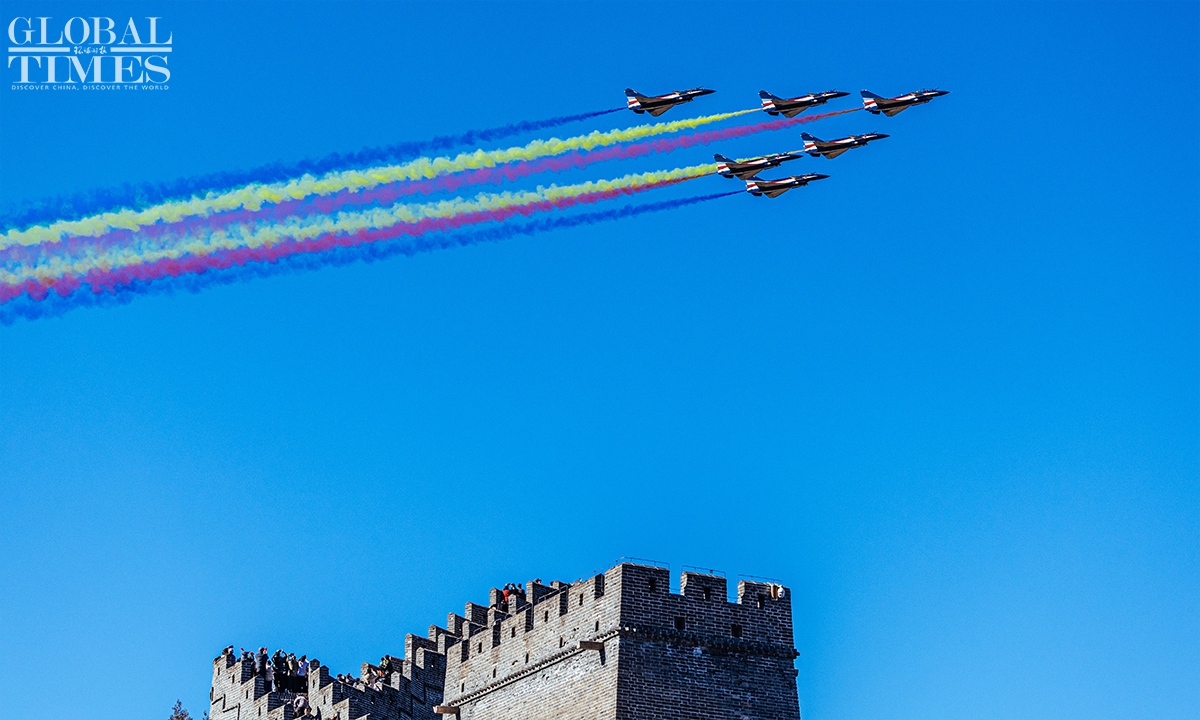
On Friday, six J-10 jets from the Chinese Air Force August 1st aerobatics team flew over the Great Wall as an anniversary tribute. On Monday, CCTV News’ military channel released new footage offering a close-up, multi-angled look at the GJ-11 stealth drone, revealing its high-stealth characteristics, a buildup to the anniversary.
Military affairs experts told the Global Times on Wednesday that in the new era, the Air Force’s system-based combat capability has undergone profound changes and made great leaps. A series of broader international operations have also pushed domestic air power from “able to fly” toward “able to deploy far, coordinate across services and operate in unfamiliar environments.” Building its force system for the future and accelerating modernization, the Air Force remains a defender of national sovereignty, security and development interests, and a steadfast guardian of peace and stability.
System empowerment
According to the CCTV News, looking back to the 1949 military parade marking the founding of the People’s Republic of China, there were so few aircraft that they had to fly past twice to fill out the formation.
After 77 years of hard work, the PLA Air Force started from that difficult position and gradually built a mature air and space combat system, completing a great strategic transition from homeland air defense to integrating air and space capabilities as well as coordinating offensive and defensive operations, Zhang Junshe, a Chinese military affairs expert, told the Global Times.
In this transition, the main combat equipment system has continued to build and develop. With the public debut of the J-35A medium stealth multirole fighter, the Air Force’s traditional “three swordsmen,” the J-20 stealth fighter, J-16 fighter and J-10C fighter, have expanded and upgraded into a new “four swordsmen” lineup that includes two types of stealth fighters, CCTV reported.
The four “swordsmen” form a new combination of the Air Force’s aviation new-quality combat power, shaping a new air combat style of networked, coordinated air superiority and precision strikes across multiple aircraft types, CCTV reported.
Zhang stressed that modern air combat is no longer a duel between single aircraft but a contest of systems.
No matter how capable a single platform is, it can still create a weak link and struggle against complex, diverse battlefield threats. Deep integration and system empowerment across multiple services and aircraft types are essential, Zhang said.
Fighters, bombers, early warning aircraft, tankers, electronic warfare aircraft, transport aircraft, reconnaissance drones and stealth drones each perform their roles and work closely together to build a solid air and space defense line, CCTV said.
Beyond a complete equipment system, Zhang added, the Air Force’s information hub is now stronger. Early warning aircraft serve as airborne command hubs, and data links act as the neural system, closely linking stealth fighters, drones, ground radar and air defense systems to achieve seamless connection between “seeing far” and “striking accurately.”
At the same time, new-quality combat forces are accelerating. High-stealth reconnaissance-strike drones operate alongside crewed fighters, pushing air and space confrontation into a new stage of intelligence and precision. The Air Force has all-domain offensive and defensive capability, not only with strong air superiority but also with breakthroughs in strategic early warning, long-range precision strikes, air and missile defense and strategic projection, achieving all-domain reach and combat capability, the expert said.
CCTV reported that a modern strategic air force’s combat power rests not only on advanced aviation equipment but on five core branches – aviation, ground-to-air missile, radar, airborne and electronic countermeasures – each performing its role in coordinated fashion, building a comprehensive, three-dimensional air and space defense system that is the core support for system-based air combat.
An article from Outlook Weekly reposted by the Air Force’s WeChat account said that at the upcoming 16th Airshow China in Zhuhai, Guangdong Province in December, the Air Force will maintain a system-based approach, coordinating static displays and flight performances to highlight iterative upgrades of main combat equipment. The share of new-quality combat forces will increase, and multiple main combat platforms will make their debuts. Exhibits will cover reconnaissance, early warning, air defense, support, airborne operations, unmanned applications, intelligent equipment and munitions, fully presenting the service’s equipment renewal and evolving combat system.
Growing global engagement
On Wednesday, the PLA Air Force officially opened accounts on Facebook, YouTube, Instagram and X. The accounts will publish English short videos and posts on the Air Force’s international exchanges, humanitarian operations and joint training, giving overseas audiences a more authentic, three-dimensional and comprehensive view of the PLA Air Force.
Over the past year, the Air Force’s external exchanges have widened and deepened.
One of the highlights was that in August, the Air Force sent fighters, tankers, special mission aircraft and helicopters as a system to the China-Egypt Eagles of Civilization 2026 joint air training, focusing on air combat tactics, air superiority operations and combat search and rescue, along with force employment drills.
During the training, PLA J-16s conducted air combat drills against Egyptian MiG-29 and Rafale fighters. A Chinese military affairs expert told the Global Times that the exercise marked China’s first deployment of the J-16 and Egypt’s first participation by Rafale fighters, reflecting a relatively high level of mutual trust and a considerable standard of joint training.
Zhang said international joint training sessions enable the PLA Air Force to further turn equipment advantages into system capabilities, pushing domestic air power from “able to fly” toward “able to deploy far, coordinate across services and operate in unfamiliar environments.”
It tested and improved long-range projection and support, and honed system-based combat tactics and capabilities. It accumulated operational experience in foreign environments and drove continuous tactical upgrading, and spurred industrial development. Overseas users’ operating habits, maintenance conditions and mission needs feed back into modular design, logistic supply and lifecycle support, ultimately benefiting domestic fielding, Zhang said.
Beyond joint training, the PLA Air Force serves as an emissary of China’s image and responsibility as a major power, observers noted.
In September, an Air Force Y-20 transport aircraft carried multiple batches of relief supplies to Nepal for emergency humanitarian aid after mudslide disasters.
In February, the August 1st Aerobatic Team performed in Singapore, its first public appearance there after switching to the J-10C. The complex and spectacular performance won wide praise.
Song Zhongping, a Chinese military affairs expert, told the Global Times that an air force is a concentrated expression of a country’s military and industrial capability. Along with the Air Force’s growing strength, Chinese-made fighters are gaining global recognition and broad export prospects.
This year, Uzbekistan’s official media reported that the country had procured the J-10CE from China. Beyond that, countries including Bangladesh and Indonesia are reportedly advancing procurement or showing interest in the fighter.
Song said that while the use of Chinese aviation equipment continues to increase in foreign trade cooperation, China’s arms exports only contribute to regional peace and stability and help countries improve their foundational capacity for self-defense, just as the Air Force’s modernization serves to safeguard national sovereignty, security and development interests and defend peace and stability.
Committed to being a builder of world peace, a contributor to global development and a defender of the international order, the Chinese Air Force’s flight paths across the world contribute important strength to safeguarding world peace and promoting win-win cooperation, Outlook Weekly said.
“From trailing behind to running neck and neck, the PLA Air Force has traveled an extraordinary path. As China’s technological and economic strength continues to grow, the Air Force and aviation industry are expected to develop further and rapidly, bringing greater miracles and more opportunities in the good for world peace,” Song said. –The Daily Mail-Global Times news exchange item