
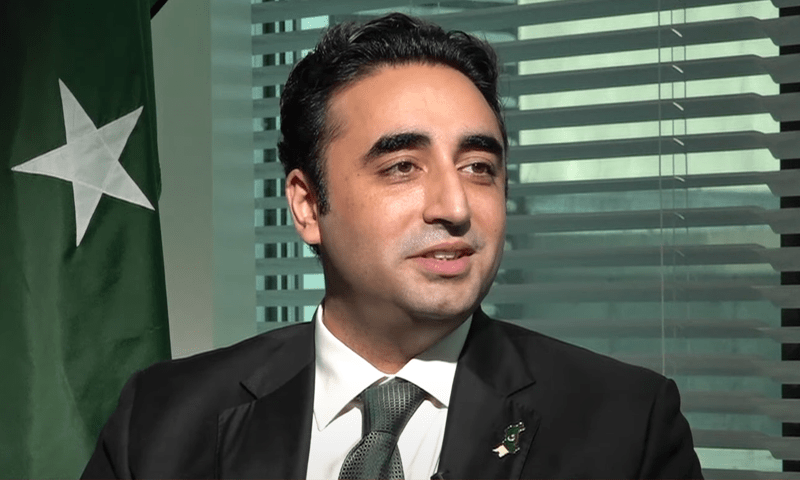
From Zeeshan Mirza
KARACHI: Pakistan People’s Party (PPP) Chairman Bilawal Bhutto Zardari said the recently passed 26th Constitu-tional Amendment was drafted after reaching a “compromise” with other political forces.
“Perhaps it’s not exactly as I would have drafted,” said the PPP lawmaker during an interview with Ox-ford Union’s President Israr Khan, adding that his party had a “positive contribution” to the conten-tious legislation as it engaged in talks with the opposition “despite having the votes”.
During the interview, he expressed his views on the status of democracy in Pakistan, legislative busi-ness in the parliament, the 26th Amendment and the Prevention of Electronic Crimes (Peca) (Amendment) Bill 2025 passed by the coalition government.
Bilawal said that the People’s Party has always and will always continue to fight for democracy whether it is related to the Constitution, subsequent rights, devolution, individual rights, or other matters.
“Every piece of legislation, politics, rights-based politics, constitution-based politics is done, champi-oned and protected by the People’s Party,” he said, adding that his party would welcome more criti-cism to do better. Regarding a question on the weakening of democracy in the country, he opined that the country was not a 200-year-old democracy and admitted that Pakistan’s democracy was not the strongest at the moment but it was not the only state facing this challenge.
He highlighted that the country was facing the same challenges of “populism and post-fact politics and post-shame politics and alternate reality politics” which shook institutions and well-established norms.
Commenting on the 26th Amendment, the former foreign minister said that it was a long-standing aim for the charter of democracy which people refer to, to establish a constitutional court in the country.
The 26th Amendment, a judiciary-oriented constitutional package which paved the way for the for-mation of constitutional benches, was passed by the parliament in October last year. He added that his party believed in dialogue, engagement and compromise instead of enforcing its views on others. “Despite having the voters [in the parliament], we engaged with the opposition, with [Jamiat Ulema-e-Islam-Fazl chief] Maulana Fazlur Rehman and came out with a compromised legisla-tion,” said Bilawal.
However, he also defended the contentious Peca amendments and said that it was not an ideal legis-lation but a better legislation than initially proposed “which had ridiculous things like 30 years in prisons for a [social media] post of god knows what not”.
The amended law, passed by the parliament in January and the president’s assent amid serious reser-vations and protests by the journalist fraternity, included new definitions, the establishment of regula-tory and investigative bodies, and stricter penalties for disseminating “false” information.
The law set the stage for the establishment of the Social Media Protection and Regulatory Authority (SMPRA), the National Cyber Crime Investigation Agency (NCCIA) and the Social Media Protection Tri-bunal.
He went on to say that his party had strongly opposed the previous shape of the legislation within its parliamentary capacity when it was first introduced by the former premier Imran Khan-led govern-ment.
Bilawal said that the PPP contributed through the amendments and input to passing the legislation.
He further said that the People’s Party was the third-largest party in the National Assembly which may not be able to dictate its terms or impose its will on the parliament except for using its space to have a positive input on the country’s legislative affairs.