
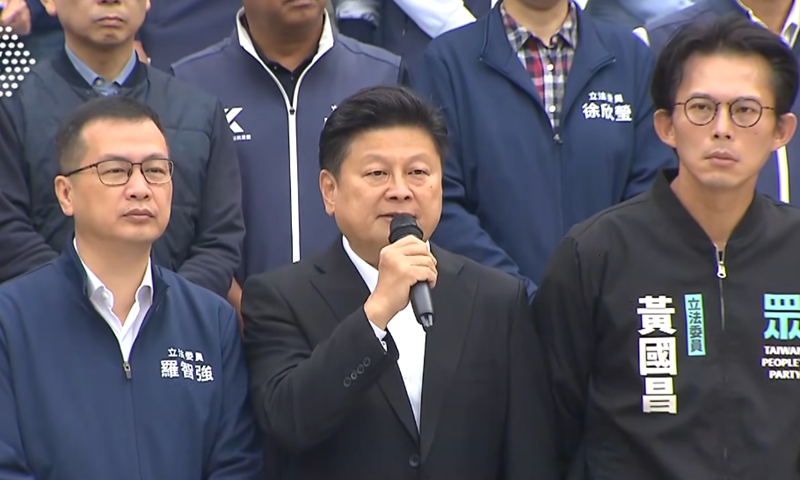
BEIJING: Taiwan opposition lawmakers from the Chinese Kuomintang party (KMT) and Taiwan People’s Party (TPP) announced a plan to impeach the region’s leader Lai Ching-te at a press conference held in Taipei on Friday, the Xinhua News Agency reported.
Meanwhile, an online petition to impeach Lai has gathered more than 5 million signatures in less than 24 hours after release.
Speaking outside the building of the legislative body on the island, KMT’s legislative caucus whip Fu Kun-chi sharply condemned Lai, declaring that he must step down and that the legislature is no longer able to oversee this “monster,” Taiwan-based China Times reported. The initiative, which also targets Cho Jung-tai, head of the island’s executive body, came amid the stand‑off sparked by the refusal of the executive body to amendments to a revenue allocation law, passed by the legislature earlier, according to Taiwan-based media.
On Thursday, opposition lawmakers Huang Kuo‑chang (TPP), Lo Chih‑chiang (KMT) and Wang Hung‑wei (KMT) tabled two censure motions and called on the legislative body to begin impeachment proceedings against Cho. Later on the day, Huang, also the head of TPP, said they would officially announce a plan to impeach Lai as well.
In a statement released by TPP on its website, the opposition party said Cho, emboldened by Lai, has flagrantly refused to countersign or implement the “fiscal revenue and expenditure act” passed by the island’s legislative body, and this open defiance sets a grave and dangerous precedent in “constitutional history.”
Zheng Jian, a professor at the Taiwan Research Institute of Xiamen University, told the Global Times on Friday that the impeachment initiative stems from Lai Ching-te’s arbitrary and dictatorial practices – a factor that has rendered impeachment a means to break the current political deadlock. Furthermore, he noted, the move is driven by widespread public dissatisfaction in Taiwan with the Lai authorities’ persistent secessionist provocations and belligerent acts, which have severely undermined cross-Straits exchanges.
Lai’s low approval ratings have given the opposition parties the confidence to launch the impeachment effort, Zheng said, noting that the impeachment itself is also likely to further amplify the public’s accumulated grievances.
According to Taiwan media reports, under the relevant regulations in the Taiwan region, for the legislative body to propose an impeachment case against the regional leader or deputy leader of the Taiwan authorities, it requires a proposal by one-half of the lawmakers, a resolution by more than two-thirds lawmakers, followed by review by the “grand justices” of the judicial body.
The impeachment is established only after obtaining agreement from more than two-thirds of the “grand justices,” with the number of agreeing justices being no less than 9, upon which the impeached person is removed from office.
Taiwan-based media analyses note that, given these high thresholds and the current seat distribution in the legislative body, where the opposition holds a slim majority but falls short of the required two-thirds, an impeachment against Cho has a realistic chance of advancing, while one against Lai is almost certain to fail.
The Taiwan-based China Times News pointed out that the opposition’s primary goal is to pressure Lai into appearing before the legislative body to provide explanations and face direct questioning. Should he refuse again, analysts say, he risks being branded as showing “contempt for public opinion.”
“The most important aspect of impeaching Lai is not the outcome, but the process itself,” Chiu Yi, a scholar and political commentator in Taiwan, told the Global Times on Friday. He added that launching impeachment would profoundly influence the political atmosphere on the island.
He added that proposing the impeachment at the legislative body requires only the support of half the lawmakers, making it a highly probable event. The case will also enable the public to gain a clearer view of the malpractices within the DPP authorities and act as a strong deterrent against the rampant behavior of the Lai’s authorities.
In addition to the impeachment plan in the legislative body, the public-initiated impeachment petition in Taiwan has also rapidly gained momentum.
Under the lead of Chiu and former DPP’s lawmaker Kuo Cheng-liang, people in Taiwan on Thursday launched an online petition to “impeach Lai Ching-te,” aiming to collect 5,586,019 signatures, exactly the number of votes Lai received in the 2024 regional leader election, in order to formally submit an impeachment request to the relevant authorities, according to a report from udn.com.
The number of signatures had already exceeded 5 million in less than 24 hours, according to media reports. As of press time on Friday, the number of signatures had far exceeded the target number, reaching 5.36 million.
Chiu has also been closely monitoring the rapid growth of the petition signatures. He stated that the pace of the signatures has exceeded his expectations.
“We initially believed that a considerable portion of Taiwan’s people would enthusiastically join us, which is why we set the target at 5.58 million. But we didn’t anticipate it would catch on with such fervor,” said Chiu. “This reflects the extreme public resentment toward Lai on the island right now, and it’s spiraling upward.”
He added that under the dictatorial practices of the DPP, no one is willing to “throw the first stone” at Lai in public. But once others see that there are people willing to do so, more and more will come forward to express their dissatisfaction with Lai.
“The fire has been lit,” said Chiu, “Now it remains to be seen whether it will spread into wildfires across the island, turning calls to oust Lai and oppose Lai into the mainstream public opinion.”
He predicted that Lai will grow ever more distant from the people of Taiwan, plunging deeper into political isolation.
Intensifying infighting
Political infighting on the Taiwan island has intensified this year. Analysts believe that since taking office, the Lai authorities have persecuted dissenting voices through judicial and other means, while stirring up tensions across the Taiwan Straits. –The Daily Mail-Global Times news exchange item