
Thelikada Kankanamge Asela Prabath Kumara:
It has been only a few days since I left Xinjiang, yet it feels as though a part of me still lingers there, among its towering mountains, sunlit bazaars and the gentle smiles of the people who welcomed me as one of their own. From my quiet study in Beijing, I often find myself transported back to that land of contrasts and harmony, where ancient traditions and modern innovation coexist in a seamless rhythm.
I had long read about Xinjiang, its vast deserts, its central role on the Silk Road and its cultural complexity. But what I encountered during my journey was far more vivid and human than any text could convey. My visit was not merely a trip; it was a profound experience that reshaped my understanding of China and cross-cultural dialogue itself.
Upon arrival in Urumqi, capital of the autonomous region, the vibrations and energy of the streets struck me straight away. The scent of roasted lamb mingled with the aroma of spices and the sound of laughter drifted through markets alive with color. It reminded me of the bustling Pettah Market in Colombo of my home country, different in language and climate, yet somehow sharing a spiritual kinship. Commerce and culture, faith and friendship, all intertwined in daily life.
In the Xinjiang Uygur Autonomous Region Museum in Urumqi, I found myself walking through living and breathing history. Each exhibit, whether an ancient manuscript, a fragment of silk or a painted mural, spoke of civilizations that once thrived along the Silk Road.
Xinjiang’s ability to merge heritage with progress is perhaps its most striking feature. The Cultural Tourism Digital Expo Center, for example, showcases how technology can breathe new life into tradition. Through immersive digital displays, ancient stories and music gain renewed vitality. As I watched young people interact with this fusion of culture and innovation, I couldn’t help but think of how my own country could learn from such initiatives, where preservation meets progress, and identity is strengthened through modernization.
The educational underpinning of this region also revealed how engaged the people were in creatively finding ways to keep this fusion alive. The academic exchanges at Xinjiang University were as enlightening as the firsthand experience of exploration. Conversations with students and professors reflected a deep curiosity about the world beyond China and a genuine openness to dialogue. It was a reminder that the future of understanding lies in classrooms where ideas move freely, not in echo chambers.
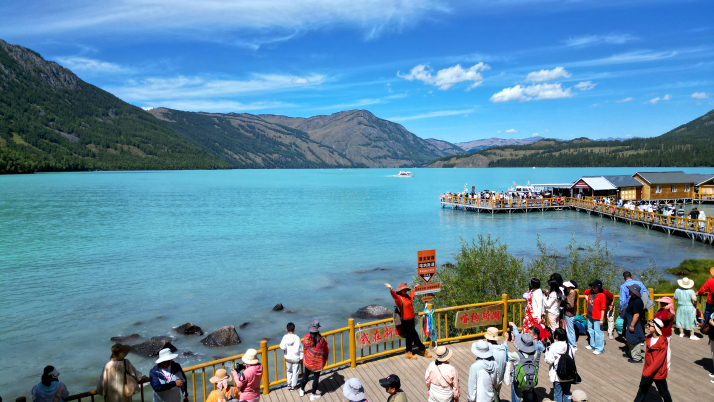
Beyond the cities, Xinjiang’s landscapes spoke their own poetry. At Hongshan (Red Mountain) Park in Urumqi, the breeze carried the scent of pine and earth, while at the city’s Ancient Ecological Park, I felt a quiet reverence for nature’s enduring balance. But it was Kanas Lake in Buerjin (Burqin) County, Altay Prefecture, shimmering beneath the Tianshan Mountains, that truly left me speechless. Its tranquil waters mirrored the sky so perfectly that I could not tell where heaven ended and earth began. These moments of stillness reminded me of the tea fields of my homeland, where time slows and reflection deepens.
Every encounter in Xinjiang unveiled something deeper about its people: resilience, kindness and pride in their shared heritage. In every encounter, be it with local artisans, fellow researchers, or ordinary residents, the quiet harmony that thrived amid such rich diversity was remarkable.
The Xinjiang I saw is dynamic, peaceful and full of promise. Modern highways link remote villages to global trade routes, green energy projects hum across the desert and rural entrepreneurs thrive with government support. Development here is not an abstract policy but a visible feature evident in the improvements of the people’s livelihoods and in the optimism that lights up their faces.
As I reflect on my journey, I realize Xinjiang is proof that harmony is not just an ideal but a daily practice, built on mutual respect, shared progress and openness to understanding. I left the region with gratitude and admiration, knowing that I will keep its lessons with me forever.

Noor Ahmad Noor:
It was my first time visiting China, and I must admit, the country surpassed every expectation I had. From the historical grandeur of Beijing to the vast expanses of Xinjiang, my journey was one of discovery, reflection and transformation.
Our journey began in Beijing, where the pulse of China’s modernity beats strongest, offering a quintessential example of Chinese culture upon arrival. But it was upon reaching Xinjiang that I began to see how that same energy extends far beyond the capital, how it resonates through the mountains, deserts and cities of the country’s western frontier.
At Xinjiang Medical University in Urumqi, I witnessed young students using cutting-edge technology and advanced medical equipment with remarkable confidence. Their classrooms reflected not only the country’s investment in education but also a sense of global vision. In those laboratories filled with quiet concentration, it was like the future of healthcare was unfolding right in front of me, driven by inclusivity and a determination to serve.
Later, at a wind power generation center on the outskirts of the city, I witnessed another side of Xinjiang’s transformation. Rows of white turbines spun steadily under the vast blue sky, their rhythmic motion turning desert wind into clean energy. In a world struggling with climate change, Xinjiang’s embrace of renewable energy speaks to China’s broader commitment to sustainability.
Beyond innovation and industry, what moved me most were the people. In the markets of Urumqi, I walked among families sharing laughter, merchants displaying colorful spices, as well as artisans weaving silk and crafting traditional instruments. Their warmth and openness reminded me that progress is not just measured in incomparable infrastructure or technological feats, but it is reflected in daily life of regular people.
During my stay, three dimensions of Xinjiang left a lasting impression on me: its industry, its infrastructure and its civilization.
Industry here is both precise and ambitious. From agricultural technology to high-end manufacturing, Xinjiang’s industrial zones reveal how strategic planning and innovation are reshaping local economies. What stood out was not merely the scale of production but the emphasis on quality and environmental balance, an approach that aligns with global standards.
Infrastructure tells a powerful story, too. Highways stretch across vast deserts; railways link cities that once seemed remote; and air routes connect the region to Central Asian countries, Russia and beyond. This network of connectivity served both as a logistical feat and a facilitator of international integration. It represents a government vision that sees Xinjiang as a vital bridge between the East and the West, a cornerstone of the Belt and Road Initiative. (The China-proposed Belt and Road Initiative aims to boost connectivity along and beyond the ancient Silk Road routes—Ed.)
And then there is Xinjiang’s civilization. Clean streets, well-kept public spaces and a strong sense of civic pride give every town an atmosphere of order and vitality. This, in turn, provides much-needed space for the locals to fully express their cultural personality. The exhibitions we visited displayed the craftsmanship, music and traditional attire of Uygur, Kazak and other ethnic groups, all coexisting under a shared sense of belonging.
Xinjiang’s geopolitical position also gives it a special role. Bordering eight countries, namely, Mongolia, Russia, Kazakhstan, Kyrgyzstan, Tajikistan, Afghanistan, Pakistan and India, it serves as a vital crossroads of trade and culture. The railways that cut across its mountains and deserts are not just routes of commerce; they are pathways of connection between the world’s civilizational hubs, echoing the ancient Silk Road that once carried silk, spices and ideas.
As my visit came to an end, I realized that what I had witnessed was more than development; it was a model of resilience and unity. The people I met were proud, hardworking and forward-looking. Their optimism was contagious, hospitality sincere. –The Daily Mail-Beijing Review news exchange item