‘The Huangpu River and the Hudson River are not only geographical landmarks; they are living witnesses to the evolution of two remarkable global metropolises,” said Siddharth Chatterjee, the United Nations (UN) Resident Coordinator in China. “Their transformation from industrial arteries into vibrant cultural, ecological and economic hubs reflects cities’ ability to reinvent themselves.”
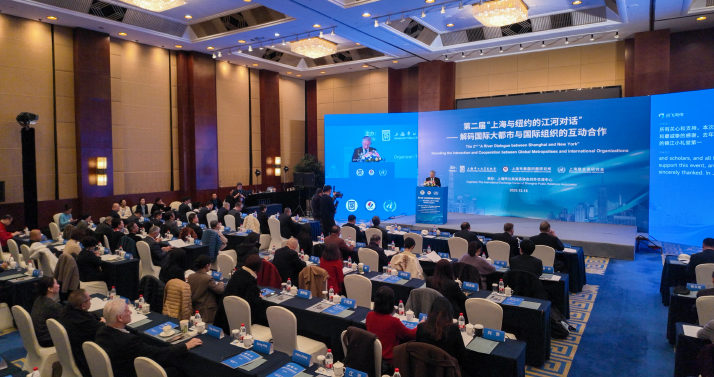
His words, delivered via video link on December 15 in Shanghai, set the tone for the second A River Dialogue between Shanghai and New York, an event that used rivers as metaphor and cities as actors to explore how global metropolises and international organizations can work together at a time of profound global change.
Where rivers meet governance
Held at Shanghai’s historic Jinjiang Hotel, the site where the 1972 China-U.S. Joint Communiqué, a document that signaled the beginning of the normalization of relations between the two countries, was signed, the dialogue brought together representatives from UN agencies, scholars, government officials and business leaders. Co-hosted by the Shanghai Public Relations Association, the Shanghai Institute of American Studies and the Shanghai UN Research Association, the event carried both symbolic and practical weight given it occurred as 2025 observes the 80th anniversary of the UN and the end of World War II, moments that reshaped the modern multilateral system.
Launched in 2024 and named after the Huangpu River in Shanghai and the Hudson River in New York, the River Dialogue began as a forum on trade, culture and economic ties between the two sides. This year, its focus shifted decisively toward the interaction between global cities and international organizations, reflecting a growing recognition that cities are increasingly central nodes in global governance.
Sha Hailin, President of the Shanghai Public Relations Association, argued in his opening remarks that international organizations are becoming more important as globalization faces headwinds, technological change accelerates and climate challenges intensify. International organizations in Shanghai, he said, bring global standards and perspectives, while the city provides a high-quality service environment and market opportunities in return—a relationship of mutual reinforcement rather than one-way hosting.
Several speakers emphasized that the rise of cities as global governance actors is not accidental. Yu Hongjun, former Vice Minister of the International Department of the Communist Party of China Central Committee and a former ambassador, noted that while Shanghai and New York differ markedly in history and culture—both occupy strategic positions in a globalized world. From that perspective, expanding city-to-city cooperation is not a symbolic gesture but a practical necessity for addressing shared challenges.
Chen Jing, President of the Shanghai People’s Association for Friendship with Foreign Countries, echoed this view in a video address, describing Shanghai’s ambition to become a globally influential modern metropolis and its desire to learn from international city experience, including that of New York. Rivers, in this framing, are not merely natural features but conduits of exchange, historically, economically and culturally.
Chatterjee placed this discussion squarely within the UN’s broader agenda. Cities, he said, are where multilateralism becomes concrete. They are centers of economic opportunity, creativity and diversity, but also on the front lines of climate impacts, demographic change, and inequality. How cities collaborate with each other and with international organizations will shape progress toward the Sustainable Development Goals (SDGs)—a universal call to action adopted by all UN member states in 2015 to end poverty, protect the planet, and ensure peace and prosperity for all people by 2030.
“Without water security, no city can achieve sustainable development,” Chatterjee said, noting that nearly 90 percent of recorded global disasters over the past decade have been water-related. In that sense, the river metaphor is more than poetic: It reflects the material challenges that cities must collectively manage, he added, quoting UN Secretary General António Guterres: “We must move from promises to action, from hope to results.”

Shanghai’s evolving ecosystem
One recurring theme throughout the dialogue was Shanghai’s transformation into a hub for international organizations. Xu Xin, Deputy District Mayor of Shanghai’s Pudong New Area, outlined concrete progress. Pudong currently hosts one intergovernmental organization, the New Development Bank, and 48 non-governmental international organizations, supported by targeted policies and the establishment of the Qiantan International Economic Organization Cluster.
Since 2024, Pudong has become home to seven international scientific organizations, including the International Society for Pharmaceutical Engineering, the American College of Cardiology and the Association for Materials Protection and Performance. These newly established presences now represent 83.3 percent of all international scientific organizations in Shanghai, making Pudong the city’s most concentrated hub for global scientific collaboration. As Xu noted, the goal is not merely to boost numbers, but to strategically align these organizations with key local industries, such as integrated circuits, biomedicine, and AI, to drive innovation and development.
This institutional ecosystem, several speakers suggested, allows global norms to be tested and localized. Ying Sheng, Country Manager of the UN-Habitat China Office, pointed to long-standing cooperation between Shanghai and UN-Habitat, including the establishment of World Cities Day and the development of global sustainability awards and assessment frameworks linked to Shanghai. Platforms like the River Dialogue, he said, can help Shanghai and New York explore new models of city-international organization collaboration.
Liu Meng, head of the China office of the UN Global Compact, described how the organization has supported Shanghai’s deeper participation in global governance through policy and standards alignment, particularly in environmental, social and governance (ESG) practices. From corporate training to accelerator programs, these initiatives, she argued, demonstrate how international organizations can work with cities to translate global principles into operational practices.
Universities have also emerged as connectors between cities and international organizations. Jeffrey S. Lehman, Executive Vice Chancellor of New York University Shanghai, presented a university-led initiative aligned with the World Health Organization’s Decade of Healthy Aging (2021-30). The project compares age-friendly urban environments in Shanghai and New York, seeking to translate research findings into actionable policy recommendations.
“The Dual-City Project opens up the possibility of designing a hybrid health intervention model that could combine the strengths of both Shanghai and New York,” Lehman said, describing it as a practical example of how two river cities can advance the goals of a UN initiative.
The contrast he outlined was instructive rather than competitive: Shanghai’s government-led approach offers consistency and coverage, while New York’s multi-stakeholder, market-driven model encourages innovation and personalization. Studying both, Lehman argued, could generate insights relevant not only to the two cities but also to aging societies worldwide.
Lessons and beyond
International perspectives further enriched the discussion.
Hans d’Orville, former Assistant Director General for Strategic Planning of UNESCO, offered a more institutional lens, explaining why UNESCO chose Shanghai as the site for new education and STEM-related centers. Hosting an international organization, he emphasized, is only the first step; long-term value depends on governance structures, sustained activity, and the ability to convene global expertise.
Beyond policy and institutions, several speakers highlighted the human dimension of city-to-city and city-to-organization cooperation. Michael Rosenthal, a New York-born business executive who has lived in Shanghai for more than two decades, spoke of the deep historical and cultural ties between the two cities, from early trade links to Shanghai’s role as a refuge for Jewish refugees during World War II.
International organizations, Rosenthal argued, are uniquely positioned to sustain cooperation even when national-level relations face difficulties. They create spaces for shared standards, long-term trust and practical experimentation in climate action, public health, digital governance and cultural exchange.
Xu Bu, a member of the UN Secretary General’s High-Level Advisory Board on Effective Multilateralism and former head of the China Institute of International Studies, brought the discussion back to first principles in his closing remarks. People-to-people exchange and city-to-city engagement, he said, are becoming increasingly important in a fragmented world. For Shanghai, strengthening institutions, supportive policies, and talent attraction will be essential as it continues its bid to become a hub for international organizations.
If rivers symbolize continuity, then the River Dialogue seeks to turn conversation into current, something that moves, connects and reshapes landscapes over time. By placing Shanghai and New York within a broader multilateral framework, the second edition of the dialogue underscored a central message: global governance is increasingly practiced in cities, tested in neighborhoods, and sustained through networks that link the local to the global.
The Huangpu and the Hudson are not just witnesses to urban history; they are reminders that flows—of water, people, ideas and institutions—shape the future. And when cities learn to navigate those flows together, they can become powerful engines of multilateral cooperation in an uncertain world. –The Daily Mail-Beijing Review news exchange item