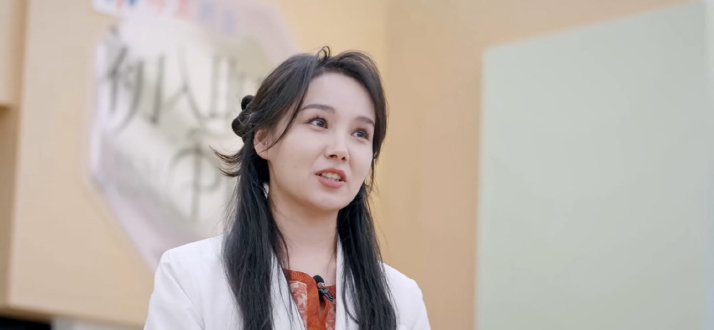
Ayizuremu Semaiti, known on the show as Ayi, was the youngest participant and the only one without postgraduate training. The 22-year-old from Kashi (Kashgar) in south Xinjiang is an undergraduate majoring in clinical TCM at Guangzhou University of Chinese Medicine in Guangdong Province, south China.
Initially, she faced online scrutiny for her perceived limited clinical experience and visible lack of confidence. But by the season’s finale, viewers began to recognize the determined young woman who had traveled far to pursue her dreams and had become transformed from a rookie who didn’t know how to engage with patients to someone capable of managing a range of clinical situations with composure.
“With no practical experience, I entered the competition like a soldier without weapon,” Ayi said in her final presentation on the show. “But now, winning or losing no longer matters. I am not here to compete with others, but to challenge myself.”
The line summed up not only her journey on the show but also the path that had brought her there.

Seeds of a dream
Ayi’s earliest understanding of medicine was shaped by the folk practices of her hometown, where a bowl of mutton soup was often considered a faster remedy than a visit to hospital.
When someone was ill, she recalled, his or her family would boil onions in water or cook thick mutton broth as a form of food therapy; in winter, people sometimes wrapped the sick in freshly prepared sheepskin to drive out the cold.
It was in this world of inherited knowledge that Ayi’s interest in traditional medicine first took shape, long before she had the language to describe it.
What turned that curiosity into an aspiration was the death of her grandmother. In fifth grade, with no prior experience of loss, Ayi at first believed her grandmother was merely asleep. When she later asked her mother what had happened, she was told an angel had taken grandmother away so that she would no longer suffer.
The little girl’s next question was practical. How could such suffering be avoided so that angels would not take them away? “We need good doctors,” her mother replied. That was when she decided to become one.
Ayi did not come from a family of doctors. Her parents were in the wool felt trade. Within the family, views on education were deeply divided. Despite having little schooling herself, her mother was a staunch supporter of Ayi’s ambitions and firmly believed education was the path to realizing her daughter’s dreams.
Her father was more traditional, seeing little reason for a girl to pursue schooling beyond the basics.
But with her mother’s support, as well as her own hard work, Ayi earned a place in a senior high school in Shenzhen through a government program that started in 2000 to support middle-school students from Xinjiang in studying at high-performing schools in other parts of China.
It was the first time she left home. After 76 hours of train ride, she arrived in Shenzhen, Guangdong, with a mixture of nostalgia for what she was leaving behind, hope for what lay ahead, and unease about the unknown.
Shenzhen appeared as a dense landscape of light and movement in the night, defined by high-rises and ceaseless traffic. The scale and energy of the city exceeded anything she had imagined. In that moment, she realized she had entered a different world and begun a new chapter of life, one she would have to navigate on her own.

New way of thinking
After three years of sustained effort, Ayi was accepted by Guangzhou University of Chinese Medicine, one of the country’s leading institutions for TCM.
Yet the path to becoming a TCM doctor proved far more demanding than she expected. A daunting body of arcane ancient texts awaited her, which she would not only have to understand but also memorize.
“For me, terms like yin and yang, or xu (deficiency) and shi (excess) were not just unfamiliar—they represented an entirely new way of thinking, and so I was always half a step behind my peers,” Ayi said.
To catch up, she put in extra hours and developed a study method of her own. In the margins of her textbooks, she would break dense classical prose into a chain of clear questions that she could work through step by step. Using this method, she slowly but steadily worked through The Inner Canon of the Yellow Emperor, Treatise on Febrile Diseases and other weighty texts in the Chinese medical canon.
Alongside her schoolwork, Ayi also served as the president of the university’s youth volunteer association and took part in more than 30 volunteer programs. One of them carried particular personal meaning.
Eager to bring the benefits of TCM closer to her own community, she spent the summer of her sophomore year leading a group of classmates to a community in Kashi to offer free consultations and treatments. The warmth of that summer remains vivid: She can still recall the elderly patient who repeatedly murmured rehmet, “thank you” in Uygur, throughout the treatment.
There was a sad memory as well. Her grandfather suffered a stroke and heart failure triggered by hypertension. Sitting by his bedside, Ayi gently placed her fingers on his wrist, only to recognize the “death pulse”—a rhythm that in TCM signals life ebbing away.
If her grandmother’s death had first stirred her resolve to become a doctor, her grandfather’s passing taught her a hard lesson, one familiar to many medical students: That even with medical knowledge and skill, death is sometimes inevitable. The sense of helplessness made her question whether she could continue on this path.
Just as she was on the verge of giving up, the second season of Tales of TCM, a television program promoting TCM culture, announced it was looking for participants and her school counselor encouraged her to apply. And she eventually got in.
The program broadened her exposure to TCM, introducing practices ranging from tea therapy to gentle abdominal vibrations to stimulate internal organs and improve circulation. It also brought her in contact with experienced practitioners whose stories showed that TCM was no mere body of abstract theories but a deeply humane approach to life and illness.
The story of Song Zhaopu, the head of a rehabilitation hospital in Henan Province in central China, left the deepest impression on Ayi. Since 2009, Song has led a team that integrates acupuncture, therapeutic massage and herbal medicine to treat children with cerebral palsy. More than 7,300 children have benefited from the program. The treatment is free and families are often reimbursed their travel expenses and provided with basic living supplies.
“Back in my hometown, I know many people who hesitated to seek medical care,” Ayi said on the program. “That is why I believe it is deeply meaningful to use TCM, which emphasizes simplicity, convenience, affordability and effectiveness, to ease suffering.”
Ayi plans to pursue postgraduate study focused on the distinctive therapeutic traditions of China’s ethnic minorities. Her ultimate wish, as she said on Workplace Newcomers, is to return to Xinjiang and put her training to work by delivering TCM where it is most needed. –The Daily Mail-Beijing Review news exchange item