Since ancient times, the relationship between China and Japan has been an extremely close one. The two countries are often said to be “separated only by a thread of water as thin as the belt around a robe.” This relationship has had positive aspects, such as cultural and interpersonal exchange, but has also involved wars and invasions. Needless to say, historical processes have always had positive and negative aspects.
However, this ancient relationship has at times been in serious trouble, especially during World War II (WWII), with Japan’s invasion of China. The relations between the two nations quickly deteriorated with the outbreak of the September 18 Incident in 1931, the beginning of the 14-year-long War of Resistance Against Japanese Aggression, and were aggravated when the Lugouqiao Incident on the night of July 7, 1937, developed into a total armed confrontation that ended with Japan’s defeat in WWII in August 1945.
For much of the past three decades, China and Japan have managed a coexistence rooted in economic interdependence and the diplomatic frameworks set in place when they normalized relations in 1972. This arrangement was always delicate, resting on an avoidance of fundamental questions about regional order, territorial disputes, military balance and Taiwan Province’s status.
Hanging in the balance
One of the major irritations in Sino-Japanese relations was the Nanjing Massacre, carried out by the Imperial Japanese Army in and around Nanjing in the winter of 1937-38: Mass executions, widespread rape, looting and the wanton destruction of civilian life took place on a massive scale. Estimates vary, but scholarly research and survivor testimony document the systematic character of the atrocities. Japan’s expansion onto the Asian continent in the 1930s was driven by the needs of a rising capitalist ruling class: access to coal, iron, agricultural resources and markets for exports, amid the global economic convulsions following the 1929 crisis.
The other irritation was related to the Yasukuni Shrine located in Tokyo. The shrine is not merely a religious site or a matter of ceremonial etiquette. It is a political symbol and instrument that has been repeatedly mobilized by sections of the Japanese ruling class to legitimize militarism and whitewash imperialist crimes.
The shrine is home to many Japanese war criminals. Yasukuni holds the souls of Japan’s war dead, including 14 Class A war criminals from WWII. Successive visits by senior politicians have been used to rehabilitate a militarist narrative of Japan’s prewar and wartime actions. Underlying these gestures are material interests: sections of the capitalist class who seek a stronger military to secure markets, access to resources and geopolitical influence in competition with rivals such as China and the U.S.-led alliance system.
Yasukuni is therefore tied to the strategic drive of Japanese imperialism, which means an effort to erase the restraints of the postwar order, to reinterpret history so as to legitimize a more assertive foreign policy, and to create domestic consent for cuts in social spending and the expansion of the military budget.
Many Japanese politicians, especially a number of Japanese prime ministers, used to pay visits to the shrine. Every such instance met serious objections from China. Yasukuni serves several political intentions. Domestically, it is used to mobilize nationalism and to shift popular anger onto external “enemies.” Internationally, it is a signal to rival states and to Washington to indicate that Japan will abandon the cautious postwar deterrents and take a more active role in U.S. strategic designs in Asia.
The revival of Japanese militarism is not an accident of history or a cultural peculiarity. It is the policy expression of rival capitalist interests, a political project rooted in the needs of monopoly capital for markets, resources and strategic advantage.
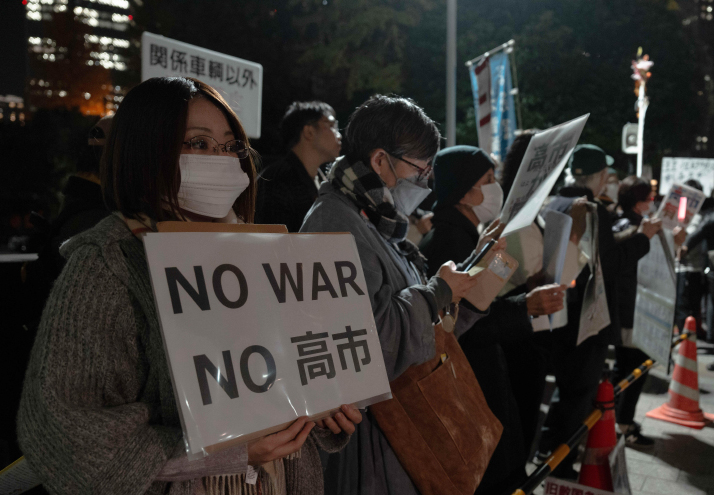
Against this backdrop, Sino-Japanese relations have been in a state of turmoil since Prime Minister Sanae Takaichi’s November 2025 comments regarding a potential “Taiwan contingency,” involving imaginary visions like the Chinese authorities’ use of force to shut down sea lanes in the region, or any other moves to reunify the mainland with the island, which she suggested could require Japan to exercise its right to collective self-defense.
The current resurgence of Japanese militarism must be read alongside rising great power tensions. Washington’s drive to contain China, together with intraimperialist competition in Europe and the Indo Pacific, compels allies and rivals to rearm.
For the sake of peace
The 1972 Joint Communiqué and the Treaty of Peace and Friendship between Japan and China, signed subsequently in 1978, also represent agreements between the two sides that, as spelled out in the former document, “Japan and China shall in their mutual relations settle all disputes by peaceful means and shall refrain from the use or threat of force.”
If Prime Minister Takaichi’s words or actions, or the response of the Chinese Government to them, contradict the content of the 1972 Joint Communiqué, then it falls upon both nations to reflect seriously on the spirit of this document.
During U.S. President Donald Trump’s visit to Tokyo last October, Takaichi demonstrated an unusually close alignment with Washington. Presenting herself as the political heir to Shinzo Abe, she made conspicuous efforts to please Trump—including a promise to recommend him for the Nobel Peace Prize. Her strategy is to leverage a personal rapport with Trump to ease U.S. pressure on Japan to increase defense spending. Takaichi praised Trump’s supposed “unwavering commitment to world peace and stability.”
Takaichi’s China policy marks a clear departure from her predecessors’ moderate approach, moving toward a “restrained strategic balancing.” The new government is accelerating efforts to counterbalance China. While direct references to China were absent during Trump and Takaichi’s meeting, at least publicly, the threats to China were clear.
Yet in the House of Representatives last November, Takaichi stated that if China “involves the use of warships and the exercise of military force, then by any measure, it could constitute a situation that qualifies as a ‘survival-threatening crisis’ for Japan.” This remark triggered strong protests from Beijing, plunging China-Japan relations into fierce tension.
Given the uncertainty about U.S. strategic commitment and the potential cost of provoking China, the Takaichi government is unlikely to test the fundamental bottom lines of China-Japan relations on historical or Taiwan-related issues.
With Trump, Takaichi pledged to increase war spending in line with the U.S. president’s demands. Later Takaichi announced a plan to raise military spending to 2 percent of GDP by the end of the current fiscal year in March by pushing through a new supplementary budget.
Trump stated approvingly in return, “I know that you are increasing your military capacity very substantially and we’ve received your orders for a very large amount of military equipment.” He added, “We appreciate that order, and we very much appreciate the trade. We’re going to do tremendous trade together. I think more than ever before.”
It seems that the Trump administration may increasingly join hands with other like-minded countries in the Pacific to encircle China. –The Daily Mail-Beijing Review news exchange item