Staff Report
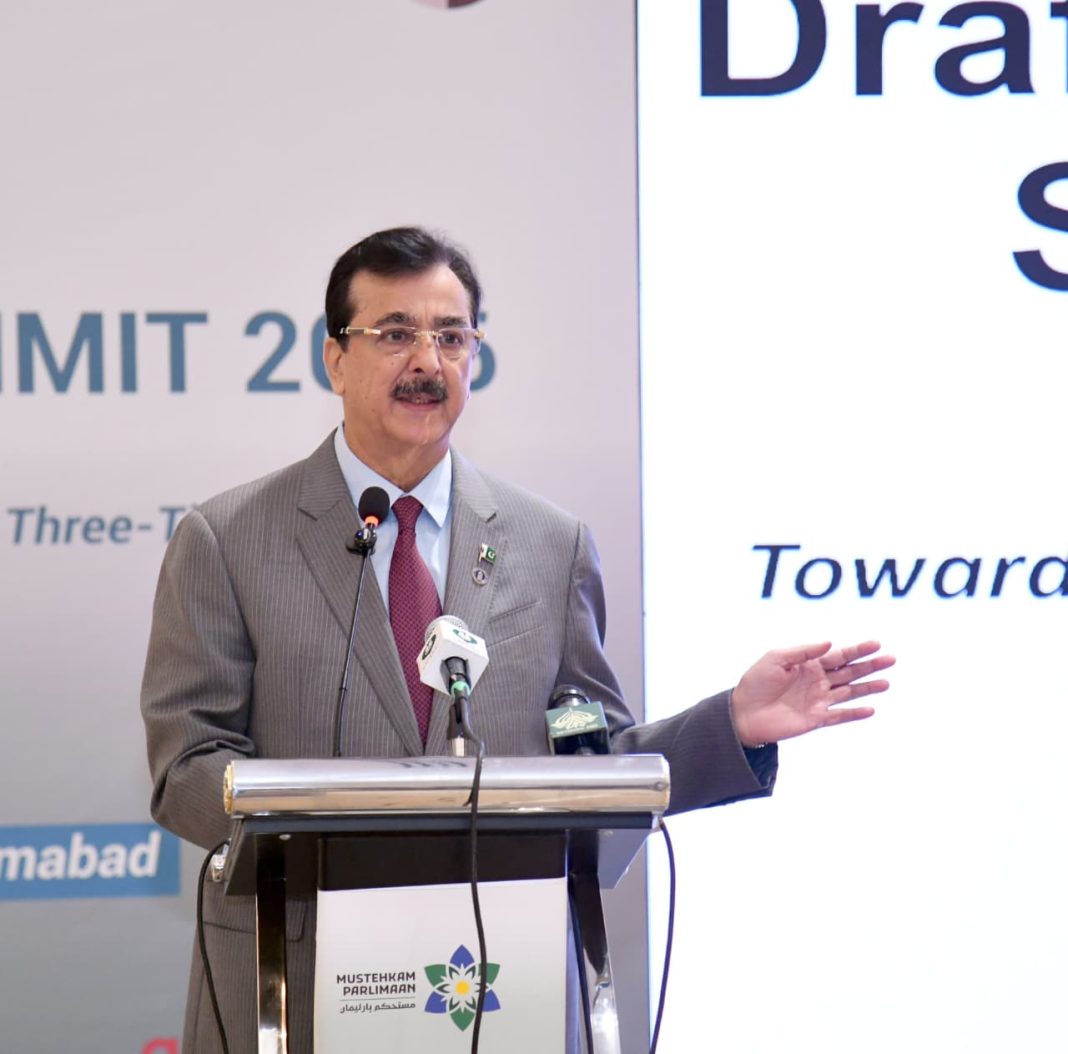
ISLAMABAD: Acting President and Chairman of the Senate Syed Yousaf Raza Gilani on Wednesday underscored that devolution was not a threat to national cohesion but one of its strongest safeguards, stressing that a confident federation empowered its constituent units while remaining united by shared constitutional values.
Addressing the concluding session of Islamabad Devolution Summit, Acting President Gilani said authority exercised closer to the people deepened democratic participation, addressed grievances at an early stage and strengthened trust in democratic institutions.
He said the two-day forum brought together parliamentarians, constitutional experts, public administrators, economists, and representatives of civil society to engage in serious and structured reflection on one of the most consequential questions confronting Pakistan today: how to make devolution durable, functional, and truly responsive to the needs of our citizens.
He reaffirmed the Senate’s commitment to advancing cooperative federalism, provincial equity and effective devolution, describing the upper house as a guardian of constitutional balance and a forum for dialogue among federating units.
Reflecting on Pakistan’s constitutional evolution, the acting president recalled that devolution had been central to his political journey, particularly during his tenure as prime minister when the 18th Constitutional Amendment was enacted through rare political consensus. The amendment, he said, fundamentally rebalanced the federation by restoring parliamentary supremacy, strengthening provincial autonomy and constitutionally entrenching decentralisation.
He noted that the abolition of the Concurrent Legislative List and the transfer of key subjects — including education, health, agriculture, labour and social welfare — to the provinces marked a decisive shift from centralised control to shared governance. To manage this transition, an implementation commission was constituted under Article 270AA to supervise and coordinate the transfer of subjects and institutions, underscoring that devolution was a continuous constitutional process rather than a one-time legislative act.
Yousaf Raza Gilani emphasised that constitutional authority without fiscal capacity remained incomplete, pointing to the Seventh National Finance Commission Award as an essential companion to the 18th Amendment. By revising the vertical and horizontal distribution of resources, he said, the award aligned responsibilities with revenues, a cornerstone of effective federalism.
The acting president observed that devolution in Pakistan had often been cyclical rather than durable, cautioning that it could not succeed if diluted or treated as a discretionary policy choice instead of a binding constitutional obligation. He highlighted the Senate’s committee on devolution as an important mechanism for parliamentary oversight to identify legal and institutional bottlenecks and to uphold the constitutional balance.
As regards governance challenges, Acting President Gilani said weak fiscal coordination, limited sub-provincial revenue authority and outdated civil service structures continued to undermine service delivery. He called for predictable, rule-based fiscal arrangements, civil service reforms aligned with a three-tier constitutional order and stronger local governments, describing them as the most visible expression of the state in citizens’ daily lives.
Welcoming the Islamabad Devolution Summit Charter, he said its real value would lie in sustained advocacy and implementation through legislative and executive action.
Speaker of Punjab Assembly Malik Muhammad Ahmed Khan also spoke on the occasion.