On December 26, 2025, China announced plans to begin the zero-carbon transformation of 52 industrial parks across the country. This first batch of parks span sectors such as new energy, advanced manufacturing and computing. The list ensures every province, autonomous region, and municipality has at least one designated park, with transformation set for completion by 2030.
A “zero-carbon industrial park” is an industrial park that, through integrated planning, design, technology and management, reduces carbon dioxide emissions from production and daily activities to a “near-zero” level, which is close to a balance between carbon emissions and offsets—commonly known as carbon neutrality, or “net zero.”
Green power
“Industrial parks have long been both powerhouses of economic growth and major emitters of carbon dioxide in China,” Wang Xuhua, Director of the Green Development Research Institute of Beijing Jipeng Investment Information and Consultant Ltd., told Beijing Review.
According to data from the National Development and Reform Commission (NDRC), China currently has more than 3,000 national- and provincial-level industrial parks that together host over 80 percent of the country’s industrial enterprises. They consume about 60 percent of total energy and account for more than 30 percent of the country’s carbon emissions. When indirect emissions from electricity consumption are included, their share exceeds 60 percent.
“Therefore, industrial parks play a key role in driving energy structure transformation, industrial upgrading and enhancing China’s green, low-carbon competitiveness globally,” Wang said.
Wang noted that the core indicator is carbon emissions per unit of energy consumption. National standards released on June 30, 2025, set a clear benchmark: To qualify as “near-zero,” a park must reduce carbon emissions per unit of energy consumption by roughly 90 percent from the current industrial average of 2.1 tons per ton of standard coal equivalent, bringing it down to 0.2 tons or less.
“At this stage, ‘zero carbon’ essentially means near-zero carbon: maximizing the use of clean energy, especially a high share of renewables, to reduce emissions as much as possible,” Wang said.
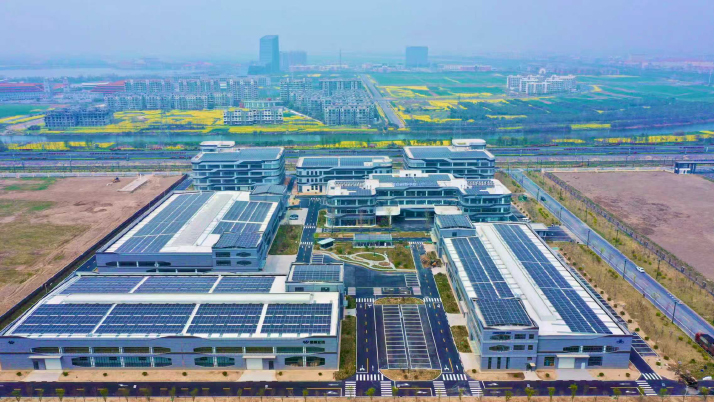
Take the Dafeng Port Zero-Carbon Industrial Park in Yancheng City of Jiangsu Province as an example. This park, covering a planned area of 31 square km, is home to new energy enterprises and equipment manufacturers. At the end of 2024, China’s first 10-kilovolt “green power dedicated line” was put into operation there, enabling the direct supply of centralized photovoltaic electricity (generated from a large solar farm) to the industrial park. “This ensures that green electricity remains physically traceable throughout its entire lifecycle—from production to consumption,” Wu Huilu, Deputy Secretary of the Communist Party of China (CPC) Work Committee of Dafeng Port Economic Development Zone, told Beijing Review.
In addition, the park’s data platform helps enterprises precisely calculate the carbon-reduction benefits of each kilowatt-hour (kwh) of green electricity and directly convert them into verified reductions in the carbon footprint of exported products. “Dafeng Port Zero-Carbon Industrial Park is the first industrial park in China to achieve green electricity traceability,” Wu added.
This capability is crucial for exporters facing strict international carbon regulations. Jiangsu Bulu Electric Technology Co. Ltd., a maker of high-end e-bikes for markets including Germany and Australia, settled in the park in February 2025 precisely for this reason.
“Thanks to the zero-carbon industrial park, our green electricity becomes traceable, thus our products gain added green value. This allows us to export more smoothly,” Hu Jinming, a company sales manager, told Beijing Review.
In 2025, the dedicated line supplied over 18 million kwh of green electricity to the industrial park, accounting for 60 percent of the park’s total electricity consumption, Cheng Shidong, a senior engineer with the Yancheng branch of the State Grid Jiangsu Electric Power Co. Ltd., told Beijing Review.
Currently, all electricity for lighting and other office functions in the park comes directly from photovoltaic stations.
“It has cut carbon emissions from externally sourced power for park enterprises by over 75 percent,” Wu said. The park aims to run entirely on green electricity by 2027 and achieve carbon neutrality by 2028.
Ambitions and challenges
Of the 52 designated parks, 24 are advancing major zero-carbon projects, 24 are in active preparation and four have finalized blueprints and will soon begin construction.
Industry estimates suggest that, once completed, the first batch of national-level zero-carbon industrial parks will generate total output value of 3.54 trillion yuan ($507.7 billion), with annual energy consumption exceeding 60 million tons of standard coal while keeping carbon emissions below 15 million tons. Carbon emissions per unit of energy consumption will be only about one 10th of the current national average for industrial parks.
Wang added that advancing the development of zero-carbon industrial parks integrates industrial transformation with the energy transition. It can stimulate the research, development and application of green and low-carbon technologies, and drive China’s manufacturing system toward a more high-end, intelligent and green transformation.
According to the Annual Report on Actions to Address Climate Change (2025) released by China’s National Climate Center and the Research Institute of Eco-Civilization at the Chinese Academy of Social Sciences, on December 26, 2025, zero-carbon industrial parks deliver triple benefits. Economically, they lower energy and carbon costs for enterprises through green power and green finance. Socially, they spur innovation and industrial upgrading and enhance the competitiveness of both enterprises and industrial parks. Ecologically, they improve regional air quality and ecosystems through renewables and enhanced carbon sinks.
The national vision is clear. Recommendations of the CPC Central Committee for formulating the country’s 15th Five-Year Plan (2026–30), released last October, state that “green development is a defining feature of Chinese modernization” and calls for building zero-carbon factories and parks. The NDRC further announced that China will strive to establish around 100 national zero-carbon industrial parks by 2030, positioning them as key drivers of the green transition.
Challenges, however, remain. “China has a diverse array of industrial parks, but a unified certification system for zero-carbon industrial parks has yet to be established. Gaps remain in institutional mechanisms, standards, technologies, business models, talent reserves, as well as public education, training and capacity building,” Wang said.
She emphasized that success requires coordinated national policy and local implementation, backed by green finance and digital solutions to optimize energy systems and reduce costs. It also depends on advancing low- and zero-carbon technologies, growing carbon management services, investing in professional talent and encouraging public participation through carbon-incentive mechanisms.
“Zero-carbon industrial parks, through a combination of policy guidance and industrial collaboration, will further advance China’s industrial green transformation,” Wang said. –The Daily Mail-Beijing Review news exchange item