
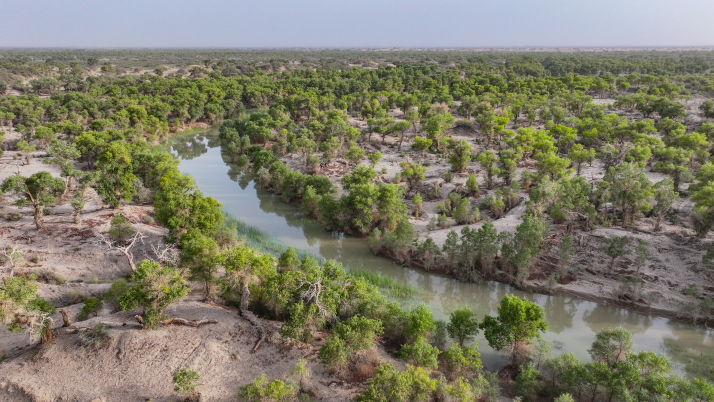
In China’s vast Xinjiang Uygur Autonomous Region, water has long been both a constraint and a promise. An arid land marked by deserts, mountains and oases, Xinjiang’s development has always depended on how effectively it can secure, manage and distribute water.
In recent years, the regional government has placed water governance and management at the center of its modernization strategy, treating water not merely as infrastructure, but as a foundation for economic growth, governance capacity and ecological security. That strategic emphasis is beginning to show results.

A water network for the future
Over the past several years, Xinjiang has accelerated the construction of a regional water network, investing heavily in reservoirs, irrigation systems, flood control works and rural water supply. During China’s 14th Five-Year Plan period (2021-25), total investment in water resources projects in Xinjiang reached 158 billion yuan ($22.6 billion), exceeding the previous five-year period by more than 20 percent. Annual investment growth over the past three years has averaged more than 16 percent, underscoring water’s expanding role as a pillar of high-quality development.
In 2025 alone, Xinjiang completed more than 40 billion yuan ($5.7 billion) in water-related investment, surpassing its original target. These projects have played a stabilizing role in helping support employment and regional growth.
Several landmark projects stand out. The Dashixia Water Control Project began storing water in September 2025. The Kuergan Water Control Project connected its first power-generating unit to the grid a month earlier. Other major projects, including the Yulongkashi Water Control Project, reached key construction milestones. At the same time, dozens of small and medium-sized reservoirs across south Xinjiang are under construction.
Almost every major river in Xinjiang now has at least one reservoir that has been built or is under construction, enhancing the region’s capacity to regulate water flows, prevent floods and secure rural water supply.
Since 2021, Xinjiang has invested more than 12 billion yuan ($1.7 billion) in upgrading and modernizing 263 large and medium-sized irrigation districts. These efforts have placed the region in the upper tier nationally for agricultural water efficiency. More than half of Xinjiang’s wheat fields now achieve yields exceeding 7.5 tons per hectare; nearly a third of its corn acreage qualifies as “one-season, one-ton” farmland; the region also produces more than 90 percent of China’s cotton.
Water resources are being reasonably allocated and more efficiently used. Since 2021, Xinjiang’s water authorities have taken a coordinated approach to water management and storage, ensuring sufficient supplies for production, daily life and ecological needs. While prioritizing flood control and safety, the region has also made better use of floodwaters, strengthening its ecological security barriers.
The region is now systematically formulating Xinjiang’s 15th five-year plan for water security. Efforts will focus on further improving water infrastructure and optimizing the allocation of water resources, with the goal of comprehensively enhancing water management, protection, efficient distribution and rational use.

Higher standards to strengthen governance
However, constructing a water network alone is not enough. According to Jiao Quanxi, Deputy Director of the Xinjiang Uygur Autonomous Regional Department of Water Resources, improving governance and project quality has also been a priority.
The regional government is introducing standardized construction manuals for major types of water projects, covering everything from concrete works and dam filling to safety monitoring systems. Training programs is being expanded for local officials and project managers, including hands-on guidance at key construction sites.
Xinjiang is encouraging competition for excellence. Several projects recently received the Tianshan Award, the region’s highest honor for construction quality.
The region is also improving the quality of water projects through targeted campaigns, training and on-site management meetings to ensure higher construction standards across Xinjiang.
Ensuring water safety
Since 2025, the regional water resources department has reinforced workplace and operational safety across the water sector through several key measures.
It has advanced a three-year action plan aimed at addressing root causes of safety risks, alongside a comprehensive safety management system, covering risk identification, assessment, early warning, prevention, emergency response and accountability. As of late 2025, all 4,900 operating water facilities and 473 construction projects in the region had adopted this system, ensuring standardized safety management throughout the sector.
Now all eligible water construction projects are covered by safety liability insurance, and all water-related production and operating units have established internal reward systems for reporting hidden safety risks. These mechanisms encourage early reporting and prevention of accidents. Both insurance coverage and reporting systems have now reached 100-percent implementation.
Safety inspections have been intensified. Focusing on key periods such as flood seasons and extreme weather events, the department organized four rounds of targeted safety inspections. These covered 131 water facilities and identified 694 potential hazards.
Finally, the government worked to build a strong safety culture. Through campaigns such as Workplace Safety Month and Fire Safety Month, authorities carried out on-site education and emergency drills, including simulations for fires, earthquakes and floods. More than 210 emergency training and evacuation exercises were conducted, raising safety awareness across the sector.
In 2025, Xinjiang faced uneven water conditions, with more flooding risks in the south and less rainfall in the north. High temperatures, intense rainfall, snowmelt floods and mountain torrents made flood control increasingly complex.
To address this, authorities updated emergency response rules, introduced a new flood-duty system and strengthened coordination across the entire disaster response chain. A daily rolling consultation mechanism was launched to track risks in real time.
During the year, officials issued 103 river flood warnings and more than 3,800 flash flood alerts, triggering over 24,000 emergency notifications to local governments and communities. These efforts helped manage 14 major river floods and 20 flash flood events, enabling the timely evacuation of over 1,200 people and achieving zero flood-related deaths.
Advanced flood-control scheduling systems, combining real-time data and visual monitoring, allowed water reservoirs to reduce flood peaks effectively. Authorities also made productive use of floodwaters by diverting excess flows into ecological zones. In the Tarim River basin alone, nearly 2 billion cubic meters of floodwater were used to restore ecosystems.
Ensuring safe rural drinking water
Rural drinking water safety remains a top livelihood priority. Xinjiang has focused on improving not just access to water, but water quality. Authorities promoted integrated urban-rural water supply systems and large-scale centralized projects, completing 56 rural water improvement initiatives.
As of late 2025, tap water coverage had reached 99.4 percent, and large-scale supply systems served 88.5 percent of the rural population—both among the highest levels nationwide.
All counties introduced formal water management rules, supported by a regional operation guide to standardize maintenance. With Central Government funding, 160 rural water projects were upgraded, including water purification and disinfection facilities. Complaint hotlines were improved to protect residents’ water rights, and smart water meters were widely installed to enable remote payment and efficient management.
Together, these measures have considerably strengthened Xinjiang’s water security and public safety while improving everyday living conditions for rural communities. –The Daily Mail-Beijing Review news exchange item