Staff Report
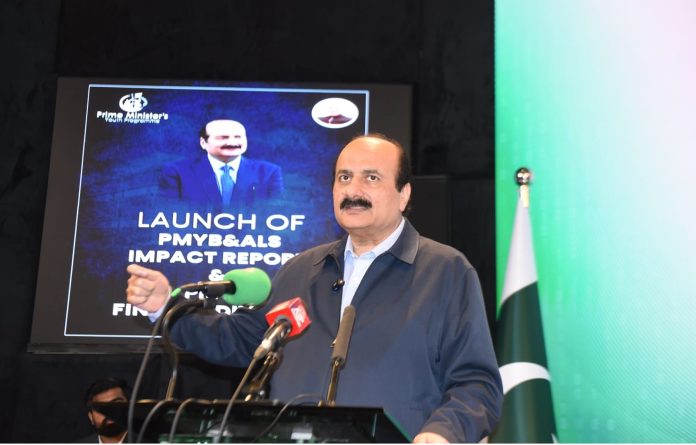
ISLAMABAD: Chairman Prime Minister’s Youth Program Rana Mashhood Ahmad Khan on Tuesday launched the Prime Minister’s Youth Business and Agriculture Loan Scheme (PMYB&ALS) Impact Report through technical assistance of the Commonwealth Secretariat, and establishment of FinTech Division in the Prime Minister’s Youth Programme, saying Pakistan’s youth empowerment agenda had moved decisively from rhetoric to results, at a ceremony held at the PTV Headquarters Islamabad.
Merit surge powers youth revolution: PMYP unleashes PMYB&ALS report, FinTech force
Addressing the event, Chairman Prime Minister’s Youth Programme Rana Mashhood Ahmad Khan said the government was pursuing a strictly merit based and technology driven approach to education, employment and entrepreneurship for young people across the country.
The ceremony was attended by media representatives, policymakers and senior officials from financial institutions.
Merit surge powers youth revolution: PMYP unleashes PMYB&ALS report, FinTech force
“The youth agenda is now anchored in delivery, supported by data, policy frameworks and implementation,” he said, adding that sustained political backing from Prime Minister Shehbaz Sharif and party leader Nawaz Sharif had ensured continuity of reforms focused on investing in children and youth purely on merit.
Mr. Mashhood said digital transformation remained a central pillar of the programme, announcing that within the next 18 months all universities in Pakistan would be provided a unified digital footprint.
He said this would place Pakistan among the first countries to digitally integrate its entire higher education sector, enabling students to transition more effectively into the job market.
He highlighted the Digital Youth Hub, Pakistan’s first integrated online platform for youth opportunities, which has already recorded around 800,000 registrations following its soft launch.
The portal currently provides access to more than 100,000 job listings, over 20,000 scholarships, training resources and verified initiatives, and is expected to become fully operational next week. Dashboards linked with the Prime Minister’s Office, provincial chief ministers’ offices and partner institutions will ensure transparency and accountability.
The PMYP, he said, operates on four pillars , education, engagement, environment and employment. Under these, initiatives such as laptop schemes, Danish Schools and the expansion of the Punjab Education Endowment Fund into the Pakistan Education Endowment Fund have benefited millions.
He also announced that the Punjab Danish Authority had been upgraded to the Pakistan Danish Authority, with the country’s first Danish University set to be launched in the next phase.
On youth entrepreneurship, Mr Mashhood said the government was preparing to expand the PMYB&ALS for the 2026–27 cycle, recommending an increase in the scheme’s overall size from Rs200 billion to Rs300bn.
He added that the Tier 3 loan ceiling, currently capped at Rs7.5 million, was under review for enhancement to between Rs20m and Rs30m, citing evidence of sustained growth among youth led businesses.
He also pointed to labour market reforms, noting that the Labour Force Survey, previously conducted every four years, is now being carried out annually. Under the cabinet approved National Youth Employment Policy, targets include at least 35pc female participation in the labour force and ka minimum 10pc share for youth led enterprises in new company registrations.
Addressing overseas Pakistanis, Mr Mashhood said digital bank accounts had been launched for low income Pakistani workers in Gulf countries to facilitate remittances through formal channels.
Working with the Ministry of Finance, commercial banks and the State Bank of Pakistan, the initiative aims to open between 100,000 and one million accounts this year, with a longer term target of 4.4 million. He said the move could add around $1bn to annual remittances.
Concluding his address, Mr Mashhood urged the media, financial institutions and education sector stakeholders to remain partners in implementation, saying Pakistan is entering a phase where youth development would be driven by merit, skills and opportunity rather than connections.