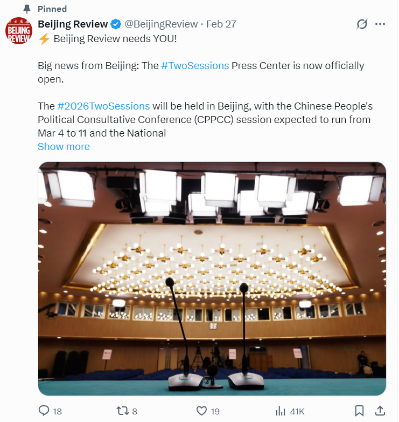
The annual gatherings of the National People’s Congress (NPC), the top legislature, and the Chinese People’s Political Consultative Conference (CPPCC) National Committee, the top political advisory body, are collectively known as the Two Sessions. Usually running in parallel in early March, they serve as the primary window into China’s governance and its roadmap for the future.
In an era of unprecedented global interconnectedness, Beijing Review took to international social media platforms to ask a simple question: “If you could ask an NPC deputy or a CPPCC National Committee member one question, what would it be?”
The response was a sophisticated tapestry of queries ranging from high-stakes geopolitics to the nitty-gritty of daily life for expats. These voices suggest that the world no longer views the Two Sessions as a purely domestic affair, but as a pulse-check for global stability and innovation.
Macro-realities and global stability
For many observers, China’s role on the world stage is the primary concern. In a “chaotic world,” as one respondent described it, there is an audible call for China to exert its influence in defense of international rule of law. One netizen said they would ask “why China—given its growing status and power—isn’t more active in the defense of countries suffering illegal attacks in terms of international law? I’m thinking about the question of Palestine, Venezuela or Iran.” The user noted a desire to understand how Chinese legislators balance the principle of non-interference with the global expectation for a more assertive guardianship of justice.
The security of global infrastructure also weighed heavily on the minds of followers. Following reports of a takeover by Panamanian authorities of two Panama Canal ports operated by Hong Kong-based conglomerate CK Hutchison, one respondent said they would ask “What countermeasures will be put in place to safeguard similar Chinese infrastructure investments that were made through the Belt and Road Initiative?” This question is consistent with a growing international interest in how China intends to protect its hard connectivity projects in an increasingly volatile geopolitical climate. The China-proposed Belt and Road Initiative aims to boost connectivity along and beyond the ancient Silk Road routes.
Consumption and confidence
Economically, the world remains tethered to China’s performance. One global observer who contacted Beijing Review via direct message, argued that a flourishing China is a global necessity. “A pick up in Chinese consumption will be beneficial for all brands all over the world… as real estate stabilizes, people will be more confident,” he noted, adding that stabilizing the property sector would drive demand for capital goods like cement and steel, potentially driving global growth.
Others sought more structural answers. An expert in China’s digital retail sectors, sharing insights on LinkedIn, queried: “How does the government plan to structurally increase consumer spending as part of GDP beyond temporary discount vouchers?” Similarly, a business owner who has engaged with China since 2004, sought clarity on investment: “What measures will be taken to make investing in China more interesting and sustainable, with respect to more predictable government policies?”
The ‘niche’ experience
Technology and the circular economy also emerged as key themes. A professional in the consumer goods sector raised the importance of the green transition, asking for concrete steps to scale up circular-economy practices and develop biomaterials for fashion. Meanwhile, a fascinating proposal surfaced regarding the frontiers of Web3, the decentralized Internet where users own their data and assets via blockchain, rather than renting them from Big Tech: “>75 percent of the world is underserved by insurance products… Would you be willing to create an environment for a new gold- and renminbi-backed reinsurer? Leveraging AI, blockchain and Web3 to serve millions globally.”
Yet, perhaps the most resonant feedback came from those living the “China experience” on the ground. A recurring frustration involves the accessibility of specialized services, such as driving licenses for foreigners. One user, who holds a C1 license, which authorizes the holder to drive small and mini passenger vehicles, light and mini cargo vehicles, as well as light, small, and mini special-purpose operation vehicles, but was stymied by the lack of English-language theory tests for motorcycles and recreational vehicles (C6 license), remarked, “I raised this question in the past but it was deemed too niche… With AI, it should be easy, no?” This sentiment was echoed by others asking for a streamlined process for tourists to hire and drive cars: “Is it possible to have one aimed at tourists (in English), and… could the test be taken online, outside China?” These niche issues are, in fact, micro-barometers of China’s high-level opening up and its ability to attract foreign talent and international visitors.
Digital democracy
A Sinologist specializing in China’s digital landscape asked a fundamental question about the feedback loop in the digital age: “I would want to know how, if, and to what extent delegates are integrating Chinese social media discourse and online public sentiment into long-term policymaking.”
Beyond material wealth, some looked toward the intellectual and cultural lives, asking: “What plans do you have to cultivate your people’s cultural-ethical needs?” This aligns with recent domestic discussions on cultural confidence and the quality of life beyond GDP.
As we analyze the content and outcomes of this year’s Two Sessions, these questions will remain on our radar. From the global implications of the renminbi’s international use to the practicalities of an expat’s motorcycle license, the world is asking for more than just statistics; it is asking for a roadmap that is inclusive, predictable and innovative.
The voices of these global citizens remind us that while lawmakers and political advisors gather in Beijing to deliberate on national affairs, the echoes of their decisions will be felt in every corner of the globe. Beijing Review will be there to seek the answers. –The Daily Mail-Beijing Review news exchange item