
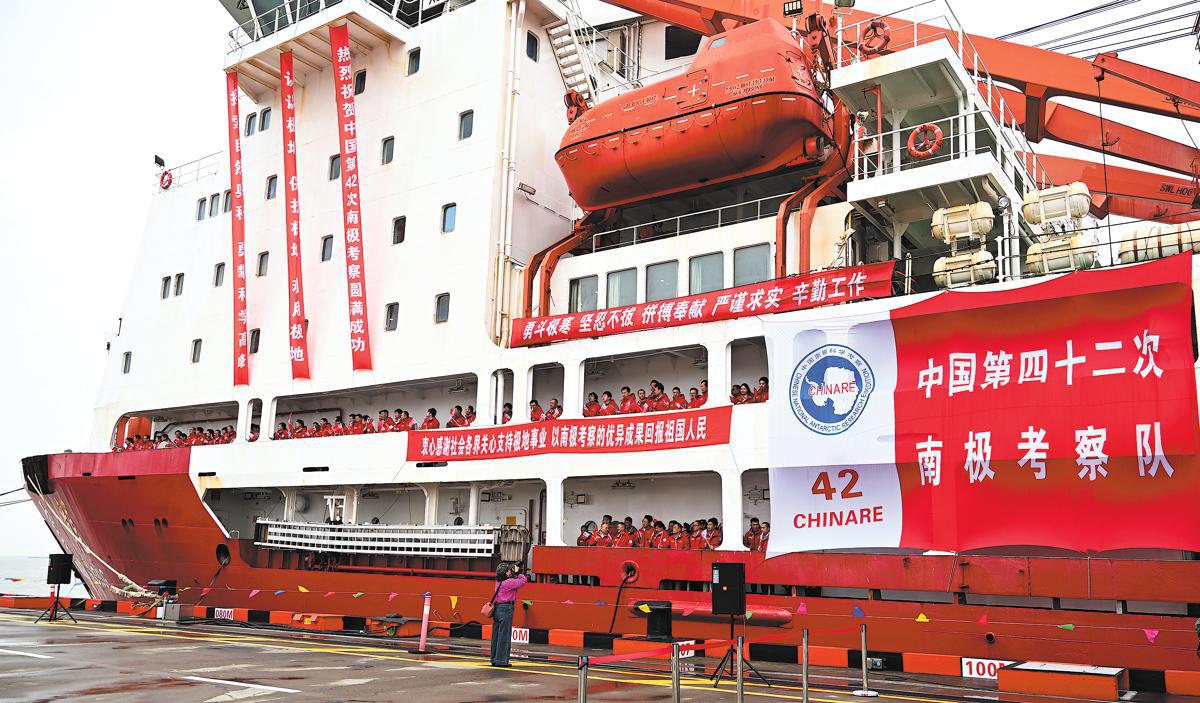
BEIJING: China’s polar icebreaker Xuelong , or Snow Dragon, returned to its home port in Shanghai on Thursday after a 160-day voyage to Antarctica, part of the country’s 42nd Antarctic expedition to the world’s southernmost region, having achieved fruitful scientific research outcomes.
A brief welcoming ceremony was held at the port for the vessel, which was attended by senior officials from the Ministry of Natural Resources and the Shanghai municipal government.
The expedition started in early November, with the Xuelong and Xuelong 2 icebreakers carrying 550 researchers from 125 domestic and international institutions. The team reached Antarctica later that month.
According to the ministry, the researchers braved harsh conditions, including complex ice formations, rough seas, strong winds and freezing temperatures, to conduct comprehensive surveys on the Antarctic Peninsula and in the Cosmonaut and Amundsen seas.
The team also carried out construction work, resupply assignments and personnel transfer tasks, it said.
The Xuelong traveled 63,000 kilometers before returning to port from its monthslong voyage, while the Xuelong 2 embarked on another mission to investigate Southern Ocean ecosystems after completing its Antarctic tasks.
During the polar mission, crew members of the two vessels set up a clean energy microgrid, built intelligent management and communication systems, and completed the construction of a research observation building at Qinling Station, China’s fifth scientific outpost in the Antarctic region.
They conducted China’s first hotwater drilling at the Qilin Subglacial Lake in East Antarctica, setting a new world record for the deepest polar hot-water drilling.
Engineers on the team tested a domestically developed wheeled vehicle and a new inland cabin, filling gaps in rapid personnel transfer and emergency rescue while improving field support capabilities. They also deployed China’s first domestically developed ocean-bottom seismometer array near the Antarctic Peninsula.
Cao Shunan, the expedition’s assistant chief scientist, said the voyage focused on the impact of climate change on Southern Ocean ecosystems, and the team conducted comprehensive surveys that have further enhanced China’s research capabilities in Antarctic marine ecological protection and climate change.
Cao said that the scientific results of the expedition will provide crucial support for a deeper understanding of the polar ecosystems. –The Daily Mail-China Daily news exchange item