
By Adnan Rafique
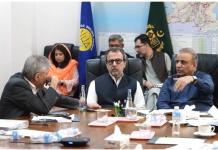
ISLAMABAD: The National Disaster Management Authority (NDMA) on Wednesday conducted Pakistan’s first ever Integrated National Search and Rescue multi hazard simulation exercise at its headquarters, bringing together federal, provincial, and humanitarian stakeholders to test coordinated disaster response mechanisms, improve early warning systems, and strengthen preparedness against multiple high risk scenarios.
Held at the National Emergencies Operation Centre, the exercise was designed to enhance integration and centralised coordination of search and rescue resources, officials.
The simulation was driven by risk projections developed by NDMA’s NEOC, incorporating advanced weather forecasting, satellite data, and real time monitoring to create predictive hazard scenarios, signalling a strategic shift from reactive response to anticipatory disaster management.
Conducted under the Integrated National Search and Rescue framework, the exercise brought together Provincial Disaster Management Authorities, State Disaster Management Authority, Gilgit-Baltistan Disaster Management Authority, Rescue 1122, Civil Defence, armed forces, federal and provincial departments, humanitarian organisations, and trained community volunteers. The exercise simulated multiple concurrent disasters, including glacial lake outburst floods in Gilgit Baltistan, widespread flooding across several provinces, and a major earthquake affecting Islamabad and Muzaffarabad.
These scenarios are developed using NEOC’s Disaster Early Warning system and hazard modelling tools to demonstrate the capacity for forecasting risks and issuing timely advisories. Participants engaged in coordinated response drills across multiple search and rescue teams, focusing on real time information sharing, early warning response linkage, unified command structures, and effective last mile communication.
Community volunteers were identified as critical force multipliers during emergency situations. Chairman NDMA Inam Haider Malik emphasised that integrating predictive analytics with response systems is vital to minimising disaster impacts, underscoring the role of NEOC in hazard forecasting and early warning dissemination.
Participants appreciated the initiative, citing valuable lessons to further strengthen preparedness and coordination frameworks. The NDMA reaffirmed its commitment to institutionalising such exercises and enhancing NEOC’s role as a national hub for early warning, risk communication, and anticipatory disaster management.