DM Monitoring
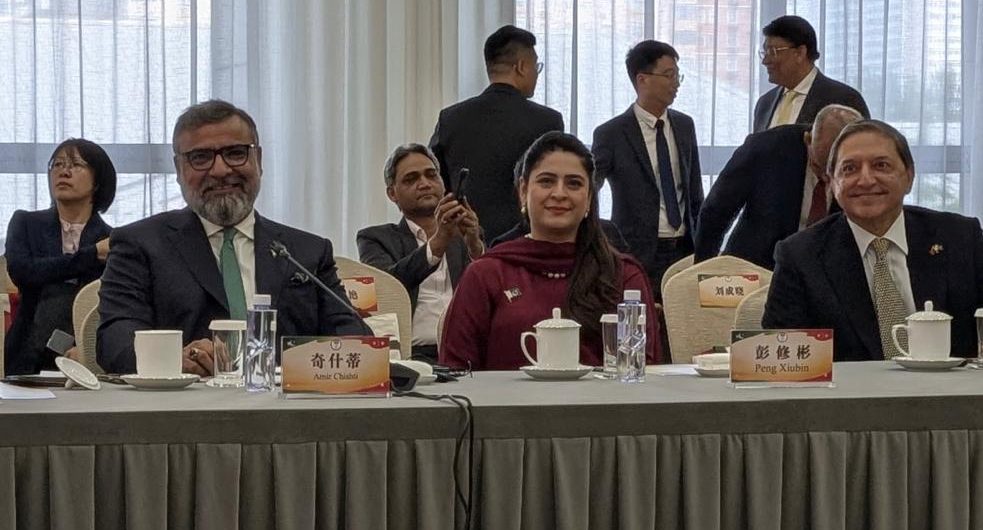
BEIJING: Senator Saleem Mandviwala on Sunday underscored the need for political parties, think-tanks, and media in Pakistan and China to build a shared, evidence-based understanding that development and security “are not competing priorities” but mutually reinforcing imperatives that must advance together.
“As grassroots institutions, political parties are uniquely positioned to shape public narrative. We must guide our media and our citizens to tell the story of China-Pakistan friendship truthfully, proudly, and consistently,” he said in his remarks at the Second China-Pakistan Political Parties Forum and the fourth meeting of the CPEC Political Parties Joint Consultation Mechanism.
In the panel discussion titled ‘Strengthening High-Level Political Mutual Trust’, Senator Mandviwala said, “We must categorically reject the disinformation aimed at driving a wedge between us.”
Senator Mandviwala, also the Chief Whip in the Senate of Pakistan and the Chairman of Senate Standing Committee on Finance and Revenue for a third tenure, highlighted that through the ‘Party+’ mechanism, Silk Road Workshops, and cultural exchange programmes, the ironclad friendship must be carried forward to the next generation. “Because ultimately, it is not treaties or corridors that make this partnership endure, it is the people,” he added.
He stressed that amid the accelerating global transformation and unpredictable international landscape, the China-Pakistan strategic cooperation must grow stronger.
“Our leaders have charted the course; we as political parties must now operationalise it,” he stressed.
He said platforms like this Forum existed precisely to align positions, deepen coordination, and ensure that no political transition in either country disrupted the strategic continuity of partnership.
Pakistan, he said, had demonstrated enormous commitment to protecting Chinese personnel, projects, and institutions on its soil.
Describing Pakistan and China’s commitment to the China-Pakistan Economic Corridor (CPEC) as “unwavering,” Senator Saleem Mandviwala urged the CPEC Political Parties Consultation Mechanism to ensure that the dividends of this strategic partnership reach all segments of society, including ethnic minorities, women, and the youth.
“As we enter CPEC’s second phase, focused on industrialisation, agricultural modernisation, Special Economic Zones, and digital connectivity,” he said, “the political parties must be vocal advocates and active enablers.”
Senator Mandviwala said China and Pakistan have consistently supported each other on issues of core interest, whether that is China’s unwavering support for Pakistan’s sovereignty and territorial integrity, or Pakistan’s firm commitment to the One-China principle.
This mutual trust has never been transactional; it has been unconditional, and it has been tested and proven in the most difficult moments of our respective histories.
He mentioned that Pak-China collaboration spans trade, infrastructure, energy, science, education, aerospace, and defence, and the results speak for themselves.
Under CPEC alone, he said, 38 projects worth over $25 billion have been completed. It has added 8,000 MW to Power generation capacity in Pakistan, directly addressing the chronic electricity shortfall that had held our economy back for decades. Over 500 kilometres of highways have been constructed.
The Senator said the two nations stood shoulder to shoulder during devastating floods, earthquakes, and the shared trauma of the pandemic.
“These bonds are rooted in the hearts of our combined 1.6 billion people. No disinformation campaign, no wedge politics, and no external pressure can sever what has been built in blood and solidarity,” he said.
On multilateral level, he said through the United Nations, the Shanghai Cooperation Organisation, and other global platforms, China and Pakistan coordinated closely to defend the legitimate interests of developing countries.
Senator Mandviwala said China and Pakistan marked the 75th anniversary of the formal establishment of diplomatic relations, high-level political mutual trust, ties that were forged on 21st May 1951, and which had grown stronger, deeper, and more consequential with each passing decade.
Mandviwala highlighted the legacy of Pakistan Peoples Party’s leader and a former prime minister Zulfiqar Ali Bhutto, terming him as the “Architect of this Iron Brotherhood”.
He recalled that during his tenure as foreign minister, Zulfiqar Ali Bhutto in 1963 negotiated the settlement of the Trans-Karakoram boundary dispute. During his visit to Beijing in February 1972 as President, Bhutto secured a $300 million economic and military assistance package for Pakistan, and China agreed to write off over $110 million in outstanding loans. Also, Bhutto played a crucial back-channel role in facilitating the Sino-American diplomatic opening, which culminated in President Nixon’s historic 1972 visit to Beijing and China’s rightful recognition as a permanent member of the UN Security Council.
He said this “flame” was carried forward by President Asif Ali Zardari, who during his tenures provided the political architecture that made CPEC possible besides transfer of the operations of Gwadar Port from the Port of Singapore Authority to China.
He said recently, President Zardari witnessed first-hand the deepening of Pakistan-China strategic ties as the highlights of his visit to China included meeting leadership in Changsha and Sanya, advancing CPEC’s next phase, attending the commissioning ceremony of Pakistan Navy’s first Hangor-class submarine, and signing six new cooperation agreements spanning energy, agriculture, and industrial development.
As a senator and representative of his political party, Senator Mandviwala vowed to translate the political legacy into forward action with an aim to strengthen the relations between Pakistan and China.