DM Monitoring
The US will attempt to redirect Iranian assets to Gulf states for rebuilding and repairs of damage caused by Iran, a source familiar with the matter said, as Tehran followed up a wave of strikes against Kuwait and Bahrain with further drone launches.
Treasury Secretary Scott Bessent has directed a team to assess costs for damage inflicted on Gulf allies by Iran, the source said on Saturday, adding the US will consider using Iranian assets for repairs of any future destruction as well.
The disclosure came a day after Mohsen Rezaei, an adviser to Iran’s supreme leader, told CNN that a peace deal to end the three-month-old war hinged on the release of $24 billion in Iranian assets frozen by the United States.
Negotiations appear stalled
The source did not specify what kind of assets the Treasury was examining. The language used to describe the new measures did not appear limited to frozen assets.
The threat to redirect Iranian assets could create a new irritant to a fragile ceasefire between the United States and Iran, which was tested again this weekend with strikes by both nations.
Peace negotiations appear to have stalled, although Interior Minister Mohsin Naqvi travelled to Tehran on Saturday with a letter for Iran’s supreme leader, Ayatollah Mojtaba Khamenei, Iran’s semi-official ISNA news agency reported.
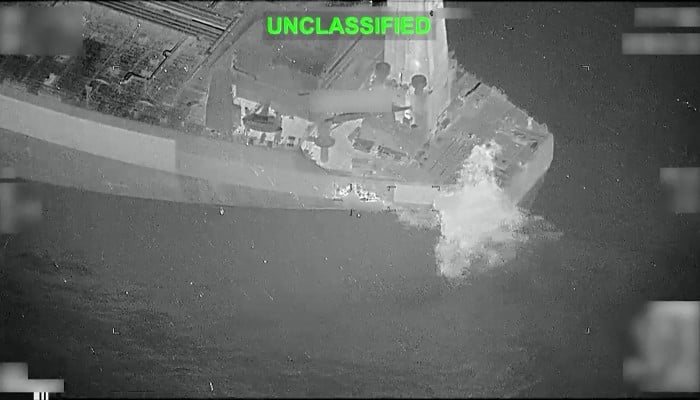
US forces struck Iranian coastal radar sites in Goruk and Qeshm Island, both in the Strait of Hormuz, early on Saturday after shooting down drones launched by Iran that US Central Command says posed a threat to maritime traffic. Two more Iranian attack drones that were threatening shipping in the strait were shot down, the US military said late on Saturday.
Iran’s Revolutionary Guards said it retaliated against US bases in Kuwait and Bahrain, and Kuwait’s army said it engaged seven ballistic missiles that passed over residential areas, resulting in material damage but no casualties.
In Bahrain, sirens sounded and residents were urged to seek shelter. Kuwait and Bahrain condemned the strikes.
Iran later said it had hit US bases in both countries with ballistic missiles, but the US military said six missiles were intercepted and a seventh did not reach its target.
OPEC+ eyes another output hike, but war thwarts shipments
The US and Iran have engaged in largely indirect negotiations for an interim deal to halt the three-month-old war that would leave issues including Iran’s nuclear program to further negotiations.

But a deal has remained elusive while the two sides have periodically skirmished.
Tehran wants access to billions of dollars in oil revenue, waivers on sanctions on crude exports, the lifting of a US blockade on its ports and leverage over the Strait of Hormuz. Iran has effectively blocked the waterway, where about a fifth of global oil traffic transited before the war.
US President Donald Trump is facing mounting domestic political pressure due to rising gas prices to bring the unpopular war to an end. He told NBC that while most of Iran’s drone and missile manufacturing facilities had been destroyed, the Iranians still had access to about a fifth of their missiles.
“They have some missiles, they have some drones. I would say percentage wise, maybe 21% to 22% of their missiles. It’s a lot of missiles, but it’s not what it was when we first attacked,” Trump told NBC News’ “Meet the Press” program, according to excerpts released by the network on Friday.
The conflict has driven up oil prices and fueled inflation around the globe. OPEC+ is set to agree on Sunday a fourth increase in oil output targets in as many months, three sources in the oil-producing group said, even though the war is still preventing several of the group’s members from pumping more.
Israel’s military said on Sunday it had intercepted two projectiles that crossed into Israeli territory from Lebanon. The attempted attack came a day after Lebanon said two army officers and a soldier were killed in an Israeli strike on a military vehicle in south Lebanon.