By Ali Imran
Stocks extended losses on Tuesday, as a sharp rise in global oil prices and fresh uncertainty over the Middle East conflict kept investors under pressure.
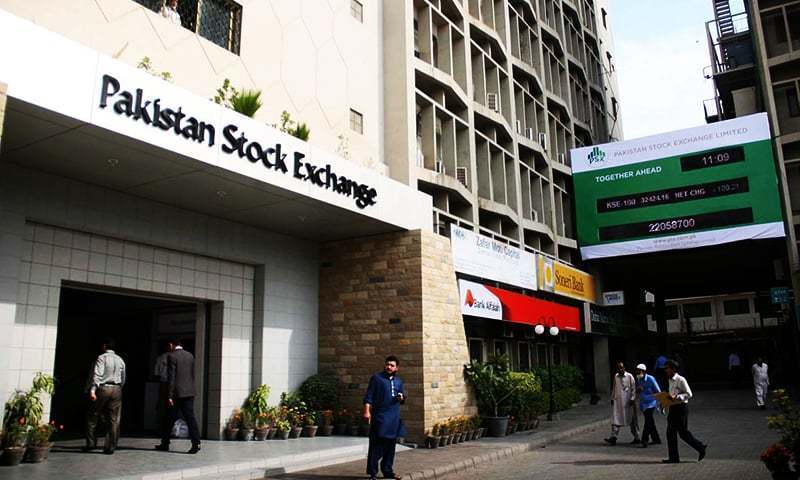
The Pakistan Stock Exchange’s (PSX) benchmark KSE-100 Index closed at 173,518.81, down 6,408.23 points, or 3.56%, from the previous close of 179,927.04.
During the session, it touched an intraday low of 173,349.41, down 6,577.63 points, or 3.66%, while its intraday high stood at 178,112.04, still down 1,815 points, or 1.01%.
Ismail Iqbal Securities Chief Executive Officer Ahfaz Mustafa told Geo.tv that: “Markets are reacting to a sharp rise in oil prices and the new uncertainty that has developed in the Middle East conflict and oil prices.”
“Result season is also around the corner, which will help determine market direction,” Mustafa said.
Tuesday’s fall extended the previous session’s selloff. The PSX had closed sharply lower on Monday as the KSE-100 Index plunged 2,314.73 points, or 1.27%, to settle at 179,927.04.
Oil prices rose on Tuesday to their highest level in four weeks after the United States reimposed a naval blockade of Iran and renewed attacks between Washington and Tehran heightened concerns over energy flows through the Strait of Hormuz.
Brent crude futures were up $3.17, or 3.81%, at $86.47 per barrel at 0941 GMT, while US West Texas Intermediate crude rose $2.15, or 2.75%, to $80.29 a barrel.
Brent rose to its highest level since June 12 and WTI to its highest since June 16, before the United States and Iran signed a memorandum of understanding to end the conflict on June 17.
Hostilities between the United States and Iran intensified this week, as US President Donald Trump reinstated a blockade of Iranian shipping and proposed charging a 20% fee to guard the Strait of Hormuz.
The waterway is a critical artery for global energy trade, carrying about a fifth of the world’s daily oil and liquefied natural gas supplies before the conflict began.
“The fears of war resumption and consequent increase in oil prices is keeping investors nervous again until a final deal is struck. Further escalation could result in worsening global energy markets and regional peace,” said AAH Soomro, an independent investment and economic analyst.
Amid the strikes, one Indian crew member was killed and eight others were wounded when two Emirati oil tankers were struck by Iranian cruise missiles in the Strait of Hormuz, the United Arab Emirates Ministry of Defence said.
Shipping data on Monday also showed the number of tankers transiting the Strait of Hormuz fell in the past day to the lowest level in two months.
Citi said in a note that the possibility of Iran walking away from the memorandum of understanding until after the US mid-term elections had also risen, a scenario that would most likely mean higher oil prices for longer.
However, Iran’s oil exports are continuing as usual despite the cancellation last week of a 60-day waiver of US oil sanctions, Oil Minister Mohsen Paknejad said on his official Telegram account.
Regional risks also widened after Yemen’s Houthi movement fired missiles at Saudi Arabia, accusing the kingdom of bombing an airport under its control on Monday.
Global equities were volatile as oil hit one-month highs. European shares opened lower, with the pan-European STOXX 600 index slipping 0.7%, dragged down by travel and leisure stocks, while MSCI’s broadest index of world shares edged into negative territory as Europe opened.
Markets were also rattled by hawkish comments from Federal Reserve Governor Christopher Waller, who said the US central bank may need to raise interest rates “in the near term” if data shows inflation remaining well above the 2% target.
US inflation data was due later on Tuesday, followed by comments from Fed Chair Kevin Warsh, who was scheduled to deliver the central bank’s semi-annual monetary policy report to Congress.
Overnight, Wall Street sold off, with the S&P 500 closing 0.8% lower and the Nasdaq Composite falling 1.6%.