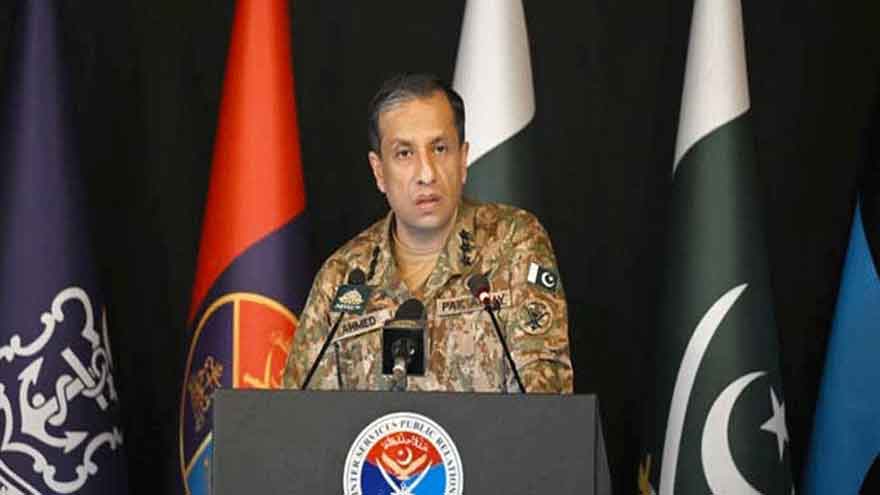
ISLAMABAD:”Terrorists must surrender to the Constitution and the law or face the consequences,” Director General ISPR Lieutenant General Ahmed Sharif Chaudhry said on Friday, revealing that security forces had eliminated 2,084 terrorists in 40,348 counterterrorism operations this year.
Addressing a press conference on counterterrorism and national security, the Director General (DG) Inter-Services Public Relations (ISPR) said 3,145 terrorism incidents had been reported across the country this year. Of these, 1,971 occurred in Khyber Pakhtunkhwa, 1,148 in Balochistan, and 26 in other parts of the country.
He said security forces had conducted 7,177 operations in Khyber Pakhtunkhwa and 2,091 in the rest of the country, bringing the total number of counter-terrorism operations to more than 40,000 nationwide during the year.
“This comes to an average of 10 terrorists being killed every day, which is the highest ratio ever,” he added.
The DG ISPR said security forces were currently conducting nearly 200 intelligence-based operations daily, averaging 194 operations every day, reflecting the sustained momentum of the country’s counterterrorism campaign.
He said 819 Pakistanis embraced martyrdom in terrorist attacks during the current year. Among them were 303 Army personnel, 194 personnel from law enforcement agencies, including the police and civil armed forces, while 322 were civilians.
The DG ISPR said 28 suicide bombings had taken place this year, adding that, as in the previous year, the majority of the suicide bombers were Afghan nationals.
“The recent incident in Tank involved Afghans, and the incident in Karachi also involved Afghans, so that trend remains. Afghan nationals, and even individuals associated with their security forces, were among the terrorists who were killed, captured and involved in these suicide bombings,” he said.
Referring to last year, he said 2,597 terrorists were eliminated in 2025, while 2,084 terrorists had already been killed this year, despite nearly four to five months of the year still remaining.
“The way the kinetic prong of counter-terrorism is maturing, responding and delivering is evident. If you look back at 2023, the ratio of our martyrs to terrorists killed was unfavourable, as fewer terrorists were eliminated compared to the sacrifices made by our personnel,” he said.
The DG ISPR said the improved results reflected the increasing effectiveness of Pakistan’s counter-terrorism strategy and the proactive posture adopted by security forces. “These terrorists and their sponsors have now realized there is no room for appeasement or negotiations. Once they understand that the state has made it clear they must either surrender to the Constitution and the law or face the consequences, their desperation becomes apparent,” he said.
He added that the proactive nature of security operations had also played a key role in improving counter-terrorism outcomes. The DG ISPR said a deliberate narrative was being promoted that the security situation in Balochistan had become extremely dire.
“I would like to examine this issue through three questions and three aspects. This is not only a Balochistan-specific issue but also relates to Pakistan’s overall security environment,” he said.
Explaining the concept of a “hard state,” he said it meant a state where the Constitution and the law applied equally to everyone, with no room for discrimination or elitism. “A hard state means a state where the Constitution and the law apply equally to everyone, where all affairs are conducted strictly according to the Constitution, and where there is no elitism. It is a state where the law is applied equally to all citizens,” he said.
“If all state affairs are conducted in accordance with the Constitution and the law, without discrimination, where the elite and ordinary citizens are treated equally, that constitutes a hard state. Such a state ensures security, stability and the resolution of grievances,” he added.
The DG ISPR said many people raised grievances and demanded their rights, some of which could be genuine, but stressed that fundamental obligations preceded fundamental rights. Referring to Article 5 of the Constitution, he said it came before the provisions dealing with fundamental rights.
“It states that loyalty to the state is the basic duty of every citizen. It also makes obedience to the Constitution and the law the inviolable obligation of every citizen, wherever they may be,” he said. He said the Constitution clearly established that every citizen’s foremost responsibility was loyalty to the state and obedience to the Constitution and the law, adding that the discussion on rights came only after these obligations had been fulfilled.
The DG ISPR said certain members of the elite and some tribal sardars wanted to preserve the status quo.
“I am not talking about all of them, but some among the elites and sardars do not want an ordinary citizen to study, progress, become an engineer, a doctor, join the Army, become an economist, an agricultural expert, or succeed in business,” he said.
According to the DG ISPR, such individuals were among the principal drivers of terrorism because they feared social and economic change.
“They are afraid that times are changing. The more afraid they become, the more anxious they get, and the more they resort to violence. The old way of doing things is over. We do not want to negotiate with them anymore. We will engage with the real stakeholders, the people of Balochistan. They are not the real stakeholders,” he said.
“You are only stakeholders in your own interests and your own family’s wealth, not in the interests of the people of Balochistan,” he added.
The DG ISPR further alleged that such elements were involved in smuggling under the guise of trade.
“They are accustomed to smuggling in the name of business and so-called trade. They bring in narcotics and diesel and sell them at many times their original price. When these illegal activities are stopped, they resort to terrorism and then claim that the situation is out of control and that Balochistan is slipping away,” he said.
Continuing his remarks, he said certain members of the elite sought privileges and control over public resources.
“They say, ‘Talk to us, restore our permits, reopen our businesses, and give us a share of this budget of more than Rs. 1,000 billion.’ No more. You are not the stakeholders. The money will go to the people of Balochistan,” he said.
The DG ISPR said Balochistan’s strategic location and abundant natural resources had made it a target for hostile interests. “They know that Balochistan enjoys a strategic geographical location. They also know that it is blessed not only with talented and progressive human resources but also with vast natural resources,” he said.
“If Balochistan prospers, the whole of Pakistan prospers, and so does the region. That is why they oppose its progress. They become directly involved through terrorist groups,” he added.
Referring to militant groups described by the state as “Fitna al-Hindustan” and “Fitna al-Khawarij,” he said they had found willing partners among certain members of the elite and tribal sardars who feared changing times.
“They want to preserve the old sardari system. They want the same servants, the same personal prisons, and the same system of control,” he said.
Commenting on regional security, the DG ISPR said that India and Afghanistan were linked through support for terrorism.
“What is common between India and Afghanistan? The only thing they have in common is terrorism. Their diplomacy is also based on terrorism,” he said. He added that although the two militant groups differed ideologically, they shared a common objective.
“One is secular, one is nationalist, and the other is an extremist religious group, but propaganda unites them,” he said. Highlighting development in Gwadar, he said the city, with a population of around 305,000, had three universities, four education colleges, 318 schools, the Pak-China Friendship Hospital, a district headquarters hospital, a rural health centre, five child dispensaries, and 19 basic health units.
He said Gwadar also had an international airport, a deep-sea port, the East Bay Expressway, industrial and tax-free zones, a cricket stadium, and several other development projects. Referring to Turbat, he said the city had two universities, six education colleges, cadet colleges, a girls’ cadet college, numerous schools, nine public medical facilities, one teaching hospital, 27 private hospitals, an international airport, and extensive road and business connectivity.
“Show me another city with a similar population that has this level of infrastructure and facilities,” he said.
The DG ISPR said Balochistan had only 114 schools at the time of independence in 1947, compared with more than 15,300 schools today, along with 12 universities, five medical colleges, 145 colleges, 13 cadet colleges, and 321 technical institutes.
He said the province had only six dispensaries in 1947, but now had 13 major hospitals, 18 teaching hospitals, 36 district headquarters hospitals, 56 rural health centres, 650 dispensaries, five cardiac centres, eight tuberculosis centres, and 24 dialysis centres.
He further said Balochistan’s road network had expanded from 375 kilometres in 1947 to more than 24,400 kilometres today, including over 4,400 kilometres of highways.
Questioning the narrative of deprivation, he said Balochistan’s per capita development budget exceeded
Rs. 75,000, the highest among all provinces, compared with less than Rs. 45,000 in Punjab.
“So on what basis is this narrative of deprivation being promoted?” he asked.
The DG ISPR said terrorist groups opposed development by targeting labourers and attacking infrastructure before claiming that no development was taking place in the province. Speaking about missing persons, he said the government had established a permanent Commission of Inquiry on Enforced Disappearances, headed by a retired Supreme Court judge, with representatives in every district.
He said the commission had received 10,901 complaints since its establishment in the early 2010s.
Of those, 9,372 cases had been disposed of, he said adding that in 4,896 of the disposed-of cases, missing people had returned home, around 1,030 were located in prisons, 308 were found dead and 2,400 cases were declared as misreported cases that did not pertain to a missing person.
Moreover, he said, 2,933 of the total cases were reported from Balochistan, among which 2, 767 had been disposed of. –Agencies