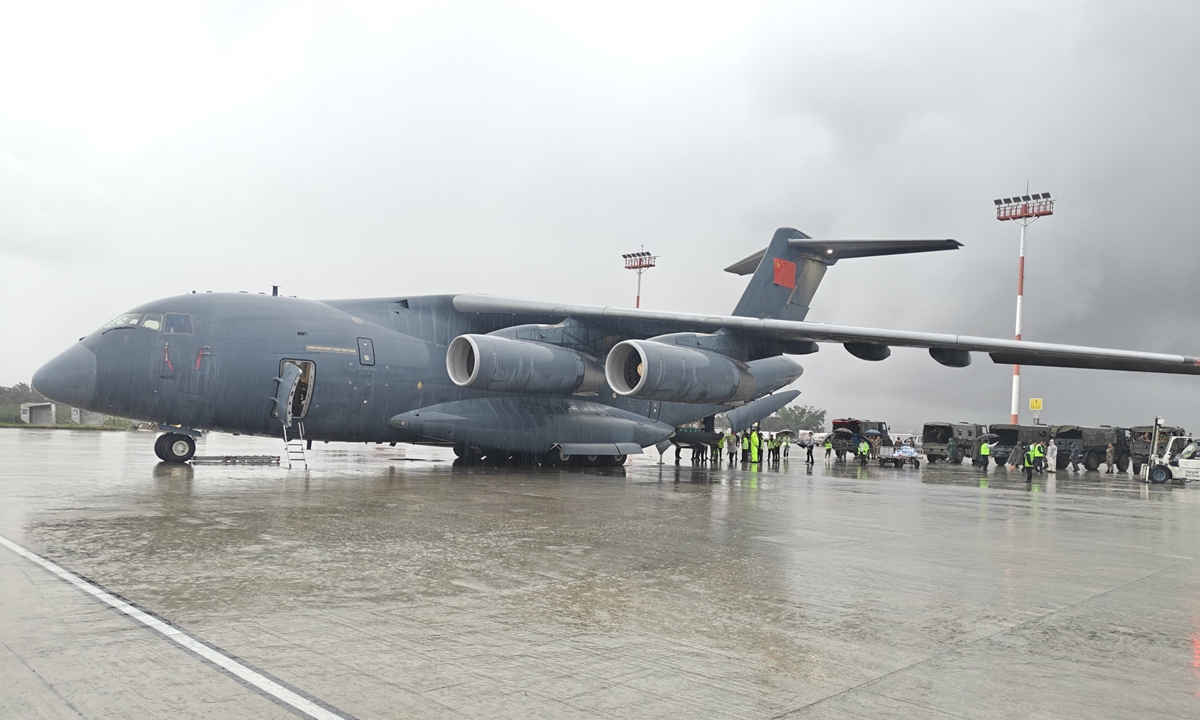
BEIJING: More emergency humanitarian aid supplies provided by the Chinese government departed from Shenzhen in South China’s Guangdong Province on Tuesday afternoon bound for mudslide-hit Nepal.
These supplies, including water purification systems, lighting and genetic testing equipment, as well as drones, arrived at Tribhuvan International Airport in Kathmandu on the evening of Tuesday, Xinhua News Agency reported.
Five experts from Shenzhen have traveled along with the supplies to Nepal to provide rescue assistance, according to media report.
The deadly mudslide, caused by an ice-rock avalanche in Nepal, hit Gyirong Port on August 26.
Memorial services were held on Tuesday morning in Gyirong County, Southwest China’s Xizang Autonomous Region, to mourn the victims of the mudslide that caused heavy casualties and left many missing.
Rescue workers put down their equipment and bowed their heads in silence to mourn those who lost their lives. After the moment of silence, they quickly returned to the rescue front line, continuing systematic grid searches of the affected areas, the Global Times learned from the National Fire and Rescue Administration.
Faced with the high-risk working environment in the gorges, firefighting and rescue teams have adhered to scientific rescue protocols and strictly implemented measures to prevent secondary disasters, while continuing efforts to advance search and rescue operations, according to the administration.
Rescue efforts also made further progress as of Tuesday noon, as the barrier lake formed on the Purepu Tsangpo River during the mudslide disaster has now completely discharged its water, with the risk under control, according to CCTV News.
Crews working to reopen the G216 national highway have also advanced to within 700 meters of the core disaster area, People’s Daily reported.
In response to a question regarding China’s plan of further support to Nepal, Chinese Foreign Ministry spokesperson Guo Jiakun said at a press conference on Tuesday that to provide emergency assistance to Nepal’s disaster-hit areas and carry out international rescue and relief cooperation is an important political decision of China and embodies our friendship with Nepal. Guo also stated that Chinese DNA testing experts are about to travel to the disaster-hit areas to assist Nepal in their operations.
Addressing another question on information sharing between China and Nepal over the mudslide disaster, Guo said that China and Nepal have maintained smooth cooperation in fields including meteorology, water conservancy, and disaster prevention and mitigation.
In the wake of the disaster, China has maintained sound communication with Nepal on the information sharing for search and rescue and the prevention of secondary disasters, continuously provided meteorological and hydrological information, conducted professional consultations, and sent relevant early warnings, Guo said.
China will continue to strongly support Nepal in disaster relief, strengthen cooperation in disaster prevention and mitigation, and safeguard the common interests of the two peoples, he added. Beyond the immediate search and rescue operation, experts warned that the potential for secondary disasters and lessons from the disaster should not be overlooked.
Zou Changxin, deputy director and a research fellow at the Nanjing Institute of Environmental Sciences under the Ministry of Ecology and Environment, told the Global Times that the accelerating trend of global warming tends to amplify warming effects across plateau regions, where sustained temperature rises drive glacier instability which can cause disasters.
As for cross-border cooperation, four key areas could be prioritized, including sharing satellite-based monitoring data, establishing joint monitoring sites for high-risk glacial lakes and glaciers, strengthening capacity building and technology transfer, and enhancing joint monitoring and early-warning efforts, Zou added.
“The occurrence of this disaster also reminds us that going forward, we need to strengthen risk assessment, monitoring and early warning, and emergency response for ecological security in cross-border areas,” Zou said. –The Daily Mail-Global Times news exchange item