Gyirong county: Forty-three people are confirmed dead and 519 remain missing in Gyirong county, Xizang autonomous region, after a devastating mudslide swept through the area on Aug 26, as search and rescue operations continued, local authorities said.
Ren Wei, commander of the frontline headquarters and executive vice-chairman of the regional government, said during a news conference in Gyirong that, as of 6 pm on Saturday, 993 items of personal belongings recovered.
As of Saturday evening, more than 2,500 rescuers had been deployed, along with over 500 vehicles and more than 9,000 sets of rescue equipment. Drones had made over 1,000 flights, while 5.43 metric tons of supplies and equipment had been air-dropped.
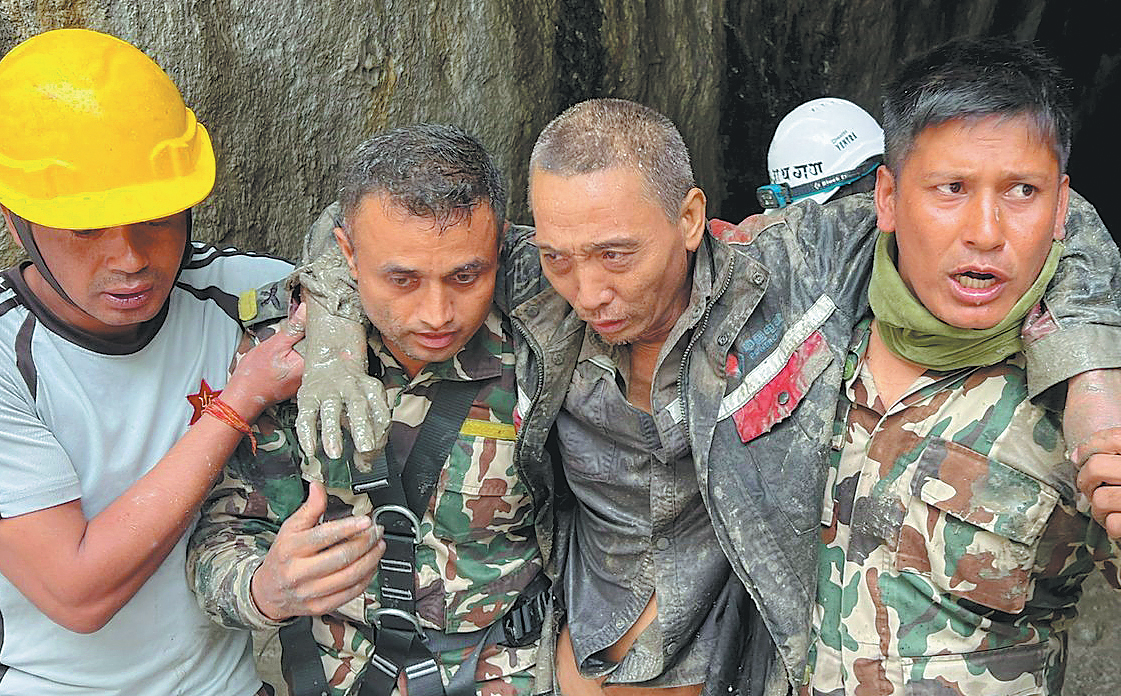
Since road access to the core area was restored on Wednesday, six specialized groups and seven rescue teams have been carrying out detailed searches. Rescuers have been clearing debris layer by layer and searching each section thoroughly, with some areas already cleared down to the original foundations.
Ren said searches will continue under the existing plan to ensure the core disaster area is covered as thoroughly as possible.
Meanwhile, authorities are providing support to the families of the dead and missing.
A dedicated hotline has taken 675 calls from relatives so far, while 791 family members had been received and 640 of them accommodated. Two local villagers had been rescued late last month.
Pu Weidong, executive deputy head of the regional public security department, said more than 60 forensic specialists and three laboratories had been mobilized to identify the victims.
Remains and personal belongings are being registered and documented, while fingerprints, genetic information and other identifying features are being collected and cross-checked with information provided by relatives. Pu said the work is being carried out scientifically, rigorously and carefully, with full respect for the dignity of the deceased and local customs.
Pu added that the authorities would regularly release information about the search, rescue and follow-up work. A 24-hour hotline has also been established to respond to families’ concerns, with further updates to be released according to developments in the search and identification process.
Preventing secondary disasters remains the priority. More than 100 experts and technical personnel have been deployed, along with 150 sets of professional monitoring equipment to track slope deformation, water levels, weather conditions and other factors.
Deng Buchuan, deputy director of the special disaster rescue department of Xizang Fire and Rescue, said the team is searching through the mud layer by layer.
“I hope more people can be rescued and we will do as much as we can to the best of our ability,” he said.
Su Pengcheng, a researcher at the Chinese Academy of Sciences’ Institute of Mountain Hazards and Environment, said experts have monitored barrier lakes, unstable slopes, glaciers and glacial lakes, while surveying geological hazards around five villages and along the emergency route.
He said a high-altitude ice-rock collapse on the Nepalese side of the Himalayas triggered the disaster. The resulting debris flow traveled about 22 kilometers downstream in only six to seven minutes, causing severe damage.
Although a barrier lake that had formed after the disaster has drained naturally, Su said unstable deposits and slopes remain, creating risks of localized blockages, landslides and debris. Satellite and aerial remote sensing, radar, hydrological monitoring and real-time drone imagery are being used to support continuous risk assessment and provide warnings to rescuers downstream.
Su said climate change is increasing the risks of disasters in the Himalayas, calling for early glacier-risk assessment, an integrated satellite, aerial and ground monitoring system and stronger cross-border cooperation on data sharing, risk assessment and early warning.
Foreign journalists visiting the site also noted the difficulty of reaching the remote area. Muhammad Asghar, a correspondent for the Associated Press of Pakistan in China, said the rescue response had been “very quick” despite the challenging access.
Bruno Falci, a Brazilian journalist with Latin American television channel teleSUR, said it was “really impressive how fast China acts”, citing the rapid mobilization of rescuers and reopening of roads.
The State Council Information Office and the Ministry of Foreign Affairs organized a visit to the disaster area on Saturday and Sunday for 17 journalists from nine overseas media outlets, including those from the United States, Britain, Russia, India and Singapore. –The Daily Mail-China Daily news exchange item