
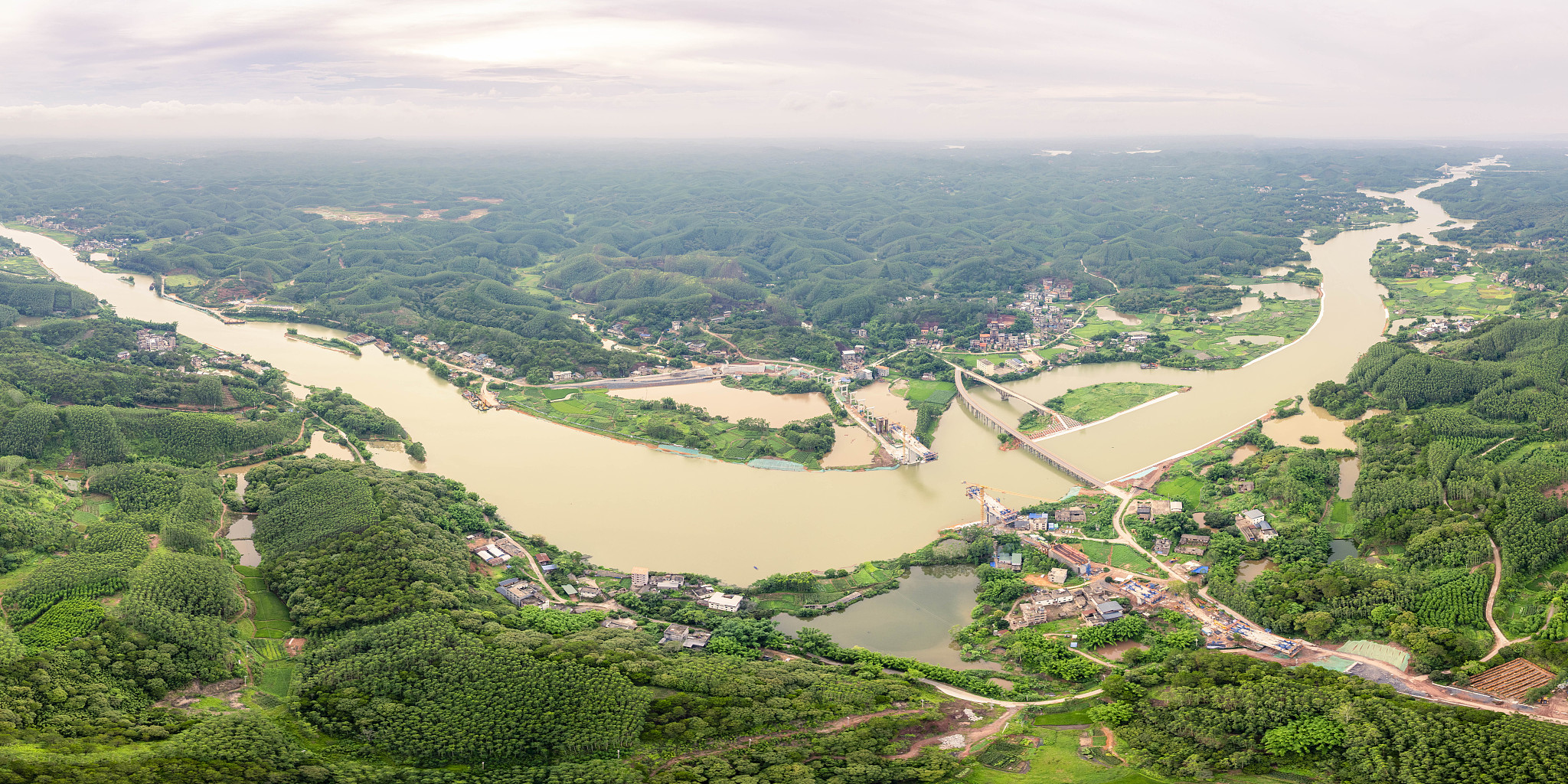
BEIJING: The opening of the 134.2-kilometer-long Pinglu Canal in south China’s Guangxi Zhuang Autonomous Region is expected to strengthen trade and logistics links between China’s southwestern regions and Southeast Asia.
Scheduled to open on September 16, it connects the Xijiang River shipping network with the Beibu Gulf and can accommodate vessels of up to 5,000 tonnes.
As a key part of the New International Land-Sea Trade Corridor, the canal provides a more direct route from China’s inland regions to the sea and onward to ASEAN markets.
For the southwest, cargo bound for international markets has traditionally relied on routes through China’s eastern and southern coastal ports.
Pinglu Canal will shorten the traditional shipping distance between southwest China and Southeast Asian markets by over 560 kilometers, reduce logistics costs by 18-30 percent and cut 5.2 billion yuan (about $775 million) in logistics costs annually, China Media Group reported.
The impact could be particularly significant for bulk commodities, including minerals, coal, grain and construction materials, where transportation costs account for a relatively large share of the total costs.
The canal will also strengthen the Beibu Gulf’s role as a maritime gateway for China’s inland provinces. Cargo from the southwest will be able to reach Southeast Asian markets through the Beibu Gulf without first traveling eastward to ports in Guangdong Province.
Pinglu Canal is part of the New International Land-Sea Trade Corridor, a logistics network linking western China with Southeast Asia through railways, roads, waterways and ports. The canal adds a water connection to the corridor, linking China’s inland river system with the ports and shipping routes of the Beibu Gulf.
The corridor has already become an important route for trade between western China and ASEAN, Singaporean newspaper Lianhe Zaobao reported.
By the end of November last year, more than 5 million twenty-foot equivalent units (TEUs) had been transported through the corridor. The Pinglu Canal is expected to strengthen the connection between the corridor’s inland origins and its maritime gateway in Guangxi.
Zhou Yan, deputy general manager of Beibu Gulf Port International Port Group, told The Straits Times that the canal could add about 3.5 million tonnes of cargo throughput when it opens and potentially reach 150 million tonnes annually in the longer term.
The development comes as China-ASEAN trade continues to expand.
China and ASEAN have been each other’s largest trading partners for six consecutive years. In the first half of 2026, bilateral trade reached 4.34 trillion yuan, up 18.2 percent year on year, according to the General Administration of Customs. Beibu Gulf Port is also expanding rapidly. Its container throughput reached about 10 million TEUs in 2025, compared with 2.28 million TEUs in 2017.
The combination of a growing port and a new inland waterway could further increase the volume of goods moving between western China and Southeast Asia. –The Daily Mail-CGTN News exchange item