
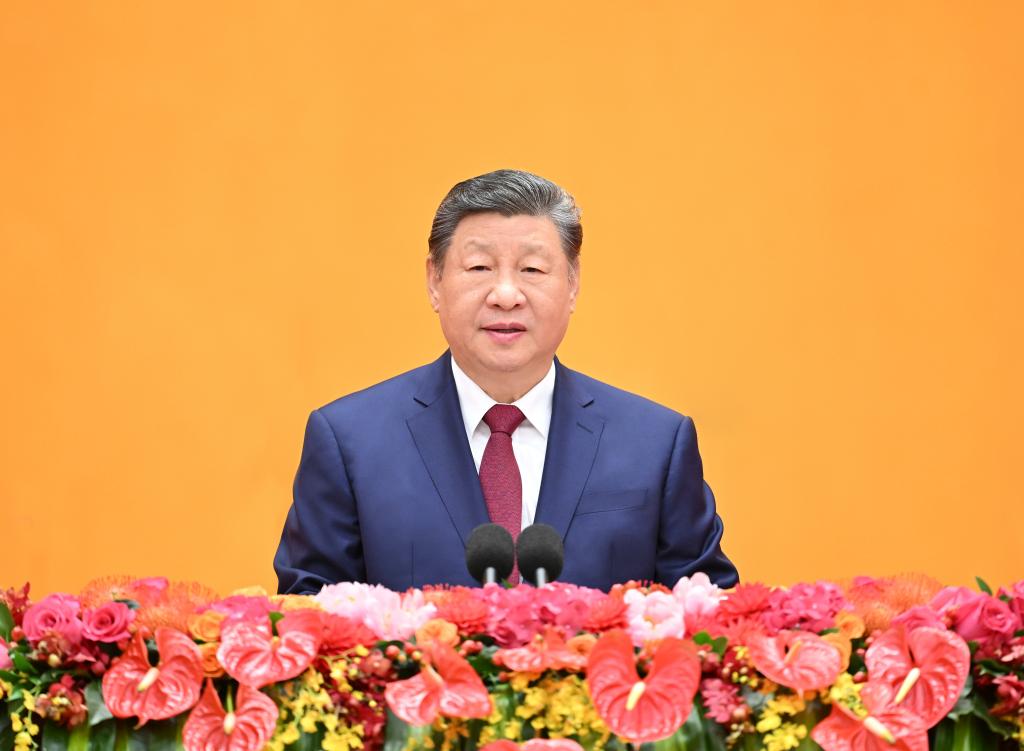
BEIJING: Chinese President Xi Jinping left Beijing on Wednesday for a state visit to the US at the invitation of US President Donald Trump, according to the Xinhua News Agency.
Xi’s entourage includes his wife Peng Liyuan, Cai Qi, a member of the Standing Committee of the Political Bureau of the Communist Party of Chi-na (CPC) Central Committee and director of the General Office of the CPC Central Committee, and Wang Yi, a member of the Political Bureau of the CPC Central Committee and foreign minister, according to Xinhua.
The departure marks the start of the Chinese President’s three-day US visit. As the closely watched summit approaches, experts expressed expecta-tions that head-of-state diplomacy will guide bilateral ties toward greater stability and advance cooperation on issues affecting global peace and prosperi-ty. Observers also emphasized the importance of sustained dialogue in reducing uncertainty for the wider world.
Head-of-state diplomacy
“There is no substitute for the presidents of the two nations talking face to face,” Anthony Moretti, an associate professor of communication at Rob-ert Morris University in Pennsylvania, told the Global Times.
“There is unparalleled acknowledgement of head-of-state diplomacy when the two leaders meet. Nothing compares to it,” he said, expressing hope for agreements on important issues.
“Critical answers need to be found in areas like AI global governance, food insecurity issues, the environment and more. The two nations working alongside each other can instill within the world’s 8+ billion people a sense that the future should be thought of optimistically,” Moretti said.
A Chinese expert also highlighted the role of direct engagement between the presidents in setting the direction of bilateral relations.
Head-of-state diplomacy serves as a central anchor of China’s diplomacy, steering its most important diplomatic relationships, Chen Dongxiao, a senior research fellow and president of the Shanghai Institutes for International Studies, told the Global Times on Wednesday.
That role is particularly evident in China-US relations, Chen said. Their exchanges and reciprocal visits can help advance bilateral ties, build consen-sus on strategic stability and translate that understanding into further progress, he said.
Chen expected that the summit would address both issues of common bilateral concern and global challenges. A meeting between the leaders of the world’s two largest economies has significant implications for the international landscape and can help consolidate their shared understanding of strate-gic stability, he said.
Alongside the substantive agenda, the welcome arrangements have drawn attention for the diplomatic signals they convey.
Worldwide perspectives
Beyond China and the US, the summit has prompted hopes that a steadier relationship will reduce the costs of conflicts for other countries. Observ-ers from countries including those in Southeast Asia and the wider Global South, welcome a China-US summit as it steadies the relationship and keeps the two major countries in dialogue rather than in collision.
Lye Liang Fook, an associate senior fellow at the ISEAS-Yusof Ishak Institute in Singapore, told the Global Times that Southeast Asian countries would like to see the US and China build further on their definition of constructive strategic stability.
In this regard, it would be a very positive outcome if the two countries could reach further agreement on trade and investment matters in particular, Lye said.
Chinese and US economic and trade officials held talks on Sunday local time on economic and trade issues of mutual concern, with artificial intelli-gence (AI) also among the topics discussed, Xinhua reported on Monday.
Lye noted that a dialogue on issues related to artificial intelligence is a positive step forward in showing that the two countries are making an effort to collaborate in an area where there is intense competition.
As the leaders of the two major countries meet, the Global South is keeping a close eye on their agenda.
Warwick Powell, an adjunct professor at the Queensland University of Technology and former policy adviser to former Australian prime minister Kevin Rudd, told the Global Times that China-US relations are highly consequential to all concerned. How the relationship is calibrated, curated, man-aged and advanced has multiple implications globally for peace and security and for prosperity.
Smaller nations hope for stability and constructive engagement, coordination and collaboration rather than conflict, Powell said. Critical issues, rang-ing from global energy security and trade flows to artificial intelligence (AI) are best addressed through concerted cooperation and collaboration rather than coercion and caprice, he added.
“In Asia, we have the additional dynamic of the drums of war. A stable relationship between Washington and Beijing wards off these drums, and that is the hope of those in the region who cherish hard-won peace,” Powell said.
The view is echoed by Peter TC Chang, a research associate with the Malaysia-China Friendship Association and a former deputy director of the In-stitute of China Studies at University of Malaya. He told the Global Times that China-US relations are one of the most consequential bilateral relation-ships in the world.
When the two countries are able to engage with one another constructively and manage their differences responsibly, the benefits extend far beyond their shores, contributing to greater stability and confidence across the international community, he said.
For ASEAN, Chang said, this relationship is not simply a matter between two major powers. The quality and stability of China-US relations have a direct bearing on the peace, security, and prosperity of the region.
The region therefore has a strong interest in an environment where dialogue is sustained, differences are managed peacefully, and major powers can cooperate where their interests converge, he said.
This is particularly important as new technologies reshape our economies and societies, Chang told the Global Times, adding that Washington and Beijing have an opportunity to establish practical guardrails and risk-reduction mechanisms for emerging and dual-use technologies, including AI.
Responsible cooperation in this area could help ensure that technological competition does not deepen economic fragmentation, he said.
“Ultimately, Southeast Asia does not wish to choose between major powers. We hope to see a region where countries can engage all partners openly and confidently, and where constructive coexistence creates the space for innovation, sustainable trade and shared prosperity,” Chang said. –The Daily Mail-Global Times news exchange item