
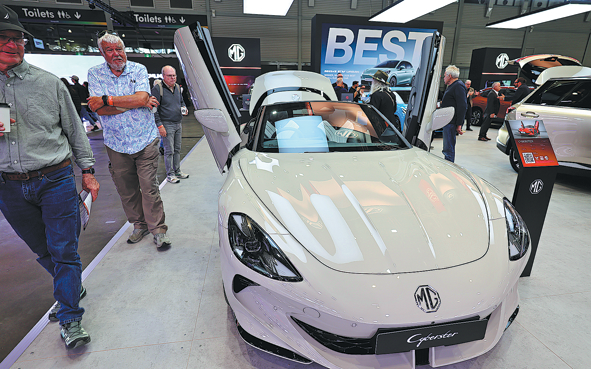
BEIJING: The Everything Electric Sydney trade show arrived with the Australian spring this year. The Southern Hemisphere’s largest event of its kind, the home energy and electric vehicle show has become a major stage for Chinese carmakers.
Industry data showed that battery EV sales in Australia broke records in August, surging 171 percent year-on-year and accounting for nearly one-fourth of all new vehicle sales that month. Five Chinese brands — BYD, GWM, MG, Geely and Chery — sold more than 26,000 vehicles combined, claiming five of the top 10 spots in Australia’s auto market.
At the show, held from Sept 18 to 20, I met Anthony Crawford, cofounder of automotive review platform CarExpert. He said Chinese cars were dominating Australian new vehicle sales for good reason. “They provide the technology. They provide the design, now getting so good,” Crawford said.
The Chinese auto industry has been a game changer and deserves credit for helping accelerate EV growth in Australia, he added.
Another trend being driven by Chinese cars also caught his attention. After seeing a new model from a Chinese carmaker, he was particularly impressed by its AI features. Instead of using “broken English” or simple commands, drivers can speak to the car more like a normal conversation, which he found very convenient.
Bringing AI into cars, Crawford said, was another game-changing development for the Chinese auto industry.
Australia is a vast country, where driving conditions can shift quickly from city streets to the outback. Range, charging, and a vehicle’s ability to handle different road conditions are practical concerns for car buyers. Easing “range anxiety” while meeting diverse driving needs has become an important test of whether a car brand can truly serve the local market.
Echoing this stance, a ministry spokesperson said the vast majority of members stressed during discussions that the most-favored-nation principle remains paramount to global trade, and any attempt to change it would severely damage the system’s foundation. Consequently, the US did not propose an outcome document on this topic.
On the highly controversial issues of industrial capacity and forced labor, Li said that Beijing firmly opposes unilateralism and protectionism pursued in the name of these topics.
He stressed the need for a comprehensive, objective and dynamic analysis of industrial capacity from a global perspective, advocating for cooperation rather than creating confrontation.
Bob Savic, head of international trade at the Global Policy Institute in London, said simply attributing a country’s production advantages to “overcapacity” is “neither honest nor responsible”.
Western countries’ plans to impose tariffs and restrictions on Chinese imports under the pretext of overcapacity are not merely a commercial decision, but rather a powerful industrial policy tool aimed at protecting domestic producers, Savic said.
Elaborating on the lack of consensus on these issues, the ministry spokesperson pointed out that many G20 members are currently subject to Section 301 tariffs related to forced labor and are targets of Section 301 investigations regarding overcapacity.
Due to divergent opinions among the majority of members, the US push to issue joint statements on these issues failed, the ministry spokesperson said, adding that attempting to impose domestic political agendas onto multilateral platforms only creates unnecessary division.
By weaponizing these topics to serve its own protectionist goals, the US inevitably faced strong pushback from the broader international community, the ministry spokesperson added, noting that Washington later released a separate statement on forced labor with two other countries outside the G20 framework.
Regarding the consensus reached on food security, Li highlighted China’s active contributions to global agricultural stability and urged G20 members to lower trade barriers to maintain stable and smooth food production and supply chains.
On labor, Li emphasized China’s people-centered development philosophy and its high regard for protecting workers’ rights and interests, calling on all parties to tap trade potential and create more high-quality jobs.
At the show, I met a car enthusiast who had come to see the latest models from Chinese carmakers. He said he has a fleet of 20 to 30 cars and also works in the auto industry. He frequently travels around Australia, sometimes covering long distances where fuel stations can be few and far between. He hopes a hybrid can handle everyday city driving while also performing well when he heads into the outback or even the desert.
“I think they are just being smart. They are looking at what consumers want and providing the right product,” he said.
In March, I attended an event held by the Australian Automotive Dealer Association. In a speech at the gathering, Prime Minister Anthony Albanese described buying a car as “one of the biggest financial decisions Australians make”.
Buying a car is often tied to important moments in life, such as welcoming a new baby or starting a new job, he said. In this respect, Australians and Chinese are actually quite similar.
That is also why entering a new market means much more for a carmaker than simply shipping cars in and putting them on display. Price, design, driving range, safety, after-sales service and how well a vehicle fits the local way of life can all shape a consumer’s choice.
For carmakers, gaining a foothold in a mature market like Australia also raises another question: Beyond the design and quality Chinese cars are already known for, what new technologies could take the industry to its next stage?
Chery offered one possible answer at the Sydney show by bringing its newly developed humanoid robot, Mornine, to the exhibition.
A company executive told me that the robot grew out of practical needs in Chery’s overseas business, including dealership operations and multilingual services. The company hopes to apply the technology, talent, manufacturing expertise and supply chain capabilities it has developed in the auto industry to new fields.
Official data showed that car purchases in Australia rose 10.3 percent in the second quarter of this year, even as spending in most other categories remained weak. EVs were an important driver of that growth, helping lift household consumption and, in turn, economic growth.
So, will the next generation of products from China help drive a new wave of consumption in Australia? We will have to wait and see. –The Daily Mail-China Daily news exchange item