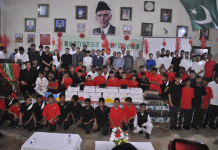
HARBIN: The China-Pakistan Youth Forum was held at Harbin Engineering University on October 15 as a parallel session of the 6th Exchange Mechanism Conference of the CPEC Consortium of Universities, bringing together scholars and students from both countries to discuss the future of bilateral cooperation through an interdisciplinary lens.
Under the theme “The Future of China-Pakistan Cooperation: Interdisciplinary Perspectives,” the forum was held in a hybrid format, with eight online sub-venues set up at Pakistani universities. More than 120 representatives from more than 40 Chinese and Pakistani universities and research institutions gathered to exchange views on joint research, talent cultivation and higher education cooperation.
The forum was guided by the China Association of Higher Education and the Higher Education Commission of Pakistan, and hosted by Harbin Engineering University. It was organized by the Secretariat of the CPEC Consortium of Universities and the College of International Cooperative Education at Harbin Engineering University.
Nine scholars from the two countries delivered presentations focusing on CPEC development and bilateral higher education collaboration. Participants exchanged views on CPEC construction, youth engagement and academic cooperation, sharing perspectives on scientific and technological innovation, sustainable development, entrepreneurship, overseas education and frontier materials science.
The forum also launched a call for papers under the theme “Commemorating the 75th Anniversary of China-Pakistan Diplomatic Relations,” inviting young researchers from universities in both countries to contribute scholarly work. Participants noted that the 75-year friendship was forged by earlier generations, and that the next 75 years will be written jointly by the youth of both nations.
Participating universities spanned Pakistan’s Punjab, Sindh, Balochistan, Khyber Pakhtunkhwa and Gilgit-Baltistan regions, promoting multidisciplinary dialogue covering political science, international relations, regional studies, materials science, nuclear technology and higher education governance. –Agencies