
By Asim Hussain
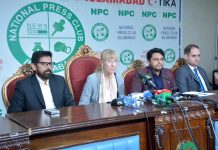
ISLAMABAD: Federal Minister for Climate Change and Environmental Coordination Senator Dr Musadik Malik on Monday called for a shift towards rights-based and climate-resilient development, stressing that poor and vulnerable communities should not continue to bear the disproportionate burden of climate change, global economic inequalities and mounting debt.
Musadik Malik calls for rights’-based development, climate justice at SDPI conference
Addressing the inaugural plenary session of the 29th Sustainable Development Conference (SDC 2026), organised by the Sustainable Development Policy Institute (SDPI) under the theme “Rethinking Development in an Age of Disruption,” the minister said development should not be measured merely in dollars but by its impact on the lives and future generations of ordinary people.
“For the poor, development is measured in generations, not dollars,” he observed, questioning a development model in which communities repeatedly lose their livelihoods and assets to natural disasters.
Explaining the conventional development pathway, Dr Musadik Malik said countries traditionally moved from agriculture to productive farming, industrialisation and then services, with several countries, including China and South Korea, successfully following this trajectory. However, he stressed that changing global economic and climate realities required a fresh understanding of development.
Highlighting the growing constraints on development financing, he said resources available for development had declined by 23 per cent in a single year, with the funding position in 2024-25 falling back to the level of 2015, when the Sustainable Development Goals (SDGs) process began.
He also pointed out the disparity in borrowing costs, saying wealthy countries paid around 2.2 per cent interest on borrowed funds, compared with 5.2 per cent for developing countries.
The minister said approximately 3.7 billion people lived in countries where debt servicing consumed more resources than combined spending on education and healthcare, undermining efforts to improve public services and achieve development targets.
He questioned how meaningful progress could be achieved when countries were spending more on interest payments than on education and healthcare, adding that such financial pressures also affected maternal and infant mortality and school enrolment.
Highlighting the human cost of climate change, Dr Musadik Malik said vulnerable communities were effectively paying a climate tax through physical suffering and loss of livelihoods.
Citing the example of a brick-kiln worker, Gulab Rohi, in Jacobabad, he said the worker continued working in extreme temperatures because otherwise his children would go hungry.
“This is not merely weather or climate; it is a tax that a poor person pays through his body,” he remarked, emphasising that climate change must also be understood through the experiences of people exposed to extreme heat and hazardous working conditions.
The minister said developing countries were downstream of emissions they had not produced, interest rates they did not determine, wars they did not initiate and technological systems often designed without their participation.
He argued that the challenges faced by developing countries should be viewed through the lens of rights rather than simply categorising them as less developed.
Referring to the international economic and political order, he questioned the effectiveness of the concept of a rules-based global system when developing countries continued to face unequal financial and economic conditions.
Dr Musadik Malik said Pakistan needed to reconsider how development was planned and implemented, raising three fundamental questions: whether development projects could withstand future floods, who would bear the cost of destruction, and who would own the benefits of development.
He stressed that climate resilience should not mean expecting poor communities to recover repeatedly after disasters. Instead, development planning should ensure that homes and infrastructure were constructed in safer locations and that settlements were protected from recurring climate-related risks.
Outlining Pakistan’s priorities, the minister identified three key areas: measuring and preventing climate-related losses, addressing extreme heat as a human rights concern and an emerging economic opportunity, and promoting local ownership through research, innovation and investment in young people.
He said solutions to extreme heat, including shading, cooling systems and indigenous technologies, could create new opportunities while protecting vulnerable communities.
Elaborating on the government’s initiatives, the minister highlighted the proposed Virtual Green University, which would connect Pakistani universities with international research institutions to promote collaborative studies on glaciers, climate change and environmental challenges.
He said institutions including Allama Iqbal Open University, National University of Sciences and Technology (NUST), Lahore University of Management Sciences (LUMS), Aga Khan University and Karakoram International University could contribute to the initiative.
The proposed programme would facilitate student and faculty exchanges as well as joint research projects, particularly on glaciers and mountain-related environmental challenges.
Referring to Pakistan’s international engagements, he mentioned cooperation with Italy and the United Kingdom, including the Green Compact, as opportunities to strengthen joint research and knowledge-sharing.
The minister also outlined the proposed Green Cloud initiative, under which technological resources developed through public funding would be made freely accessible to young people, enabling them to experiment, innovate and develop practical solutions.
He further said the government had established a $10 million Green Field Fund to support startups and young innovators working on science, technology and climate-related solutions.
A board had been constituted for the fund, while its first competition was expected within the next three months, he added.
The minister acknowledged the support of international development partners, including UNICEF, the United Nations Development Programme (UNDP), the World Bank, Asian Development Bank and GIZ, in developing the initiative.
He said the fund would focus on supporting young innovators through investment rather than conventional lending, allowing them to pursue innovative ideas and research.
“Invest in these kids. Give them the resources, let them experiment with science and get out of their way,” he said, emphasising the need to provide young people with opportunities and resources to turn their ideas into practical solutions.
The minister said Pakistan’s development strategy must prioritise sustainability, climate justice, research and local ownership to ensure that the benefits of progress reached vulnerable communities and future generations.