On a shaded hillside south of Hongyuan County in Aba Tibetan and Qiang Autonomous Prefecture, Sichuan Province, the Qiongxi Town Martyrs’ Cemetery rests quietly at an altitude of 3,507 meters. A total of 189 gravestones stand in neat rows. Seven of them bear no names—only a five-pointed star carved into the stone.
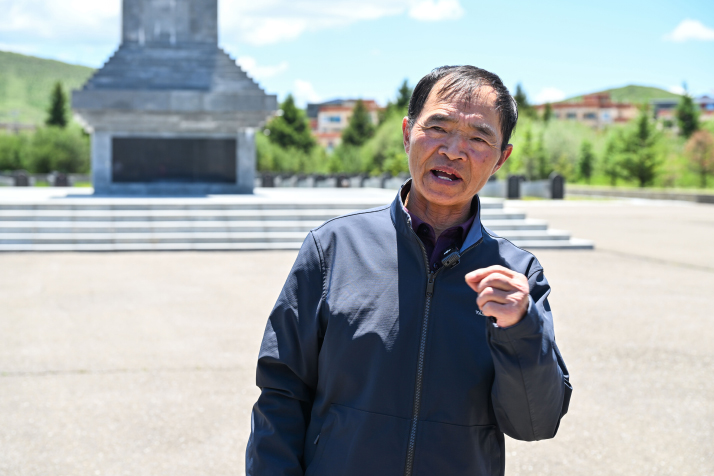
Every day, 58-year-old Luo Jianguo comes here to pull weeds, pick up fallen branches and wipe the gravestones clean. His father, Luo Daxue, did the same every day during his lifetime. Two generations of the Luo family have guarded this cemetery for nearly 60 years since 1967.
An unfinished Long March
In 1933, 15-year-old Luo Daxue joined the Chinese Workers’ and Peasants’ Red Army in Bazhong County, Sichuan. Two years later, he followed the Fourth Front Army on the Long March. In the same year, a bullet pierced his right leg during a battle. Supported by comrades and using a tree branch as a crutch, he struggled all the way to the Zoige Grassland in west Sichuan, which was the starting point of the treacherous marshy grassland section that the Red Army crossed in 1935.
But after prolonged exposure to the poisonous swamp water, the wound became severely infected, and Luo Daxue’s entire leg festered. Eventually, he could no longer walk and fell behind the troops. “He was devastated,” Luo Jianguo told Beijing Review. “He was only one step away from joining the three main forces of the Red Army that converged in Gansu Province.”
Kind-hearted locals saved Luo Daxue and cared for him for three years. The injury healed, though it left a scar the size of a palm on his leg. By the time he recovered and tried to find his unit again, the troops had already been reorganized. Luo Daxue eventually settled in Hongyuan.
In 1952, Luo Daxue, as a Red Army veteran, was invited to work in Beijing. But he declined. He didn’t want to leave this land. It had not only saved his life, it also held the graves of the comrades who never made it out of the grasslands.
Hongyuan, literally “red plain,” sits in a high-altitude pastoral region. The old walls around the cemetery were low, and yaks and sheep often wandered in to graze. So in 1967, Luo Daxue began voluntarily guarding the cemetery and continued doing so for 28 years. Every day he weeded the grounds, collected branches, cleaned gravestones and dug drainage channels when it rained. Even when the old wound in his leg caused him severe pain, he never complained, never once asked the government for anything.
Perhaps for Luo Daxue, guarding the cemetery was both a way of protecting his fallen comrades and a way of reconciling with his own unfinished Long March. Since he had not been able to walk with his comrades to the end of the journey, he chose instead to stay beside those who remained buried there until the end of his own life.
Mission passed from father to son
In 1995, Luo Daxue fell critically ill. On his deathbed, he called his youngest son, Luo Jianguo, to his side and said, “You must take care of the cemetery for me.”
At the time, guarding the cemetery was volunteer work and Luo Jianguo was working at a milk powder factory. At 27 years old, he hesitated and even resisted the idea.
But his father’s voice, though weak, remained firm, “You never worried about food or clothing because these martyrs lying in the cemetery gave their lives for it. Many of them were younger than you when they died. What do you think they sacrificed themselves for?” Out of filial devotion, Luo Jianguo agreed.
Before passing away, Luo Daxue gave his son three tasks: guard the cemetery; never ask the government for money; and tell the stories of the martyrs so the spirit of the Long March can be passed on from generation to generation.
In 1995, Luo Jianguo took up the baton of cemetery guarding, and with it, his father’s unfinished Long March. This year is his 31st year watching over them.
Every day, he inspects the cemetery to check whether tiles on the gravestones have fallen off, whether facilities have been damaged by freezing temperatures or whether bird droppings need to be removed. In summer, he removes weeds; in winter, he clears snow.
One day in October 2009, a gray-haired man appeared outside the cemetery gates. The moment they opened, the man dropped to his knees. From the entrance, he bowed and crawled more than 40 meters to his father’s grave, tears streaming down his face as he whispered, “Dad, I’ve come to see you.”
The man’s father had joined the army before he was born. The two had never met in life. “I never imagined a father and son would meet for the first time in this way,” Luo Jianguo told Beijing Review, turning away to wipe his tears. In that moment, he understood even more deeply: What he was guarding was the reunion that many of the 189 families would never have.
As for the seven unnamed graves, local authorities and the Luos did everything they could to locate surviving relatives. But as time passed, hope grew slimmer. Luo Jianguo said perhaps he cannot help them find their families—but he hopes he can be family to them.
Hongyuan lies on the Western Sichuan Plateau, where winters are long and severe, and summers are almost nonexistent. Temperatures can plunge as low as minus 36.2 degrees Celsius. At an elevation of around 3,500 meters, oxygen levels are only 60 to 70 percent of that at sea level. Under such conditions, Luo Jianguo developed rheumatoid arthritis, high-altitude anemia and chronic leg pain.
One winter, amid fierce wind and snow, he suddenly suffered heart palpitations and collapsed in the cemetery. Fortunately, he was saved in time. His wife urged him to get more rest, but he replied, “It pains me if I don’t go for just one day.”
Luo Jianguo sometimes sits beside the graves of the unnamed martyrs and talks quietly to the heroes beneath the earth. “That way they’re not alone, and neither am I,” he told Beijing Review. “Their heroism and noble spirit give me strength and emotional support.”
The march’s spirit
In addition to guarding the cemetery, over the past 31 years as a volunteer, he has delivered more than 1,000 talks on revolutionary history to over 40,000 people. Every year during Qingming Festival, the Army Day and Martyrs’ Memorial Day, he stands beneath the memorial monument telling students stories of the Red Army crossing the grasslands, his father’s unfinished Long March and the significance of the Long March spirit.
For two generations of the Luo family, the father spent 28 years standing vigil for fallen comrades, while the son has spent 31 years honoring a promise. Throughout their lives, they have told future generations that those who never made it out of the grasslands have not been forgotten, and the road they could not continue on has been traveled by others. –The Daily Mail-Beijing Review news exchange item