

DM Monitoring
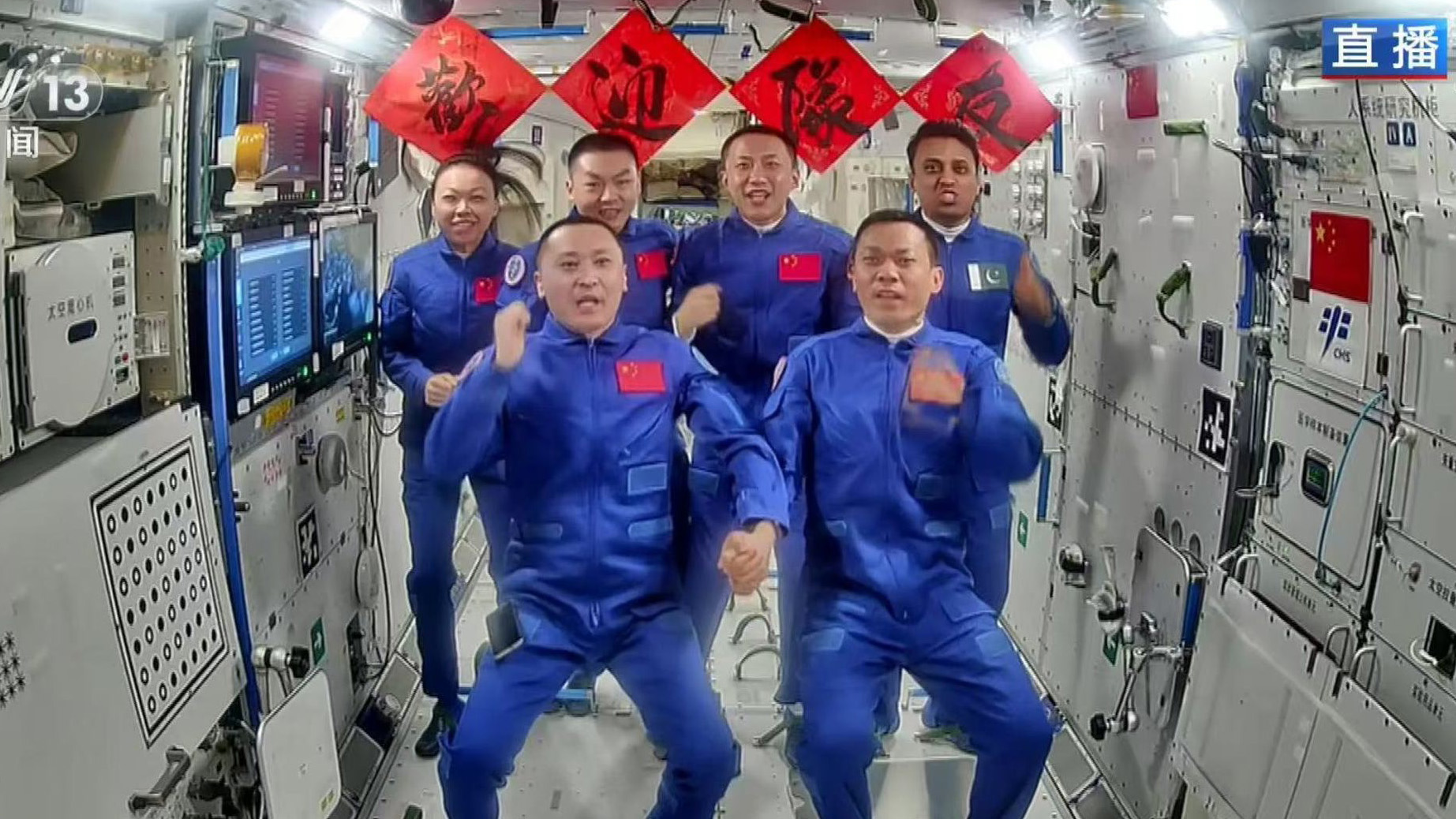
BEIJING: The China Manned Space Agency (CMSA) confirmed on Wednesday that the Shenzhou-24 manned spacecraft, carrying 40-year-old Pakistani astronaut Zeeshan Ali, successfully docked with the Tiangong space station 3 hours and 38 minutes after launch.
At 8:18 a.m. Beijing time, the Long March 2F Y24 carrier rocket was launched from the Jiuquan Satellite Launch Center in northwestern China.
Approximately 10 minutes later, the spacecraft successfully separated from the rocket and entered its designated orbit. The astronaut crew was in good condition, and the launch mission was a complete success.
After entering orbit, the spacecraft will autonomously and rapidly rendezvous and dock with the space station complex according to a predetermined procedure. Following this, the Shenzhou-24 crew will enter the Chinese space station.
The Shenzhou-24 crew consisted of Chinese astronauts Tang Hongbo and Wu Yi, and Pakistani astronaut Muhammad Zeeshan Ali.
During the mission, the crew will conduct a number of experiments and applications covering fields such as space life sciences and human research, microgravity physics, and new space technologies, including several international collaborative scientific experiments.
This mission marks the 8th manned flight during the application and development phase of China’s space station, and the 41st launch since the start of China’s manned space program. It is also the first Chinese manned spaceflight mission to involve foreign astronauts.
This launch also marked the 680th flight of the Long March series carrier rockets and the 24th flight of the Shenzhou manned spacecraft.
Currently, the space station assembly has entered the docking orbit and is operating well, meeting all the conditions for rendezvous and docking with Shenzhou-24 and for astronauts to move in.