
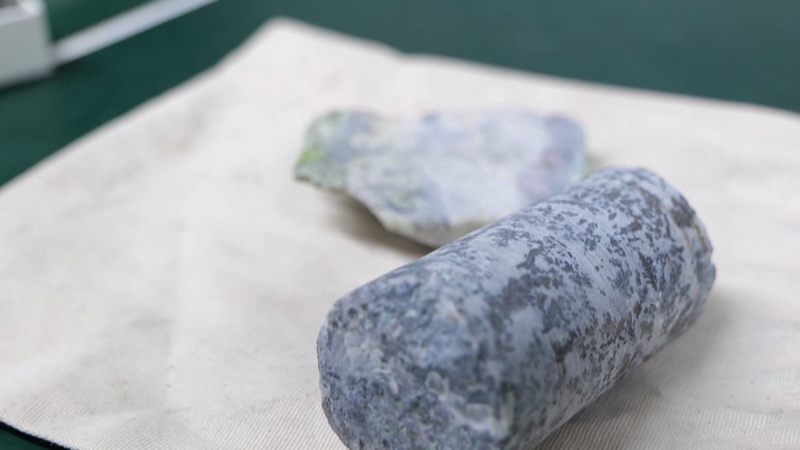
The International Mineralogical Association (IMA) last November officially approved a new mineral, nickel bismuth antimony arsenic sulfide, giving it the code IMA2025-059 and the name Jinxiuite, after its discovery site in Jinxiu Yao Autonomous County, Guangxi Zhuang Autonomous Region in south China. The discovery was led by researchers from the Chinese Academy of Geological Sciences.
Jinxiuite’s story began by chance in April 2006 during the construction of a small hydropower plant. Workers uncovered a “black-green” lode containing unusually high concentrations of nickel and cobalt. Over nearly two decades, Chinese researchers conducted extensive studies to understand its origin and structure, culminating in its official classification.
Scientifically, Jinxiuite expands the known boundaries of the material world. Its discovery adds not just a new mineral species, but also a unique “code” recording Earth’s, and possibly the universe’s, evolutionary history under extreme geological conditions. Its highly stable crystalline structure, a natural design refined over 4.6 billion years, offers major insights for materials science.
Could this “blueprint” unlock pathways to more powerful, cost-effective energy materials? The potential is vast.
Economically, Jinxiuite opens new directions for mineral resource utilization. Its unique composition may prove pivotal for future innovations in materials science and environmental technology.
Nickel and cobalt have properties such as high-temperature resistance, corrosion resistance and high strength, making them extremely valuable in the aerospace, chemical, machinery manufacturing and home appliance industries. As essential components of lithium-ion batteries, they have been widely used in the manufacturing of rechargeable batteries in recent years. China faces a severe shortage of nickel and cobalt mineral resources, especially cobalt, and has long been heavily dependent on imports.
The discovery of Jinxiuite is hence of strategic importance to China, alleviating resource shortages and ensuring the security of the new-energy industry chain. It is not only a major breakthrough in fundamental geology but also holds profound implications for national resource security, advanced materials research and regional economic development.
The naming of Jinxiuite enhances the geological reputation of Jinxiu County, making it a new geological calling card. It underscores the growing influence of Chinese geological sciences. The right to name a new mineral belongs to its discoverer, and that name becomes permanent in the global scientific record. From Changesite, the lunar mineral named after the mythological moon goddess Chang’e, to Jinxiuite, Chinese scientists are increasingly taking the lead in defining the very substances of the world. –The Daily Mail-Beijing Review news exchange item