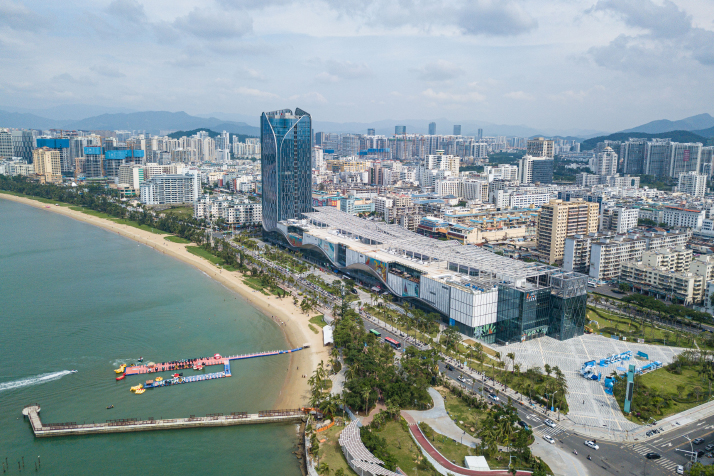
David Adrian Janke, a British citizen operating a translation company in Haikou, capital of Hainan Province in south China, witnessed surging orders as special customs operations got underway in the island province on December 18.
This endeavor is one of the key measures to build Hainan into China’s first free trade port (FTP) by 2035. “It means that Hainan is separated from the traditional domestic customs area and enters a higher level, broader scope and deeper system of liberalization and facilitation, becoming an important experimental field for China’s institutional innovation for global trade,” Zhao Zhongxiu, President of the Beijing-based University of International Business and Economics, told Beijing Review.
Janke echoed Zhao’s views. “The island-wide special customs operations will likely only accelerate the pace of development. With development come opportunities,” he told Beijing Review.
More foreign-invested enterprises
Janke has been living in China since 2007, previously working as an English teacher in Hong Kong Special Administrative Region, Shanghai and Nanjing in Jiangsu Province. In August 2020, two months after China rolled out its master plan to build Hainan into an FTP, Janke relocated to Hainan and continued his teaching career in Qionghai, a city in east Hainan.
Starting up a translation service company had long been Janke’s dream. However, it hadn’t come true due to a lack of startup funding. His dream was reactivated when Janke met an American friend who had started a business in Hainan. It was then that he got to know that the process for foreigners to found their own companies in Hainan is convenient and the corporate tax is just 15 percent, 10 percentage points lower than that in most other provinces in the Chinese mainland.
In January 2022, Janke moved to Haikou and started his own company. “My company is involved in translation, which falls under the category of modern services, one of the four pillar industries in Hainan,” he said. Hainan focuses on a wide array of industries, ranging from its four key industries—tourism, modern services, hi-tech industries and high-efficiency tropical agriculture—to future-oriented industries such as commercial aerospace, plant genetics, and deep-sea science and technology, and consumer sectors like duty-free shopping, education and healthcare.
“These sectors offer a broad platform for career development and entrepreneurial ventures,” Janke said. Thanks to the opportunities brought by the development of the Hainan FTP, his company has received many orders from government agencies and enterprises, which makes him feel like “being in the right industry in the right place at the right time.”
Janke is not alone. According to the Registration Bureau of the Hainan Provincial Market Supervision Administration, as of late August, the number of foreign-invested enterprises in Hainan had reached 10,690, an increase of 13.61 percent compared to the same period last year, with the growth rate ranking first in the country for eight consecutive months. Also, 74 percent of these foreign-invested enterprises were established after June 1, 2020, the day the master plan to build Hainan into an FTP was released.

A new phase
In April 2018, China announced a plan to build Hainan into a pilot free trade zone (FTZ) and then an FTP in a step-by-step and phased manner. China’s pilot FTZs are designated areas where special economic policies and regulations are tested to promote trade liberalization, investment and economic development.
Hainan is not only an island but is also larger than other free trade ports around the world, such as Singapore and Dubai in the United Arab Emirates. Hainan is approximately 35,400 square km in size, 48 times the size of Singapore and 8.6 times the size of Dubai. “This means more space for diversified industrial development, including logistics, trade and deep-sea industries,” Zhao said.
The commencement of special customs operations on December 18 was one of the milestones in the development of the Hainan FTP. The island will be transformed into a special customs supervision zone, implementing a liberation and facilitation policy system characterized by “freer access at the first line, regulated access at the second line and free flows within the island.”
“Freer access at the first line” means treating the border between the Hainan FTP and all other countries and regions outside China’s customs territory as the “first line” and implementing a series of free and convenient entry-exit measures. “By permitting foreign nationals from 86 countries to visit the island visa-free for almost any purpose for up to 30 days, Hainan has created a valuable space for facilitating cultural and talent exchanges, enabling foreign nationals to experience the real China firsthand and, if so inclined, explore potential career opportunities,” Janke said.
Also, after special customs operations got underway, the zero-tariff goods list expanded from 1,900 tariff items, about 21 percent of all tariff items, to more than 6,600 items, about 74 percent of the total.
“Hainan is an island province, which determines the uniqueness of its special customs operations,” Zhao said. He added that the institutional innovations of the Hainan FTP are not limited to facilitating customs clearance; they represent a systemic reform, including zero tariffs, low tax rates, a free and convenient cross-border capital flow mechanism, and a digitalized and intelligent regulatory system. As a result, the Hainan FTP far exceeds traditional FTZs in terms of institutional integrity and openness.
“The special customs operations are expected to significantly reduce the institutional costs of foreign goods flowing into Hainan, enabling Hainan to function as a gateway for global goods,” Zhao said. “At the same time, strict regulation of the second line ensures that possible risks of the FTP do not spill over, safeguarding national tax revenue and market security. The FTP therefore strikes a balance between liberalization and regulation.”
Zhao believes the special customs operation will result in three positive effects: injecting strong momentum into Hainan’s high-quality development, opening broader space for China’s international economic and trade cooperation, and setting an example for China’s high-level opening up.
Regionally, Hainan will play a more prominent role as a gateway connecting the Chinese mainland, Southeast Asia, and the Pacific and Indian Ocean markets. Hainan will serve as a new platform for cooperation between China and the Association of Southeast Asian Nations (ASEAN) as well as other Regional Comprehensive Economic Partnership (RCEP) member countries. The RCEP is a free trade pact comprising the 10 ASEAN member states and five of their major trading partners—China, Japan, the Republic of Korea, Australia and New Zealand.
The Hainan FTP will facilitate the entry of foreign goods and build a more stable regional trade network, Zhao said.
At the same time, the province will foster a business environment that aligns with international standards, attracting global companies to invest in China. Hainan will become a vital channel for global capital to enter China, and its open environment for talent development and cultural interaction will promote the island’s development as a regional tourism, exhibition and cultural hub, Zhao added.
“The Hainan FTP is a comprehensive platform and testing ground for China’s major opening-up initiatives,” Ye Fujing, a researcher with the Beijing-based Academy of Macroeconomic Research, explained.

Challenges
“The province has clearly demonstrated the will and has dedicated the resources required to improve its international services offerings,” Janke said.
He noted that establishing services such as international clinics in hospitals across the island and facilitating work and residence permit applications are an encouraging indication that Hainan intends to go all in on improving the living and working environment for foreign nationals. In terms of the business environment, initiatives such as providing bilingual investment guides are narrowing the gap, making it easier for investors and entrepreneurs to get started in Hainan.
“The Hainan FTP is rapidly developing,” Janke said, adding he has seen new faces from different countries at almost every recent social gathering. “My company has already helped a few foreign nationals set up their own companies here this year.”
However, challenges persist. “To be entirely honest, Hainan still has a long way to go in terms of ‘internationalizing’ its living and business environment,” Janke said.
More accessible talent support policies are needed. “I hope that Hainan can introduce more readily accessible talent support policies for foreign nationals, including offering its own preferential policy for permanent residence, similar to those of other special zones, such as the Lin-gang Special Area of the China (Shanghai) Pilot FTZ in Shanghai and Zhongguancun Science Park in Beijing,” Janke added.
Zhao thinks that besides learning from FTZs and FTPs at home and abroad, Hainan needs to take the initiative to blaze a new trail and become a leader in high-level opening up. “Hainan cannot always follow; it must also have the foresight to lead, knowing where it is headed,” Zhao said. However, at the moment, Hainan’s own capabilities in this regard are insufficient. “More talents and new brains are needed in Hainan,” he added.
As for Janke, becoming a permanent residence holder in Hainan is one of his goals. “I look forward to the day when I finally fulfill the requirements to apply for permanent residence in China,” he said. BR
Special Customs Operations
The Hainan FTP will implement a special supervision model described as “freer access at the first line, regulated access at the second line and free flows within the island.”
The “first line” refers to Hainan’s connection with overseas markets. “Freer access at the first line” allows overseas goods to enter the island more conveniently, with most benefiting from zero tariffs and expedited clearance.
The “second line” refers to the customs boundary between Hainan and the mainland, where goods will undergo standard customs oversight to ensure fairness and prevent smuggling.
The two-tiered customs system enables freer trade between Hainan and areas outside China’s customs borders. –The Daily Mail-Beijing Review news exchange item