

Hi-tech prowess
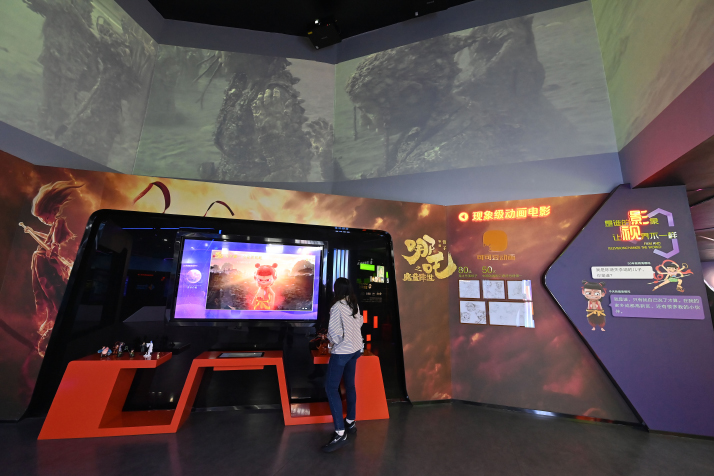
In 2019, Jiaokeli Animation Studio was upgraded from a basic animation team into Cococartoon, a large-scale animation company capable of creating animation films. In the same year, the Tianfu Park was opened. At the end of Nezha 2, a list of 138 Chinese animation companies appear on the screen. Most of them are located in Tianfu Park. Thousand Bird Animation, the studio behind the Nezha 2 character Shen Gongbao, is less than 100 meters from Cococartoon’s doorstep, while Morevfx, which supported the realization of the film’s top-tier special effects, is only five minutes’ walk away. If Cococartoon comes up with a special effects idea, its creative team can walk directly to Morevfx and soon see how their idea plays out. The advantage of being close to each other is that creative ideas can swiftly be realized, which greatly reduces the cost of making mistakes and increases the chance of creation and innovation.
To shore up this industry, this May, Chengdu launched China’s first targeted support program focused specifically on cultivating digital cultural and creative startups, to provide the sector with systematic assistance across space, funding, operational scenarios and talent. Within less than a decade, the Tianfu Park has already grown into a digital cultural and creative base led by gaming and e-sports, animation, film and television, with coordinated development in digital music, ultra-high-definition video, and other sectors, gathering a working staff of around 6,000 people.
Chengdu’s hi-tech stories exist far beyond the digital cultural and creative industry. In July 2023, the Communist Party of China Sichuan Provincial Committee released an official document, intending to promote new-type industrialization and accelerate the growth of a modern industrial system covering nine major industrial clusters like culture and tourism, pharmaceutical and healthcare, advanced energy technology and electronic information.
Chengdu hosts many universities and research institutions and is home to some of China’s leading medical facilities, like West China Hospital of Sichuan University. It thus possesses research capabilities in biomedicine and medical engineering. In September 2021, the construction of the City of Future Medicine was launched in Chengdu Eastern New Area.
Chengdu Tianfu Jincheng Frontier Medical Equipment Research Institute, which is based in the City, is a specialized platform dedicated to the commercialization of medical research achievements and focuses on tackling key medical difficulties and bottlenecks.
Wu Zhe, a professor at the University of Electronic Science and Technology of China and director of the research institute, said in a group interview on November 27 that most of the institute’s technological achievements stem from cooperation with local hospitals, as it mainly provides solutions to clinical medical problems that the hospitals report. Wu said the institute is also working to make smaller, smarter medical devices that can be controlled remotely. He has been working on this for more than a decade and back in his lab in the university, he developed the first micro ultrasonic instrument in China.
Compared with high-end professional ultrasonic instruments, which usually cost millions, the portable ultrasonic instruments developed by this institute, around the size of a cellphone, are much more affordable and convenient to use. The instruments have so far been adopted by a dozen public health centers in the Eastern New Area.
According to professor Wu, the institute’s ultrasonic instruments have been exported to Peru through cooperation with the Pontifical Catholic University of Peru. These instruments are mainly used to examine the health of women in medical stations deep in the Amazon rainforest, and as the instruments are connected through remote means to hospitals in the capital city, images can be examined by professional doctors.
While some of the institute’s research results are already widely used in hospitals, more medical research is underway, which is expected to bring more advanced medical equipment and solutions to health problems.

All-dimensional support
In the summer of 2013, a new team joined the Chengdu Digital New Media Innovation and Incubation Base. It was Cococartoon’s predecessor Jiaokeli Animation Studio. Back at that time, the company only had a few employees, and although they were planning to make the film Nezha1, the team lacked personnel, technology support and especially funding.
Fortunately, the team benefited from Chengdu’s new policy aimed at strengthening startups by offering financing, technology sharing, rent waivers and resources matching.
Dedicated platforms also exist to assist in the commercialization of sci-tech research achievements. The Hi-Tech Zone Hummingbird Pilot Research and Development Technology Service Platform has served more than 500 research teams and enterprises, helping to commercialize over 300 scientific research achievements, and maintaining close collaboration with 28 prestigious universities and research institutes, including Tsinghua University, Sichuan University and the University of Electronic Science and Technology of China. The platform has an in-house research team and also employs outside experts and talents when necessary.
Liu Zixuan, an employee of the platform, explained to Beijing Review how a new material invented by a professor from Sichuan University, which did not sell well at first, became a hit in the market with the platform’s help.
The material, which absorbs and releases carbon dioxide, was initially designed to regulate the content of oxygen and carbon dioxide in vegetable greenhouses, but it was poorly received by the market. When the professor turned to Hummingbird, the latter redesigned the material as a mosquito hunter, as mosquitoes are very sensitive to carbon dioxide. The new product, air suction insecticidal lamp, is very popular with users and was even adopted by Chengdu 2021 FISU World University Games in major venues and the Universiade Village, and also in many parks and residential compounds in Chengdu. “The list of such stories is very long,” said Liu.

A group of international experts visit the exhibition hall of the City of Future Medicine in the Hi-Tech Zone of Chengdu, Sichuan Province, on November 27 (COURTESY PHOTO)
Cherishing talents
Chengdu demands a huge talent pool to fuel its ambition for growth. Between 2022 and 2024, the city attracted more than 1.56 million young talents. Its drawcards include its comfortable and relaxed living environment, lower living costs than major coastal cities, as well as various subsidies and rent waivers for qualified personnel. However, Chengdu appeals not only to Chinese talents. According to the findings of the 2024 survey “Amazing China–the Most Attractive Chinese Cities in the Eyes of Foreign Talents” released by the Foreign Talent Research Center, Ministry of Human Resources and Social Security (MOHRSS), Chengdu ranked the fifth in its appeal for foreign talents, outperformed only by big cities like Beijing, Shanghai, Guangzhou and Hangzhou.
Lutz Gunther Plümer from Germany came to Chengdu in 2018 as a freshly retired professor of Geoinformation and AI at the University of Bonn. Awarded the title of “Academician of the Bavarian Academy of Sciences,” he now serves as an adjunct professor at the Faculty of Geosciences and Engineering in Southwest Jiaotong University, where he led the research of a new vacuum system that, integrated with AI technology, delivers fully automated operation and is applied in cutting-edge fields such as aerospace, aviation and micro-electronics.
“I discovered an unexpected home here in Chengdu–a city that redefined my understanding of progress and belonging,” Plümer said during the Chengdu 2025 Foreign Experts Symposium in November. “The people here embody a rare balance: open-hearted toward foreigners like myself, fiercely hardworking, yet always making time for life’s joys.”
He said that he has made it a mission to bridge the gap between his countrymen’s perception of Chengdu and the reality. “At lectures in German universities… I’ve shown my audiences a Chengdu they never imagined: a city where ancient teahouses sit beside AI startups, where high-speed rail feels like the future, and where ‘developing country’ simply doesn’t seem to fit.”
Matt Vegh, a Canadian national, is now the chairman of Confluence Universe, a Canadian company working in the field of Quantum AI. He came to China in the early 2000s, serving as the director of the Chengdu branch of a Canadian business in Shanghai. Since then, he has lived, worked and collaborated with a number of companies in Chengdu.
“The city excels in two essential paradigms: trust and livability. These are the conditions that allow foreigners to stay for 10 or 20 years, build families, and contribute their best ideas,” Vegh said during in the Foreign Experts Symposium.
When talking about his experience in Chengdu, Vegh told Beijing Review that he is proud to have been a founding foreign editor of Chengdu Daily in 2001 and to have five of his works published in China. He has also authored a white paper for the Chengdu Municipal Government.
During the symposium, Xu Jiajun, Deputy Director of the Foreign Talent Research Center of the MOHRSS, told attendees, “International talents have made essential and indispensable contributions to China’s modernization. It is precisely through their participation that China can better build itself into a global sci-tech powerhouse. At the same time, China’s modernization drive also offers a wide platform for international talents. We are drawn to each other and are achieving success in tandem.” –The Daily Mail-Beijing Review news exchange item