A bull market continued its slow but steady emergence in China’s A-share market in January, propelled by robust trading activity, rebounding investor confidence and sustained capital inflows from last year.
A-shares are the stocks of companies incorporated on the Chinese mainland and listed on mainland stock exchanges. In mid-2025, the A-share market achieved a historic milestone by exceeding a total market capitalization of 100 trillion yuan ($14.3 trillion), securing its position as the world’s second largest equity market. The annual turnover of the market surpassed 400 trillion yuan ($57.4 trillion) last year.
In 2025, China’s annual GDP reached 140.19 trillion yuan ($20.1 trillion), up 5 percent year on year, according to the National Bureau of Statistics. Facing mounting challenges at home and abroad, China has pledged to adopt more proactive and effective macro policies this year.
He Feng, a professor at the Capital University of Economics and Business School of Finance, told Beijing Review that China’s complete manufacturing system and emerging new sectors have sharpened its competitive edges.
Notably, despite a notable rebound in 2025, valuations of A-shares remain lower compared to those of major global stock markets. “That suggests the rally is not driven by investor sentiment, but rather by a rational upturn built upon economic recovery and the correction of prior valuations,” He said.
Optimized market
According to He, the bull market is underpinned by renewed valuation fundamentals for A-shares, as China’s economic drivers shift from real estate and traditional infrastructure to advanced manufacturing, the digital economy and technological innovation.
The reform of the capital market system also improves market expectations by optimizing fundraising and investment functions, and mechanisms for medium- to long-term capital inflows, He said.
China has been steadily expanding institutional opening up of its capital market during the 14th Five-Year Plan (2021-25) period to facilitate foreign investment and promote financial opening up. Over this period, the number of foreign-controlled securities, funds and futures companies increased markedly.
The number of qualified foreign institutional investors (QFIIs) had expanded to almost 907 by the end of August in 2025, with their holdings of Chinese shares valued at around 949.3 billion yuan ($133.6 billion). The QFII program, introduced in 2002, allows licensed overseas investors to invest in the Chinese mainland’s capital market.
On January 23, the China Securities Regulatory Commission (CSRC), the country’s top securities regulator, announced that it had expanded access for overseas investors to 14 new futures and options varieties in China’s futures market.
The newly added specific domestic varieties include nickel futures and options on the Shanghai Futures Exchange, lithium carbonate futures and options on the Guangzhou Futures Exchange in Guangdong Province, the CSRC said.
“The move indicates deeper opening up of China’s capital market. This opening up is backed up by China’s industrial foundation appealing to international participation in China’s futures market,” He said.
As foreign investor participation grows, Chinese futures prices are set to become key barometers of global supply-demand dynamics and market expectations. This shift will significantly enhance China’s influence over global commodity pricing, He said.

Two-way connection
During the 14th Five-Year Plan period, the CSRC rolled out measures to bolster the role of Hong Kong Special Administrative Region as an international financial center, while optimizing mechanisms such as Stock Connect, a two-way trading link between Chinese mainland and Hong Kong stock markets, which was introduced in November 2014.
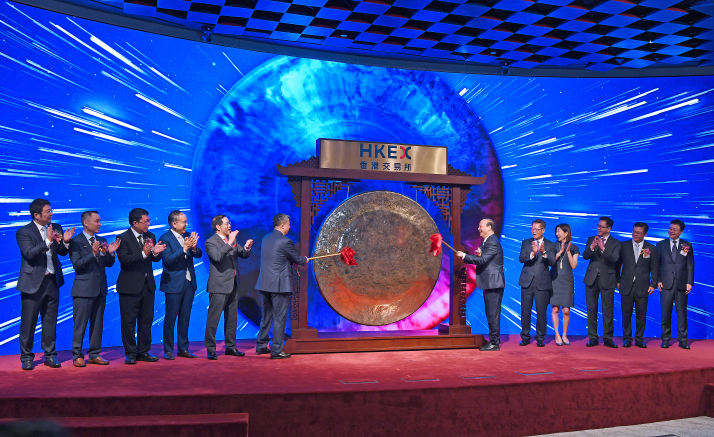
“The strong growth momentum of the Hong Kong stock market last year is expected to continue in 2026,” Gregory Yu, head of markets with Hong Kong Exchanges and Clearing Ltd. (HKEX), told media during the 2026 annual meeting of the World Economic Forum, convened from January 19 to 23 in the Swiss Alpine town of Davos. HKEX owns the Stock Exchange of Hong Kong Ltd. (SEHK), the region’s stock exchange.
In 2025, a total of 119 companies were newly listed on the SEHK, up 68 percent from 2024. Fundraising through initial public offerings (IPOs) exceeded 285.8 billion Hong Kong dollars ($36.6 billion), the highest of any stock exchange worldwide in 2025.
Yu noted that the heightened attention from international investors toward Hong Kong-listed companies, particularly in the biotech and AI sectors, contributed to the recovery last year.
“International investors are looking to diversify their global investment portfolios, and the Hong Kong stock market, with its innovative dynamism, is appealing,” Yu said.
According to Yu, companies from Thailand, Singapore and Middle Eastern countries were listed on the SEHK in 2025, and the trend has become even more pronounced in early 2026. Over 300 companies were queuing for listing as of January, including many multinational firms.
Yu pointed out that international investors’ interest in investing in the Chinese mainland market through the SEHK is also growing. In January, the trading volume through Stock Connect reached the second highest monthly level since the mechanism was launched.
With the listing applications, IPO fundraising in Hong Kong will reach at least 300 billion Hong Kong dollars ($38.4 billion) this year, consulting firm Deloitte China projected.
“Stock Connect, increased mainland investment in Hong Kong equities and a rise in yuan-denominated trading in the Hong Kong stock market have strengthened the region’s role in cross-border capital flows and the internationalization of the yuan,” He said.
In light of economic upgrading and the sustained inflow of medium- to long-term capital, Hong Kong’s capital market is expected to maintain its critical function within the international financial system, He said.
Shields for risks
Looking into 2026, external policy uncertainties, diminished expectations for AI-driven productivity gains and geopolitical tensions still pose challenges to growth of the A-share market, Fu Yifu, a researcher with Suzhou City Commercial Bank in Suzhou, Jiangsu Province, wrote in an article published on news portal Yicai in January.
But Fu is optimistic that stocks in hi-tech sectors ranging from AI to commercial aerospace have much room for growth. Emerging consumption, bolstered by targeted policy stimulus, is poised to become a significant catalyst for the A-share market’s upward momentum.
He highlighted the need to enhance the role of the capital market in channeling funds to the real economy. According to him, China should improve the multi-tiered market system and institutional arrangements to support technological innovation, green transformation and industrial upgrading.
The mechanisms for dividend payout, share buybacks and corporate governance should also be optimized to provide sustainable support for the real economy, He said.
On retaining foreign investment, He noted that expanding investment channels alone is inadequate. He called for more transparent and predictable regulatory policies and mechanisms to facilitate foreign investor’s long-term participation in stock, bond and derivatives markets, and make account opening, trading and settlement more convenient.
“The regulatory authorities should also enhance the monitoring and early-warning mechanisms in order to guard against risks stemming from cross-border capital flows, abnormal trading activities and cross-contagion between international stock markets,” He said. –The Daily Mail-Beijing Review news exchange item