BEIJING: As the Philippines has recently stepped up efforts to play up the 10-year mark of the so-called 2016 “South China Sea arbitration” ruling, Philippine President Ferdinand Marcos Jr and Canadian Prime Minister Mark Carney reportedly referred to South China Sea issues and “reaffirmed” support for a “free and open Indo-Pacific grounded in international law” in a joint statement issued during Marcos’ visit to Canada. Chinese experts said the South China Sea references are largely symbolic, warning that Manila’s continued introduction of external forces is intensifying major-power rivalry, and that the Philippines would be among the first to bear the cost should friction escalate in the South China Sea.
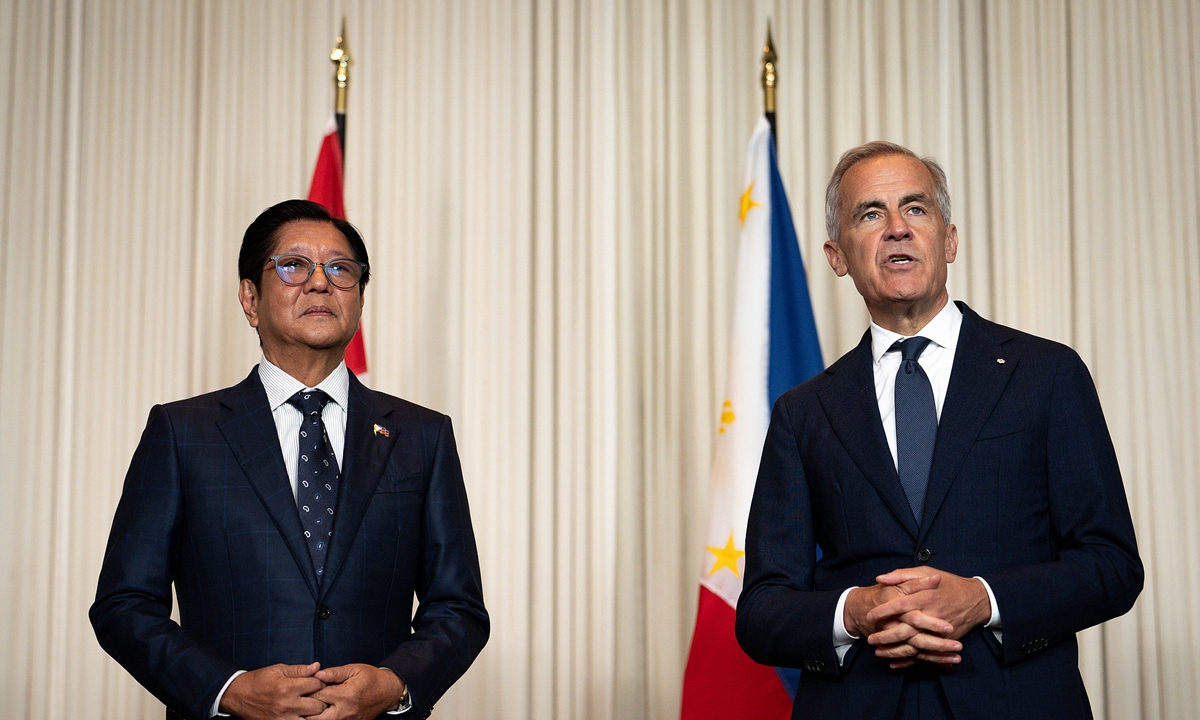
Marcos on Thursday Canada time thanked Canada for its continued support for a rules-based order in the South China Sea (SCS) and for recognizing the 2016 arbitral tribunal award as final and legally binding, according to a report from Inquirer.net.
Marcos is paying an official visit to Canada from July 1 to 4. Invited by Carney to visit Vancouver during the 2026 FIFA World Cup, which Canada is co-hosting, Marcos became the first Philippine president to visit the country in 11 years, per Inquirer.net.
After Thursday’s meeting, the two leaders released a joint statement in which they agreed to upgrade Canada-Philippines relations to a strategic partnership. The statement also claimed that, in addressing “shared challenges”, the two leaders “reaffirmed their shared commitment” to a “free and open Indo-Pacific” grounded in international law and reiterated support for the so-called “South China Sea arbitration.”
Marcos’ visit has a clear political agenda: to use the 10-year mark of the so-called “South China Sea arbitration” ruling to rally international support, as Manila intensifies efforts to push its maritime narrative and elevate the ruling’s standing in international law. The Canada stop is likely only a part of a broader, coordinated publicity campaign ahead of the date, Chen Xiangmiao, a research fellow at the National Institute for South China Sea Studies, told the Global Times on Friday.
By leaning on Western partners such as Canada, the Philippines is trying to magnify its own narrative on the South China Sea, attempting to use diplomatic pressure and maritime operations in tandem to keep regional disputes in the spotlight, said Chen.
The Philippine side recently hyped up the so-called “South China Sea arbitration” issue again. For example, in late June, its foreign affairs department issued a “rejection” of China’s position and certain individuals criticized the Chinese Embassy. The embassy had reiterated that the arbitration was a political farce disguised in legal clothing, and that the so-called award is illegal, null and void.
The Philippines’ recent frequent hype over South China Sea-related issues exposes its anxiety at the domestic political level and reveals its calculation to drag the South China Sea disputes onto various multilateral platforms and deliberately poison the situation in the region, Ding Duo, director of the Research Center for International and Regional Issues at the National Institute for South China Sea Studies, told the Global Times previously.
“No matter how the Philippines stages different forms of international publicity shows, it cannot confer legitimacy on an invalid ruling that was unilaterally engineered without China’s consent. Nor can it whitewash the Philippines’ series of maritime provocations that undermine peace and stability in the South China Sea. In the end, such moves will only invite stronger and stricter legitimate countermeasures from China,” Ding said. –The Daily Mail-Global Times news exchange item