

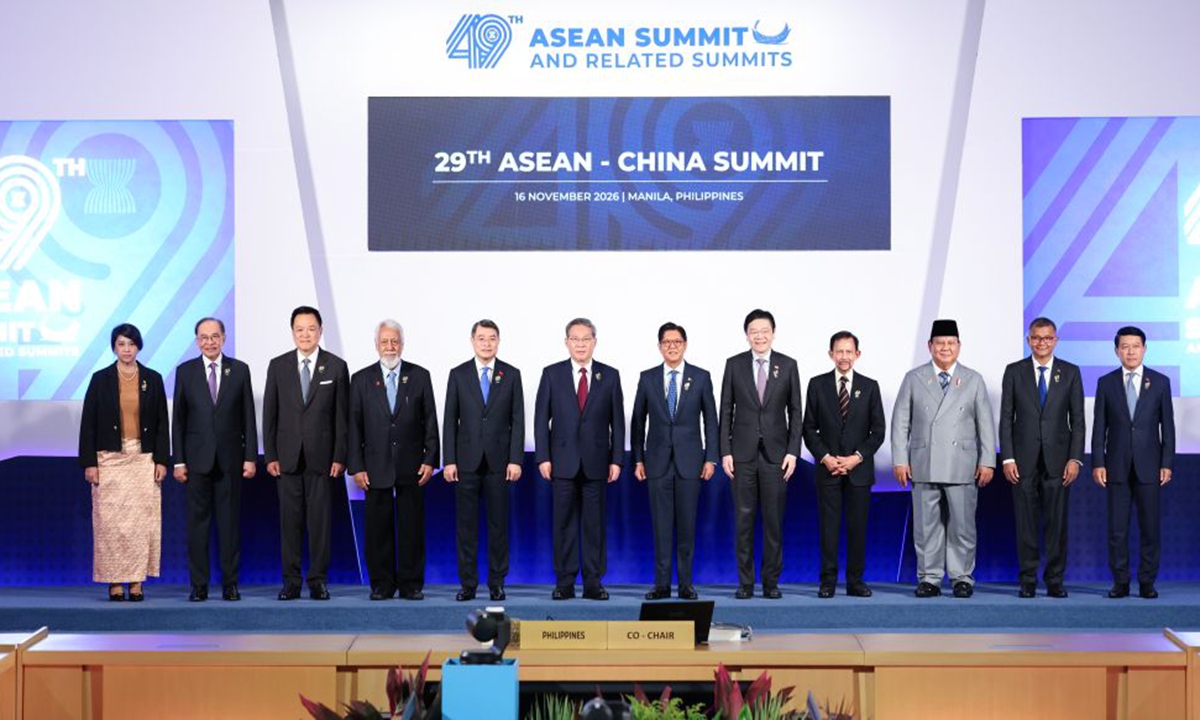
BEIJING: At the 29th China-ASEAN Summit in Manila, Chinese Premier Li Qiang said on Monday that this year marks the fifth anniversary of the establishment of the China-ASEAN comprehensive strategic partnership. Over the past five years, the world has witnessed a growing trend of unilateralism and protectionism, while geopolitical conflicts have flared up one after another. Against this backdrop, China-ASEAN cooperation has forged ahead, achieving both quantitative growth and qualitative improvements, with cooperation mechanisms further consolidated and connectivity steadily enhanced, he said.
Li urged China and ASEAN countries to protect and develop their common home, injecting greater stability and certainty into the development and prosperity of the global village, Xinhua News Agency reported.
Commending the fruitful outcomes achieved over the five years since the establishment of the ASEAN-China comprehensive strategic partnership, leaders of ASEAN countries expressed readiness to strengthen strategic communication and political mutual trust with China, fully implement the ASEAN-China Free Trade Area (FTA) 3.0 Upgrade Protocol, and deepen cooperation in areas including economy and trade, connectivity, AI, clean energy, digital economy and combating transnational crime.
It was announced during the meeting that the China-ASEAN FTA 3.0 Upgrade Protocol will enter into force on December 1, 2026, and 2027 has been designated as the Year of AI cooperation. Outcome documents were released, covering the fifth anniversary of the China-ASEAN comprehensive strategic partnership, energy partnership building, and deeper forestry cooperation, the Xinhua News Agency reported.
Li said that China is ready to work with ASEAN to ensure the success of the Year of AI cooperation in 2027, and China is willing to carry out “AI plus” cooperation with ASEAN, and build a strong engine for high-quality regional economic development.
The two sides have already built a strong track record of cooperation in AI. For example, in China’s Guangxi Zhuang Autonomous Region’s border city Chongzuo, the center for disease control and prevention has partnered with neighboring Vietnamese provinces to deploy a bilingual AI platform for early disease detection, per Xinhua.
In Laos and Cambodia, for example, a platform developed by local partners together with an enterprise from Guangxi has started to use satellite imagery, drones and ground sensors to optimize tropical crop cultivation.
“AI is a new area of China-ASEAN cooperation, and the implementation of the China-ASEAN Free Trade Area 3.0 Upgrade Protocol arrangements is expected to further advance it,” Xu Liping, Director of the Center for Southeast Asian Studies at the Chinese Academy of Social Sciences, told the Global Times. China has strengths in AI research and development and technology integration, while ASEAN offers broad application scenarios, creating strong potential for cooperation.
Xu said that AI can also enhance traditional logistics by improving transportation and management efficiency, while its application in education can help improve teaching quality.
Ultimately, expanding practical AI applications will create more development opportunities for ASEAN countries.
AI governance is another key area. ASEAN countries can actively participate in China’s efforts to advance international AI governance mechanisms, as AI applications and governance are expected to be two major areas for future breakthroughs in China-ASEAN cooperation, Xu added.
“Talent development and exchanges can take the lead, laying the groundwork for deeper cooperation. With priorities already clear, the key is for both sides to work together to turn plans into concrete results,” he said.
Chinese Premier Li said China looks forward to the early conclusion of a Code of Conduct (COC) in the South China Sea, which will provide a solid institutional guarantee for lasting peace and stability in the South China Sea, according to Xinhua.
Philippine Foreign Affairs Secretary Ma. Theresa Lazaro said on Sunday that negotiators are now entering the final phase of talks for a COC in the South China Sea, as 80 percent of the draft has reached “provisional agreement” among parties, according to the Philippine News Agency (PNA).
Reaching agreement on around 80 percent of the text is no easy feat, said Xu. Key obstacles for the current negotiation include interference from certain countries outside the region, which seek to expand their voice and influence on the South China Sea issue, as well as differences over how to manage disputed waters, the expert noted.
The South China Sea issue, Xu said, should be addressed through a “dual-track approach”, as China and ASEAN countries jointly safeguard peace and stability in the South China Sea, while specific island and reef disputes are resolved through friendly consultations between China and the relevant countries. –The Daily Mail-Global Times news exchange item