
BEIJING: Just days after China’s newly revised regulations on funeral and interment management took effect on March 30, advocating civilized, low-carbon, and safe tomb-sweeping practices, the China Funeral and Burial Network, developed under the guidance of the Ministry of Civil Affairs, officially went live on Sunday, the Qingming Festival.
The platform integrates resources nationwide across funeral services, burial arrangements, and memorial rituals. It is said to boost low-carbon tomb-sweeping practices in China, according to Xinhua News Agency.
Qingming Festival, or Tomb Sweeping Day, is a traditional Chinese festival during which people pay tribute to the dead and worship their ancestors. Traditionally, people in China honor their departed loved ones during Qingming by visiting graves, hanging ceremonial paper streamers, burning incense and paper offerings, and setting off firecrackers.
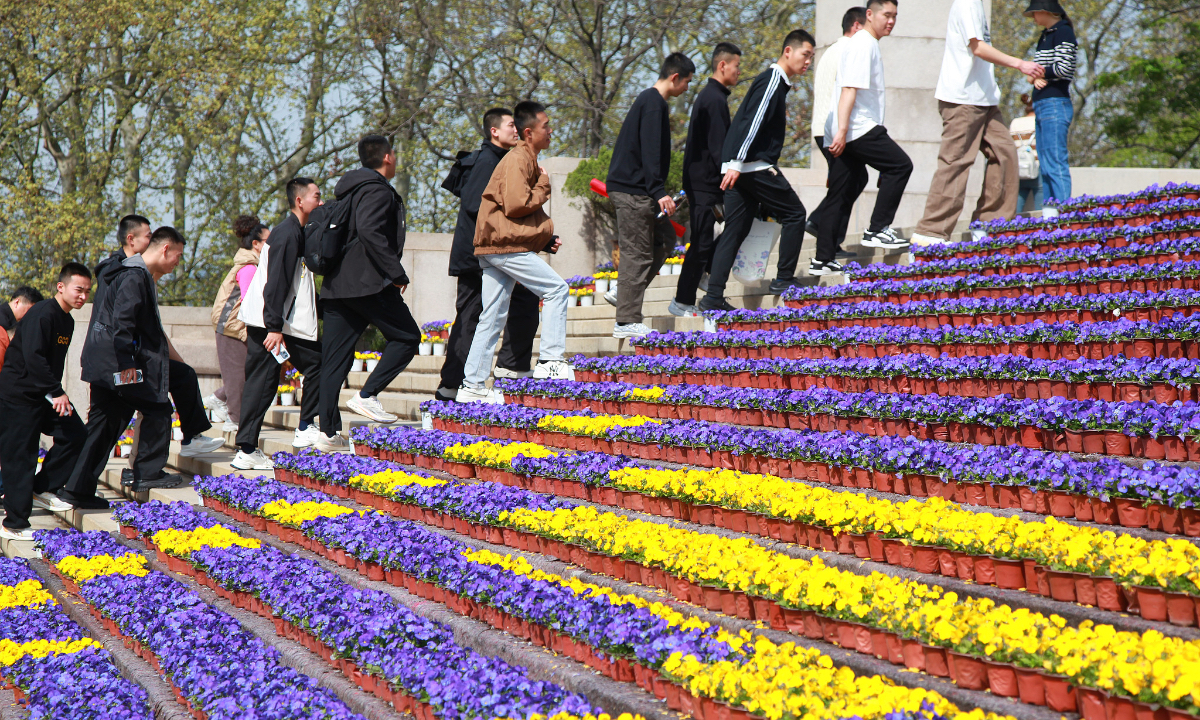
During this year’s Qingming Festival, low-carbon and safe tomb-sweeping practices are gradually taking root across urban and rural China – marked by a shift from burning incense and paper money to expressing sentiments with fresh flowers, and from on-site memorials to online tributes.
Latest data from the country’s Ministry of Civil Affairs showed that on Sunday alone, a total of 66,200 funeral and burial service institutions nationwide provided on-site memorial services. A total of 30.734 million people visited cemeteries to pay respects to their ancestors. Among them, 19.5786 million people chose green and low-carbon memorial methods such as flower offerings, accounting for 63.7 percent of the total on-site mourners.
Additionally, 859 online memorial platforms served 353,800 participants. On the same day, funeral institutions handled the interment of 19,258 sets of cremated remains, of which 1,281 were disposed of through ecological burial methods such as sea burials or tree burials, representing 6.65 percent of the total interments, the ministry said.
In Southwest China’s Guizhou Province, at the Fuzeyuan Cemetery in Guiyang, a dedicated exchange point has been set up at the entrance where visitors can swap paper money for fresh flowers. Inside the cemetery, there is no trace of firecracker residue — only flowers and greenery can be seen, according to Guizhou Daily.
In Bijie city, staff distribute fresh flowers free of charge, guiding the public toward more civilized tomb-sweeping practices. In Qiannan Buyi and Miao Autonomous Prefecture, local flower shops prominently display yellow chrysanthemums, white chrysanthemums, lilies, and other flowers commonly used for tomb-sweeping; many shops have even introduced special bouquet sets for the occasion, making it convenient for citizens to make their selections, Guizhou Daily reported.
Citing Guizhou Provincial Department of Civil Affairs, the local media wrote that on Saturday, nearly 158,000 people visited cemeteries across Guizhou to honor their ancestors, with 90 percent opting for green, low-carbon tomb-sweeping practices. Meanwhile, 11 online memorial platforms have helped connect people with their loved ones across distances.
The digital shift is also reflected in industry data. Data from China’s The Cover showed that China is currently home to over 9,400 active cloud memorial service companies. Notably, around 1,000 new firms have already been registered in 2026 alone. Basic features such as virtual flowers, electronic candles, and online messages have become standard offerings.
In Xining, the capital city of Northwest China’s Qinghai Province, major cemeteries and burial grounds in the city have strictly implemented smoke-free tomb-sweeping practices, completely banning the burning of paper money and the setting off of firecrackers, according to Xining Evening Post.
Local citizens have embraced the shift — using fresh flowers instead of paper money, offering written messages in place of burning incense, and conscientiously placing ritual items in designated areas, the report said.
“Residents are very cooperative now — they voluntarily bring flowers, refrain from burning paper, and avoid smoking. The level of civility is getting higher,” a staff member at the Xining Martyrs’ Cemetery told Xining Evening Post.
Meanwhile, it has been a decade since China’s Ministry of Civil Affairs and eight other government departments jointly issued a document in 2016 promoting land-saving and ecological burials. Green burial methods such as sea burials, tree burials, flower burials, and lawn burials have steadily gained acceptance, offering more compassionate and diverse options for people to honor their deceased loved ones, China Central Television (CCTV) reported.
To date, 28 provinces across China have introduced subsidy policies for land-saving and ecological burials. After ten years of exploration, ecological burial is steadily taking root, the CCTV report said. –The Daily Mail-Global Times news exchange item