
In 2025, the Chinese economy passed another milestone, topping 140 trillion yuan ($20 trillion). The National Bureau of Statistics (NBS) made the announcement on January 19, alongside the release of other major full-year economic indicators for the world’s second largest economy. China’s annual GDP reached 140.19 trillion yuan ($20.01 trillion), up 5 percent year on year, in line with official target.
Facing abrupt changes in the external environment and mounting domestic difficulties and challenges, China adopted more proactive and effective macro policies, Kang Yi, head of the NBS, said at a press conference that day, adding this approach has helped offset adverse external shocks and stabilize the foundation for development.
“For a super-large economy like China, achieving such stable development amid intertwined risks and challenges is by no means easy,” Kang noted.
“This achievement demonstrates remarkable resilience and vitality of the Chinese economy,” Xu Hongcai, Deputy Director of the China Association of Policy Science’s Economic Policy Committee, told Beijing Review.
Taking a multi-year view, during the 14th Five-Year Plan (2021-25) period, China’s GDP successively crossed the thresholds of 110 trillion yuan, 120 trillion yuan, 130 trillion yuan and 140 trillion yuan. The economy grew at an average annual rate of 5.4 percent over the past five years and per-capita GDP has exceeded $13,000 for three consecutive years. “An increase of 40 trillion yuan—equivalent to more than $5.7 trillion—is roughly the size of the world’s third largest economy,” Xu stressed.
“China’s economic growth rate ranks among the highest of the major economies. It is the most stable and reliable engine of global economic growth, and its contribution to world economic growth is expected to reach around 30 percent [in 2025],” Kang said.
High-quality development
Kang defined China’s 2025 economic performance through four main characteristics:
Stability has been further consolidated. The value added of industrial enterprises above the designated size, those with annual main business revenue exceeding 20 million yuan ($2.87 million), increased by 5.9 percent year on year. China’s trade in goods reached a new record high, and foreign exchange reserves exceeded $3.3 trillion.
Progress has gathered strong momentum. Final consumption expenditure contributed more than half of economic growth, while the per-capita disposable income of residents grew by 5 percent after allowing for inflation, keeping pace with overall economic expansion.
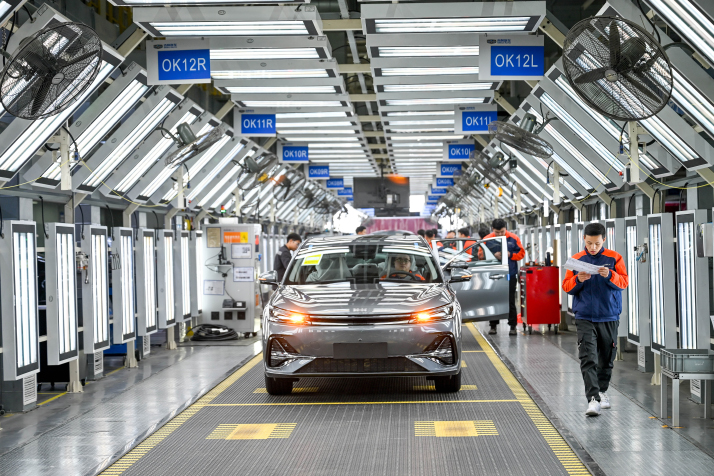
New drivers of growth have gained strength. Value added of digital product manufacturing enterprises above the designated size increased by 9.3 percent year on year. Green electricity, green energy and the green economy expanded rapidly, with new-energy vehicles (NEVs) constituting more than 50 percent of domestic new car sales.
Resilience has continued to improve. Despite severe disruptions to the global economic and trade order, and growing challenges associated with the transition from old to new growth drivers at home, China’s economy achieved both a “quantitative leap” and a “qualitative improvement.” Trade diversification gained momentum. China has become a major trading partner of more than 150 countries and regions, and exports of hi-tech products rose by 13.2 percent from the previous year.
“The performance across these four areas offers a true reflection of the solid foundation, multiple strengths, strong resilience and vast potential of China’s economy,” Kang said. “It has strengthened our confidence and resolve for development.”
Despite the growing number of external disruptions over the past five years, well-targeted macroeconomic policies and their sustained effects have provided critical support for stable economic performance, according to Xu. “In particular, since September 2024, a coordinated package of stimulus policies has been implemented in concert, playing a positive role in stabilizing market expectations, boosting investor confidence and supporting a recovery in consumption,” he said.
In 2025, policymakers reinforced this recovery with a slew of pro-consumption measures throughout the year, including a 500-billion-yuan ($71.5-billion) re-lending facility aimed at boosting service consumption and elderly care, alongside a nationwide initiative funded by ultra-long special treasury bonds to support consumer goods trade-ins.
The People’s Bank of China, the central bank, also cut the reserve requirement ratio, the share of deposits lenders must put aside with the central bank, for commercial banks by 0.5 of a percentage point and lowered a key policy interest rate by 0.1 of a percentage point, moves aimed at reducing financing costs and maintaining ample liquidity. On the fiscal side, China issued 1.3 trillion yuan ($180 billion) in ultra-long special treasury bonds and established new policy tools to energize investment.

Creating new engines
“We are in the midst of a new wave of global scientific and technological revolution, with frontier technologies such as AI being widely applied. China’s innovation capacity has been continuously rising in global rankings, reflecting the accelerated formation of new quality productive forces,” Xu said. With innovation playing the leading role, new quality productive forces are strategic emerging industries that feature high technology, high efficiency and high quality, and are in line with China’s new development philosophy that underscores innovation, coordination, green growth, openness and benefits for all.
China already ranks among the world’s leading players in many innovative fields. “For example, the production, sales and exports of NEVs have consistently remained No.1 globally. AI technologies are being widely applied and the share of the digital economy in the GDP continues to grow,” Xu added.
In 2025, China’s research and development (R&D) investment intensity, or the ratio of its R&D expenditure to GDP, reached 2.8 percent, up by 0.11 of a percentage point from the previous year, surpassing for the first time the average level of Organization of Economic Cooperation and Development (OECD) countries, according to Kang. The majority of OECD members are generally considered developed countries. In another first, China made its debut in the top 10 of the World Intellectual Property Organization’s Global Innovation Index.
As China continued its transition toward domestic demand being the main engine of economic growth, consumption played a more pronounced ballast role. In 2025, total retail sales of consumer goods exceeded 50 trillion yuan ($7.1 trillion), retail sales of services grew by 5.5 percent, and final consumption expenditure contributed 52 percent of economic growth.
Aiming to sustain this momentum and further unleash the potential of domestic demand, the Ministry of Finance will optimize and extend existing interest subsidy policies for loans to business entities in the services sector and for personal consumption loans to the end of 2026. For example, the personal consumption loan subsidy policy will include credit card installment services, removing sectoral restrictions.
China will continue to pursue a more proactive fiscal policy in 2026, in line with the plans and decisions of the Central Economic Work Conference in December 2025, which outlined development priorities for this year. “In 2026, China’s fiscal deficit, total debt and overall expenditure will be maintained at necessary levels, so as to ensure that the intensity of total fiscal spending only increases and the guarantees for key sectors remain consistently strong,” Liao Min, Vice Minister of Finance, said at a press conference on January 20.
Liao said the Ministry of Finance will strive to maximize the effectiveness of every yuan spent. In 2026, ultra-long special treasury bonds will continue to be issued to support major national strategies and building security capacity in key areas as well as large-scale equipment upgrades and consumer goods trade-in programs.
Xu called for greater efforts to boost consumption. “The root cause of insufficient domestic demand lies in weak household confidence and low overall incomes among urban and rural residents, which constrain the consumption capacity of some groups,” he said.
Moreover, the supply of high‑quality, high value‑added goods and services, particularly in areas such as elderly care and healthcare, remains short of demand. “The structural mismatch between supply and demand urgently needs to be addressed,” Xu said.
Long-term prospects
As the first year of the 15th Five‑Year Plan (2026-30) period and the start of a new chapter for China’s economy, 2026 has opened on an encouraging upward trend.
For example, during the New Year’s Day holiday from January 1 to 3, 142 million domestic trips were made and total domestic tourism spending exceeded 84.7 billion yuan ($12 billion). The Hainan Free Trade Port has just marked one month since the launch of island-wide special customs operations on December 18, 2025, with offshore duty‑free sales hitting 4.86 billion yuan ($698 million) and more than 5,000 new foreign trade companies registered during the period. Under special customs operations, goods entering or leaving Hainan, unless destined for any place on the Chinese mainland, will be subject to fewer customs checks and potentially lower or no tariffs.
“When observing China’s economy, we must look not only at its current form, but also at its long‑term trajectory. Looking at the whole of 2026, the fundamental conditions and underlying trend supporting China’s long‑term economic growth, and the overarching momentum of high‑quality development all remain unchanged. We have the foundation and the conditions to keep the economy running in a stable and positive manner,” Kang said.
Recently, several institutions have released reports, raising their economic growth forecasts for China and maintaining an “overweight” rating on Chinese assets. For example, Goldman Sachs Research expects China’s real GDP to grow by 4.8 percent in 2026, above the consensus of economist estimates of 4.5 percent.
Xu remains cautiously optimistic about China’s economic growth in 2026 and throughout the 15th Five-Year Plan period. “In the next five years, the average annual economic growth rate is expected to remain in the range of 4.5 percent to 5 percent,” he said.
Xu suggests that macroeconomic policies should remain stable and consistent. For example, long-term government bonds and other instruments should continue to be leveraged to boost consumption, improve people’s livelihoods and mitigate local government debt risks. More importantly, all policies must be implemented in a coordinated manner.
While strengthening internal capabilities, China must address external challenges in a flexible and pragmatic way and continue to expand international cooperation to foster a more favorable external environment for development, Xu added. –The Daily Mail-Beijing Review news exchange item