
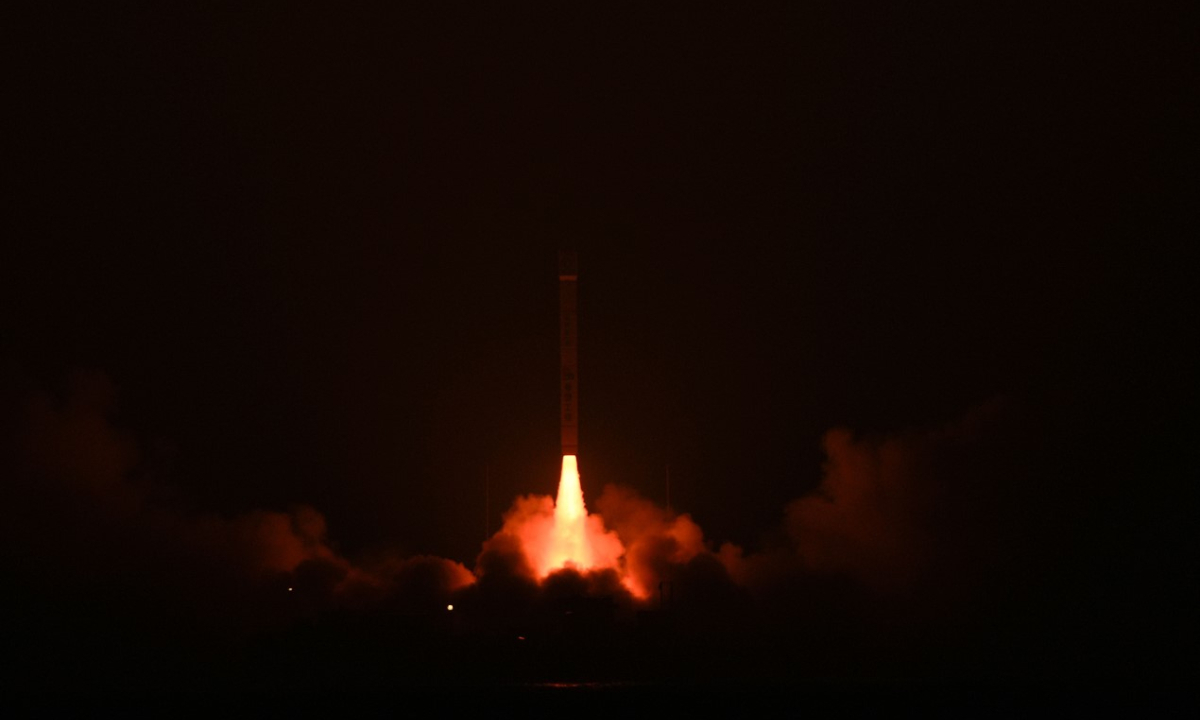
BEIJING: China launched a group of satellites from the waters near its eastern Shandong Province on Friday morning, marking the country’s first sea-based launch in the new year. The commercial rocket, CERES-1 Y7, carrying four satellites for the Tianqi constellation, blasted off at 4:10 a.m., and sent them into the preset orbit.
CERES-1, developed by the Beijing-based commercial rocket maker Galactic Energy, is a small, solid-propellant rocket designed for sending micro-satellites to low-Earth orbit (LEO). The sea launch model has successfully conducted six maritime launch missions since its maiden flight on September 5, 2023. To date, the company has carried out 21 commercial launch deliveries, placing a total of 89 commercial satellites with diverse functions into planned orbits. The Tianqi constellation is China’s first LEO IoT data communication constellation, featuring global coverage, miniaturization, low power consumption and cost-effectiveness. It can provide consumer-grade satellite IoT data services to global users, covering space, air, ground and sea.
It has been widely applied in industries such as forestry, agriculture, emergency response, tourism, water conservancy, electric power, oil, marine, ecological environment, smart cities and the digital economy. The offshore mission was conducted by the Taiyuan Satellite Launch Center, and was the 23rd flight mission by the CERES-1 carrier rocket.
The latest launch acts as an enhancement mission for this constellation. It follows the completion of its first-phase global network deployment by the CERES-1 Y5 rocket on May 19, 2025. With this launch, the Tianqi constellation enters a new stage characterized by the large-scale application and ecosystem-driven growth of China’s next-generation satellite communication services. –The Daily Mail-CGTN news exchange item