
“The work we do allows for the full, free and all-round development of people’s natural and social attributes,” Huang Binling, co-founder of Sketch Action Studio, a company established in Shenzhen, Guangdong Province, that is mainly engaged in community design and development, told Beijing Review.
Born in 1992, Huang spent his childhood in an urban village in Shenzhen’s Longhua District with his parents, who worked in the city, making trips between there and his hometown in Shaoyang, Hunan Province, like “migrating birds.” Urban villages, or chengzhongcun, are villages that have been engulfed by urban expansion, but maintain their decades-old infrastructure despite the surrounding modernity.
After completing his master’s degree in landscape design at Peking University (PKU) in Beijing in 2020, Huang returned to Longhua and co-founded the studio together with his PKU classmate Yuan Zhenyu, aiming to collaboratively remodel urban villages with their residents.
For a long time, the renewal of urban villages in China followed the “demolition and reconstruction” approach, where old buildings were flattened and new communities sprang up. Government efforts to instead modernize these areas and increase the living standards of their residents began to accelerate in 2023. Huang’s story unfolds against this backdrop.
Community governance
During his studies at PKU, Huang experimented with transforming small, abandoned spaces. In the spring of 2016, he, together with Yuan and without spending a penny, used sickles and hoes to remove weeds, plant flowers, and pave paths, turning over 100 square meters of deserted land on the campus into a small and dreamy garden they named “Kindergarten.”
“The campus is essentially a prototype of a residential community. After graduation, we wanted to explore whether these methods could be applied to residential communities because they are the smallest unit of urban governance. We needed to apply the method in real-life situations,” Huang said.
In 2020, recognizing the achievements of pilots they undertook on the PKU campus and in residential communities in Beijing, the Longhua District Government invited them to Dahe, an urban village, to take up the challenge of community development there.
In Dahe, Huang noticed there were so many motor vehicles parked in the public spaces that children were confined to playing in the narrow areas in front of doorways and the elderly were forced to sit and converse on the steps of shopfronts. Expanding the public space for residents became their starting point. However, creating their Kindergarten in college was different from creating a new space within an existing community; resident needs and interests were diverse, requiring the team to solicit opinions door to door while actively seeking solutions or guiding residents to change their perceptions.
Through negotiations, the owner of a dessert shop, Minmin, offered her long-closed courtyard to be used as a space to build a park. Social workers and Sketch Action Studio members collaborated with residents in the design, creating “Weiwei Park,” named after the shop owner’s son. Following the construction, the park featured children’s play equipment, seating, and, borrowing an idea from the children themselves, a chimney painted to resemble a colorful giraffe. Additionally, they designated parking areas to make residents’ parking more orderly.
“The fundamental principle of community development is to put residents’ needs first,” Huang said. “China is working to improve the social governance system based on collaboration, participation and benefit sharing. Our efforts align with this objective.”
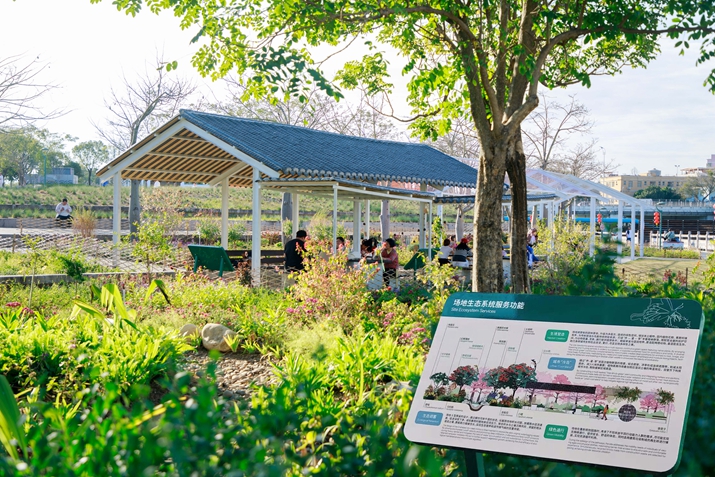
Shiyan River Mini Park, a resilient community pilot project in Shenzhen(COURTESY PHOTO)
City updates
In October 2025, at the American Society of Landscape Architects’ Annual Meeting in Washington, D.C., Huang and Yuan shared Shenzhen’s community development practices, surprising international colleagues with China’s efficiency.
“Seattle took 50 years to build 60 community gardens, while Shenzhen built 600 in five years,” Huang noted. “This is an example of Shenzhen speed.”
However, Huang also pointed out the need for reflection behind such speed. “Strong community ties in the United States and European countries have been forged over the course of decades. Now that China has rapidly narrowed physical infrastructure gaps, the next step is to slow the pace of urban life and make cities more livable and truly people-centered.”
The studio’s business is expanding to other parts of Shenzhen.
They are integrating built-in gardens into manufacturing facilities, using harvested rainwater for irrigation and installing habitats for birds and butterflies.
They also build riverside pavilions in “resilient communities” demonstration areas, providing shelter from wind and rain, as well as protection against high temperatures in summer.
Some villages in Shenzhen develop tourism and invest part of the revenue in improving public infrastructure. Huang’s team assists these villages in designing barrier-free tourist service centers and constructing and managing terraced gardens.
“These renovation projects have also revealed market potential to us,” Huang said.
Focusing on people
“In cities like Beijing and Shanghai, our counterparts are pursuing the same task: creating close-knit communities by redesigning spaces and cultivating social ties,” Huang said. “We are defining this profession through practice.”
Community building integrates aspects of social work, space design, and communication, yet its core remains “catering to people’s aspirations” and “bringing people together,” he added.
“The core of urban development lies not in pursuing flawless planning or prioritizing technological advancement, but in focusing on enhancing people’s sense of belonging and fulfillment,” he emphasized. “We aim to build dynamic and welcoming cities.”
In Shenzhen, a city renowned for its stunning transformation from a small fishing village to a hi-tech hub in just 40 years, Huang and his team are defining development in a different way: not by how quickly things are built, but by how willing people are to stay. –The Daily Mail-Beijing Review news exchange item