

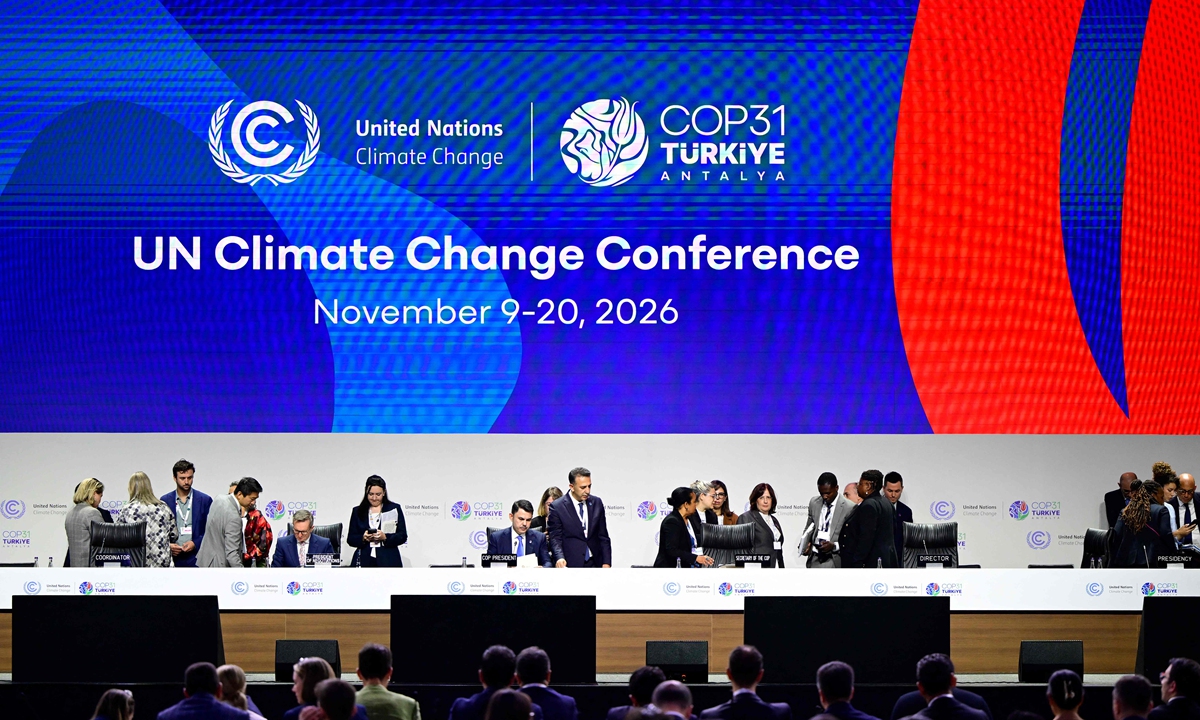
BEIJING: The COP31 climate talks headed for a historic defeat on Sunday after the EU and other countries refused to endorse a pact that omitted fossil fuels as the summit lurched into record overtime in Turkey.
“We will not endorse a cover decision, or an Antalya Pact, that does not even mention fossil fuels, which is the key driver of climate change,” said Ireland’s climate minister, Darragh O’Brien, whose country holds the rotating EU presidency, Le Monde reported on Sunday.
Chinese experts warned that growing green trade protectionism and attempts to shift climate responsibilities risk undermining global climate action, while highlighting China’s contributions to making clean energy technologies more affordable worldwide.
The organizers released a final deal early on Sunday morning, Antalya local time, which keeps a call to electrify the global economy but makes no mention of fossil fuels despite a fierce backlash when they were stripped from an earlier proposal, according to the Australian broadcaster ABC.
The developments came as a new study compiled by the Chinese Research Academy of Environmental Sciences (CRAES) and the Institute of Public & Environmental Affairs (IPE), obtained by the Global Times, estimated that China’s photovoltaic industry had helped reduce global solar module procurement costs by approximately $175.3 billion between 2011 and 2025, underscoring the practical importance of affordable clean energy technologies to the global green transition.
The latest compromise proposal came after negotiations stretched beyond their scheduled Friday conclusion and continued into the early hours of Sunday.
Despite mounting pressure from countries demanding stronger commitments on fossil fuels, the revised document again omitted explicit references to coal, oil, and gas, instead referring to an agreement reached at COP28 in Dubai in 2023 on transitioning away from fossil fuels, AFP reported Sunday.
The proposal also retained language supporting the expansion of clean energy and the acceleration of carbon capture and storage technologies, although the latter remained controversial among countries concerned about their costs and effectiveness.
The draft had not secured consensus among nearly 200 participating delegations and the COP31 failed to reach consensus on the Antalya Pact on Sunday.
While the latest COP31 draft retained the goal of tripling adaptation finance by 2035, it omitted an earlier proposal to provide at least $120 billion annually to developing countries, leaving key questions over funding levels and implementation unresolved, according to media reports.
“The deadlock at COP31 may appear to center on disagreements over the transition away from fossil fuels and the allocation of climate finance, but at a deeper level, it reflects a serious imbalance between responsibilities and interests in global climate governance. Developed countries are urging developing nations to accelerate emissions reductions while failing to take sufficient action on financial support and technology transfer,” Chen Hong, director of the Institute of Country and Region Studies at the School of Foreign Languages, East China Normal University, told the Global Times on Sunday.
The 35 percent electrification target retained in the latest COP31 draft echoed a goal supported by China and Australia in their November 20 joint statement on climate change and the clean energy transition.
The statement emphasized that measures taken to combat climate change should not constitute arbitrary or unjustifiable discrimination or disguised restrictions on international trade, reaffirming a principle enshrined in the UN Framework Convention on Climate Change.
In a Saturday report, The Guardian highlighted China’s willingness to share its experience in expanding clean energy technologies and reducing their costs, while noting Chinese concerns over US tariffs and the European Union’s Carbon Border Adjustment Mechanism, or CBAM.
A study published by the United Nations Conference on Trade and Development (UNCTAD) in 2021 found that the introduction of a CBAM results in declines in exports in developing countries in favor of developed countries, which tend to have less carbon-intensive production processes.
“Some Western countries are applying obvious double standards in their green policies. On one hand, they call for urgent climate action and an accelerated energy transition. On the other hand, they erect trade barriers against Chinese electric vehicles, solar products, and other green technologies,” Chen said.
“The irony is that, in trying to protect their own green industries, these countries are actually driving up the cost of the global green transition. The consequences extend beyond Chinese companies, affecting developing countries’ access to affordable clean energy technologies,” he added.
A study jointly released during COP31 by CRAES and IPE estimated that China’s photovoltaic industry helped avoid approximately 4.91 billion tons of carbon dioxide equivalent emissions between 2015 and 2025 through domestic installations and overseas module exports.
Ma Jun, director of the IPE, who attended the COP31 summit in Turkey as an observer, told the Global Times on Sunday that the report quantified the significant contribution of China’s photovoltaic industry to global climate action, offering a concrete example of how Chinese green technologies are delivering global public goods.
He added that China’s affordable and accessible green technologies are helping countries, particularly those in the Global South, address the challenge of overshooting global climate targets, while providing practical, financially viable, and scalable solutions for climate mitigation and adaptation. Such contributions are enabling developing countries to pursue their climate goals in a more affordable and sustainable manner, he said.
Without China’s contributions, the global cost of tackling climate change and advancing climate governance would be significantly higher, Ma noted. –The Daily Mail-Global Times news exchange item