
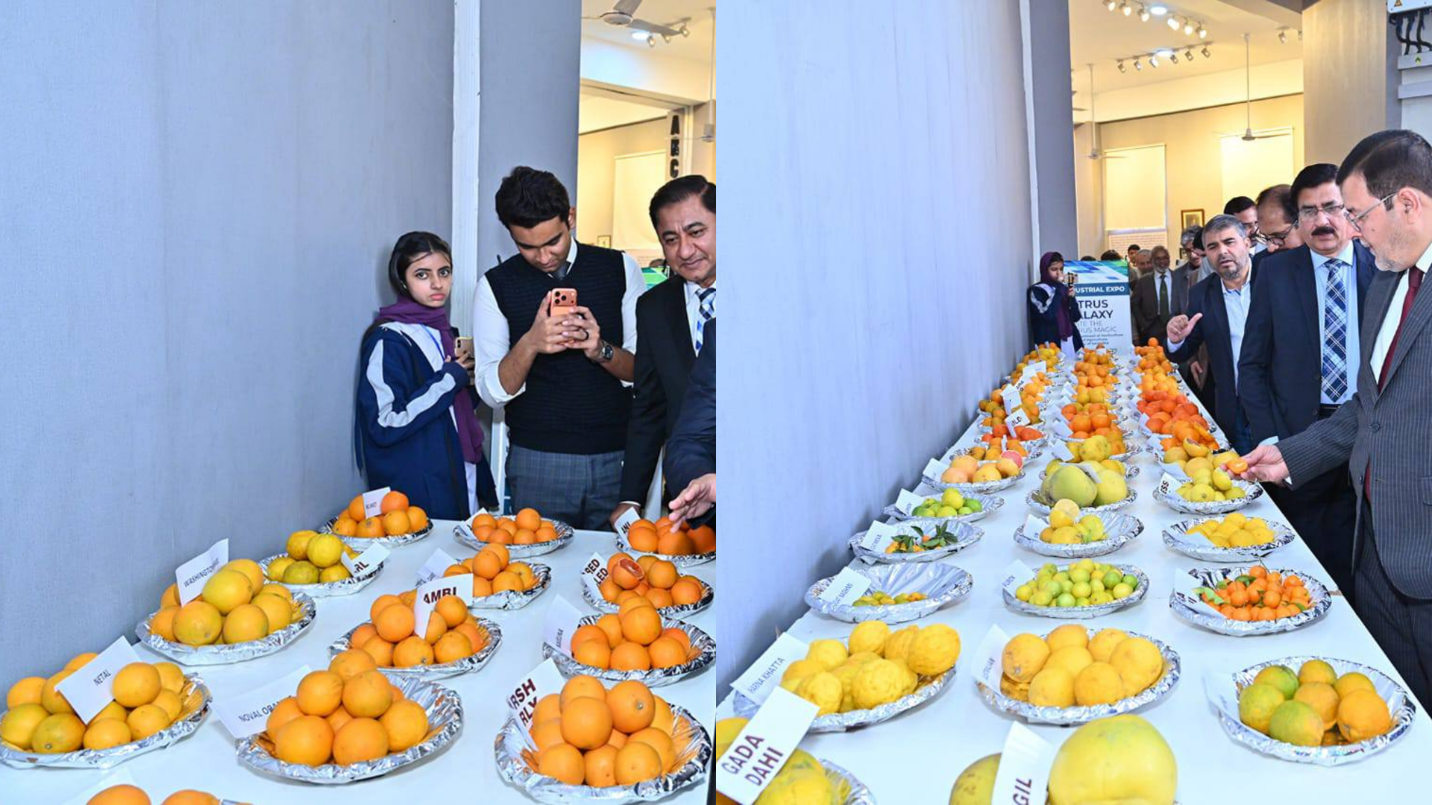
SARGODHA: The University of Sargodha on Monday inaugurated the weeklong 2nd Annual Research Arena 2025, an academic and research event featuring multiple exhibitions and scholarly activities.
As part of the opening, Vice Chancellor Prof. Dr. Qaisar Abbas inaugurated a Citrus Exhibition, along with a Research Expo and an Industrial Expo, jointly organized by the Office of Research, Innovation and Commercialization (ORIC) and the Institute of Food Science and Nutrition.
Sargodha is widely regarded as Pakistan’s leading producer of Kinnow mandarins and serves as the country’s main wholesale hub for the citrus variety, which dominates national production and exports.
While the Sargodha event focused on academic research and industry engagement, a separate study published in late 2025 highlights the broader economic importance of citrus and identifies China-Pakistan cooperation as a potential driver of sectoral revival.
The research, published in Policy Research Journal in late (Issue 10, 2025), examines Pakistan’s citrus production, market structure and the potential impact of agricultural cooperation under the China-Pakistan Economic Corridor (CPEC). The study was conducted by researchers from the University of Karachi, with contributions from the Applied Economics Research Center (AERC).
According to the study, Pakistan ranks as the 13th-largest citrus producer globally, with annual output exceeding 2.2 million tonnes. Citrus accounts for more than 30 percent of Pakistan’s total fruit production, while Punjab produces over 90 percent of the country’s citrus supply. The sector provides livelihoods to hundreds of thousands of people, particularly in rural areas.
Despite strong production, the study notes that citrus exports have declined in recent years due to climate stress, aging orchards and weak logistics infrastructure, undermining Pakistan’s competitiveness in international markets.
Researchers describe CPEC as a potential “game-changer” for the citrus sector, citing Chinese investment in transport, storage and port infrastructure.
Improved road and rail connectivity linking citrus-growing regions to Gwadar Port could reduce post-harvest losses and transportation costs, helping Pakistani citrus compete more effectively in Chinese and regional markets.
The study also highlights Gwadar Port’s growing strategic importance for agricultural trade, noting that its integration into CPEC logistics networks could open new export corridors for fresh fruit, support cold-chain development and encourage agro-processing backed by Chinese technology.
In addition, the research points to expanding China-Pakistan cooperation in agricultural research and technology transfer, including modern irrigation systems, disease-resistant varieties and improved post-harvest handling practices to address long-standing productivity challenges faced by citrus growers.
China is identified as a high-potential market as demand for imported fruit continues to rise. With improved quality standards, logistics and compliance with Chinese phytosanitary requirements, Pakistan could significantly expand citrus exports under the second phase of CPEC, the researchers said.
The study concludes that deeper China-Pakistan cooperation, combining infrastructure development, agricultural innovation and market access, could revive citrus exports, raise farmer incomes and strengthen long-term food and trade connectivity between the two countries. –Agencies