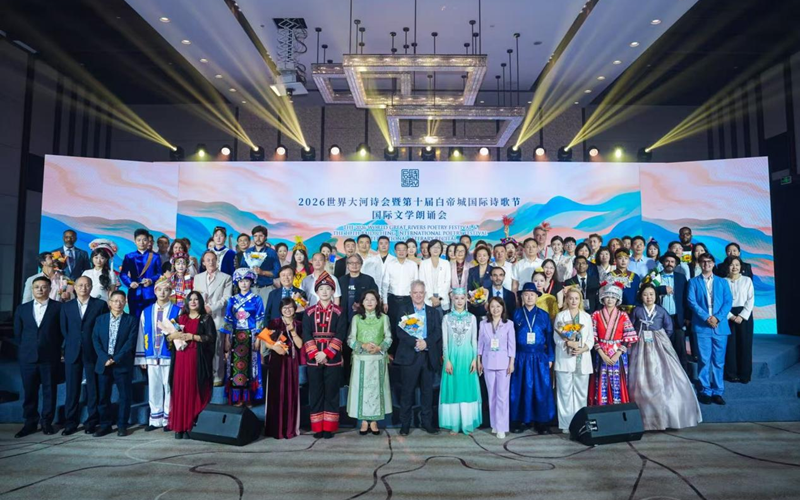
The opening ceremony of the 2026 World Great Rivers Poetry Festival & the 10th Baidicheng International Poetry Festival was held in Chongqing Municipality on the morning of September 14. The ceremony brought together government officials, literary figures, numerous international poets and writers.
During the ceremony, Li Peng, Executive Deputy Director of the Publicity Department of the Communist Party of China Chongqing Municipal Committee, introduced this year’s theme: “Gathering by the Yangtze, Dialogues Between Civilizations.”
This edition begins along the Yangtze River and reaches out to the globe. It links Yangtze River literature with writings from the world’s other major river basins, building a platform for mutual exchange and learning between Yangtze civilization and global river literature.
“The festivals encourage reading, translation and cross-linguistic appreciation among poets and writers. Through equal dialogue, we deepen understanding; with openness and mutual learning, we seek common ground. Through culture and humanities, the festivals contribute to the Global Civilization Initiative and help build a community with a shared future for humanity,” Li said.
In the days ahead, Chinese and international guests will travel through Chongqing along the Yangtze River for exchanges and creative work. Amid river gorges and natural scenery, they will explore local history and experience diverse facets of Chinese culture in modern urban and rural landscapes.
“Poetry, like a river, resists containment. The songs composed along the banks of the Yangtze centuries ago—the verses of Li Bai or Du Fu—did not remain inland. They moved downstream, boarded ships, crossed oceans, and found new life in the lexicons of writers along the Hudson and across the Arabian Gulf,” said Pulitzer Prize-winning American poet Gregory Pardlo, who shared his thoughts on river culture.
“Water reminds us that culture is fluid, always borrowing, always bound to its sources. For a writer, environmental concern isn’t an added subject matter, it is an act of ethical self-preservation. To protect the river is to preserve the condition for song,” he added. –The Daily Mail-Beijing Review News exchange item