
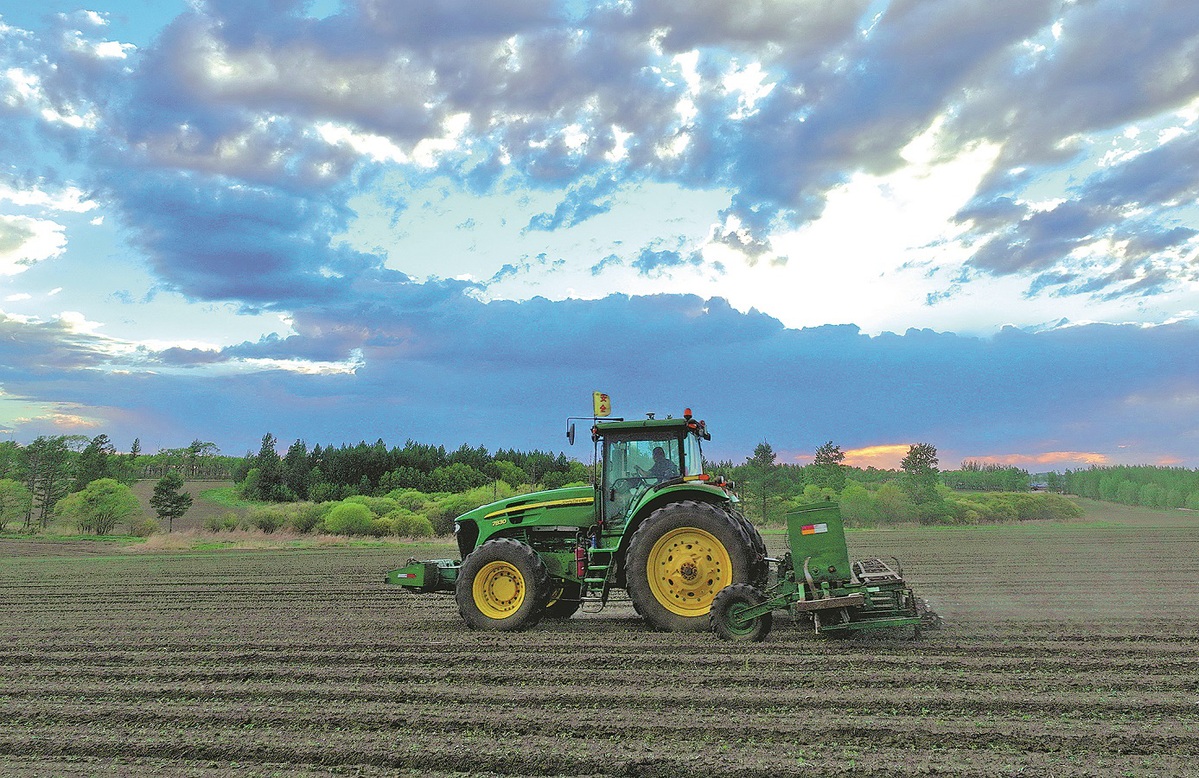
BEIJING: The protection of black soil, renowned for its fertility, has been significantly successful in China, with the country’s efforts recognized by the Food and Agriculture Organization of the United Nations.
Nora Berrahmouni, deputy director of the FAO’s Land and Water Division, emphasized that black soil is a scarce, high-quality arable resource globally and is crucial to world food security.
“China’s experience in black soil protection can significantly contribute to global soil conservation efforts,” Berrahmouni said, adding that black soil is essential for mitigating climate change impacts and supporting biodiversity, food production and farmers’ livelihoods.
“China’s efforts contribute to FAO’s goals of better production, nutrition, environment and life for all, ensuring no one is left behind,” she said. She noted that China is advancing priorities such as research and soil governance and that its establishment of national legislation for black soil protection and its robust soil information systems, including a large-scale soil survey with high-resolution data, are example.
She added that the FAO has collaborated closely with China on black soil conservation. In 2025, it launched a global South-South cooperation project with China, implemented by the FAO in collaboration with member countries in Africa and Asia.
“The knowledge and practices China is developing are crucial for advancing the global agenda on sustainable soil management and soil health, which are essential for food security,” she said.
In 2021, the Chinese Academy of Sciences launched the “Black Soil Granary” scientific initiative, deploying the “Black Soil Protection and Utilization Science and Technology Innovation Project” and organizing 98 units nationwide to address key scientific challenges.
On Monday, the CAS released a series of scientific achievements from the initiative, showing breakthroughs in theory, technological innovation, model construction and equipment development in black soil protection and utilization over the past five years.
Zhang Yucheng, a senior engineer at the CAS’ Institute of Computing Technology, said that to meet demand for large-scale and intelligent agricultural machinery in Northeast China’s black soil regions, the project completed independent development of the third-generation “Honghu” series intelligent agricultural machinery and equipment technology system, achieving more than 90 percent localization of key components.
He highlighted three core technological breakthroughs: the development of a high-power 400-horsepower motor achieving 98.7 percent system efficiency, surpassing leading international levels; the establishment of a high-strength, wear-resistant materials system with components outperforming imported counterparts; and advances in edge intelligent computing platform technology enabling millisecond-level response in complex scenarios with 200 TOPS, or Trillions of Operations Per Second, computing power. The equipment has been used across more than 2,000 hectares in Northeast China’s black soil region.
Jiang Ming, project commander and director of the Northeast Institute of Geography and Agroecology of the CAS, reported more than a 5.2 percent increase in grain yield using the technology. The technological model has been extended across 36 million hectares, providing strong scientific and technological support for black soil protection and sustainable utilization. –The Daily Mail-China Daily news exchange item