
February 24 marks the fourth anniversary of the outbreak of the Russia-Ukraine conflict. Days before the milestone, two days of talks among Ukraine, the United States and Russia, marking the third round of trilateral talks this year, concluded with no breakthrough on key issues.
Against the backdrop of intensified efforts and reports that Washington hopes to secure a ceasefire before June, questions have resurfaced over whether the protracted conflict may be approaching a turning point, or instead heading toward a more entrenched stalemate.
Experts told CGTN that while both Moscow and Kyiv have adjusted their strategies to varying degrees over the past four years, structural divergences remain profound, making a comprehensive settlement difficult in the near term.
Is the first half of 2026 ‘last window’ for ceasefire?
With Washington reportedly seeking to broker a ceasefire before June, some observers have described the coming months as a narrowing window for diplomacy.
Wang Jin, director of the Center for Strategic Studies at Northwest University, told CGTN that the U.S. timeline appears to be driven largely by domestic political considerations.
“The target set by the United States is more related to its domestic political calendar,” Wang noted, adding that Washington hopes to boost its electoral prospects by facilitating a Russia-Ukraine agreement ahead of the midterm election cycle. However, he stressed that “major divergences remain between Russia and Ukraine, especially on key details,” and that more mediation efforts are needed before any substantive breakthrough can be achieved.
Cui Zheng, director of the Research Center for Russia, Eastern Europe and Central Asian Countries at Liaoning University, told CGTN that the current window is both short and fragile.
“Although Washington is eager to secure mediation results amid the approaching election season, multiple signs indicate that the window is brief and unlikely to break the stalemate,” Cui said. He pointed out that while a round of talks may peak in late February, and possibly another in summer, failure to achieve progress could delay meaningful negotiations until next winter.
Cui added that neither side currently has synchronized incentives for a ceasefire. “Even if a June deadline is proposed by the U.S., battlefield and political realities do not support the immediate achievement of a lasting ceasefire,” he said. Should the opportunity pass, the conflict may enter a prolonged stalemate, with both sides seeking to improve their bargaining positions through continued attrition.
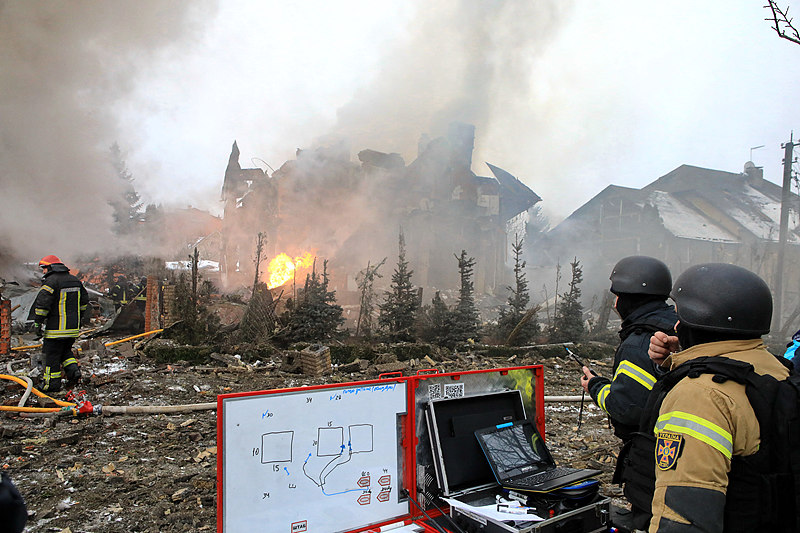
Rescuers coordinate their actions from a mobile operational headquarters set up in response to a Russian attack in Sofiivska Borshchahivka village, Kyiv region, Ukraine, February 22, 2026. /VCG
What are the key structural obstacles?
Experts agree the most formidable barriers to peace lie in deep-rooted structural disagreements, particularly over territory and security arrangements.
Wang said the two sides hold fundamentally different understandings of disputed territories, each viewing land as a cornerstone of political legitimacy.
“If the territorial issue is addressed in a one-off dialogue with the aim of resolving all sovereignty questions at once, it would be extremely difficult,” Wang said. He suggested that only a phased and transitional arrangement, beginning with ceasefire and temporary de-escalation, may be realistic under current conditions.
Cui elaborated that territorial sovereignty and security architecture form the core of irreconcilable differences. Russia insists on recognition of its control over Crimea and four eastern and southern regions, and demands that Ukraine forgo membership in the North Atlantic Treaty Organization (NATO) and limit Western military presence. Ukraine, on the other hand, maintains its claim to full sovereignty and seeks security guarantees from Western partners.
“These opposing positions leave very limited room for compromise on core clauses of any agreement,” Cui said.
He further noted that political legitimacy, ideological narratives, and the absence of a credible enforcement mechanism also complicate negotiations. Previous arrangements, such as the Minsk agreements, faltered due to insufficient supervision. Without strong third-party monitoring, any new accord would face risks of non-compliance.
Domestic political constraints add another layer of difficulty. According to Cui, Ukrainian public opinion largely opposes territorial concessions, while divisions within the Western camp, particularly between the United States and Europe, further narrow policy flexibility.
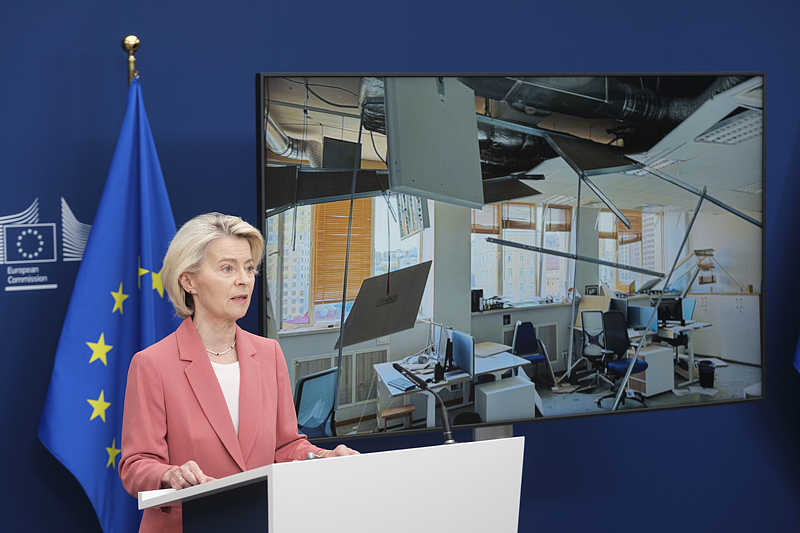
President of the European Commission Ursula von der Leyen makes a statement in the Berlaymont, the EU Commission headquarters, on the latest attack by Russia on Ukraine in Brussels, Belgium, August 28, 2025. /VCG
How U.S. and European roles evolve
Under an “America First” policy orientation, U.S. objectives in the conflict appear to be shifting, the experts said.
Wang observed that Washington has moved from firmly backing Ukraine against Russia to adopting a more pragmatic approach aimed at facilitating a deal.
“The United States has shifted from strongly supporting Ukraine and opposing Russia to playing a role of pressuring Ukraine while engaging Russia to reach an agreement,” Wang said, adding that such changes reflect Washington’s urgency to conclude the conflict.
Cui similarly argued that U.S. priorities have turned towards “quickly ending the conflict and restoring strategic stability.” He noted that recent U.S. actions, including adjusting assistance levels and increasing diplomatic contacts with Russia, indicate an emphasis on reducing the long-term burden of the war and reallocating strategic resources.
Meanwhile, Europe’s role is evolving but remains constrained.
Cui said that although European countries have been sidelined in some recent diplomatic arrangements, they continue to stress support for Ukraine’s sovereignty and are seeking a greater role in the peace process. European leaders have intensified consultations with Kyiv and explored legal avenues to utilize frozen Russian assets for Ukraine’s benefit.
However, Cui pointed out that Europe’s strategic autonomy is limited, particularly within a framework where major negotiations are driven primarily by Washington and Moscow.
Wang added that differences between the United States and Europe may become more visible if their approaches to Ukraine diverge further, potentially enhancing Europe’s independent posture but also exposing intra-Western tensions.
As the conflict enters its fifth year, experts caution against premature optimism. While tactical adjustments and diplomatic overtures suggest a possible opening for temporary arrangements, entrenched structural divides and shifting geopolitical calculations mean that a comprehensive and durable peace remains elusive.
Whether 2026 will mark the beginning of de-escalation or another chapter of protracted rivalry may depend less on externally imposed deadlines and more on whether the fundamental gaps identified by scholars can be gradually narrowed. –The Daily Mail-CGTN news exchange item