
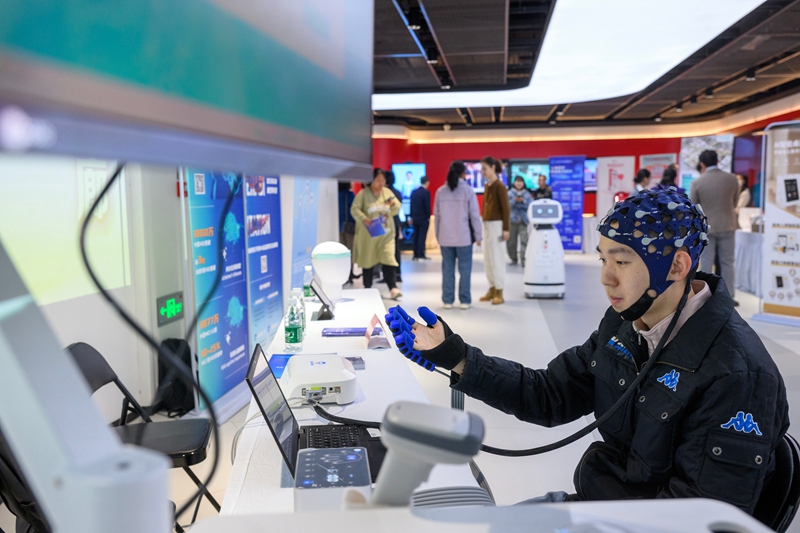
During his first year as an entrepreneur, Han Bicheng washed his hair roughly three times a day—more than 800 times in a single year. He and his team had to repeatedly apply conductive gel to their scalps to capture the clean electroencephalogram signals needed for their experiments, a routine that kept them in a near-constant cycle of shampooing.
Back in 2015, Han, then a Ph.D. candidate at Harvard University’s Center for Brain Science in the U.S., joined several Chinese classmates from Harvard and the Massachusetts Institute of Technology to co-found BrainCo with the mission of exploring the vast potential of the human brain through brain-computer interface (BCI) technology. At the time, Elon Musk’s Neuralink had not yet been launched, making their venture appear extraordinarily ambitious—if not bordering on impractical.
In 2018, BrainCo moved its headquarters to Hangzhou in east China’s Zhejiang Province. Today, it has grown into the world’s second-largest BCI company, trailing only Neuralink. In early 2026, the company secured a new round of funding totaling approximately 2 billion yuan ($285 million), marking the second-largest financing event in the global BCI field, second only to that of its U.S. counterpart.
Scaling up
BrainCo’s trajectory mirrors the rapid evolution of BCI itself—a journey from science fiction to tangible reality.
According to Academician Zhao Jizong, a neurosurgery expert at the Chinese Academy of Sciences, BCIs primarily follow two paths: invasive and non-invasive. “Invasive BCI involves implanting chips directly into the cerebral cortex,” he told newspaper The Beijing News. “This offers superior signal precision but requires craniotomy. While minimally invasive techniques have advanced, risks such as immune responses remain.” In contrast, non-invasive BCI uses external wearable devices with electrodes. “The signal may be weaker, but it requires no surgery, making it far more accessible for widespread use,” Zhao added.
China’s BCI development has accelerated dramatically in recent years. A pivotal moment arrived on June 14, 2025, when the Chinese Academy of Sciences’ Center for Excellence in Brain Science and Intelligence Technology, together with Shanghai’s Huashan Hospital (Fudan University) and industry partners, announced the success of the nation’s first prospective clinical trial for an invasive BCI. This milestone positioned China as only the second country in the world to advance this technology to the clinical trial stage.
Following implantation and just two to three weeks of adaptive training, the trial participant could control a computer touchpad through thought alone—typing messages, browsing and even playing games with a dexterity approaching that of an able-bodied person.
Also last June, a team led by Professor Duan Feng of Nankai University in Tianjin achieved another world first: a trial of interventional BCI to restore motor function in a human patient. By November 2025, Wuhan Zhonghua Brain-Computer Integration Technology Development Co. Ltd., in collaboration with Union Hospital of Huazhong University of Science and Technology, had performed the first clinical implantation using a fully domestically developed BCI chip.
These breakthroughs led the industry to declare 2025 China’s “inaugural year” for BCI. The momentum was cemented in policy when, recommendations for the 15th Five-Year Plan (2026-30), released last October, listed BCIs among the six key industries for national development, explicitly identifying BCI as a strategic future sector.
“A concrete industrial foundation has been established for BCI development,” Xu Zhaoyuan, a research fellow with the Development Research Center of the State Council, told newspaper 21st Century Business Herald. “As a high-end sector, it possesses the driving force to stimulate transformation across related industries.” Local governments have mobilized in response to this national strategic focus. Shanghai, for instance, has set clear benchmarks: to advance at least five invasive or semi-invasive products through clinical trials by 2027, and to achieve widespread clinical application of BCI products by 2030.
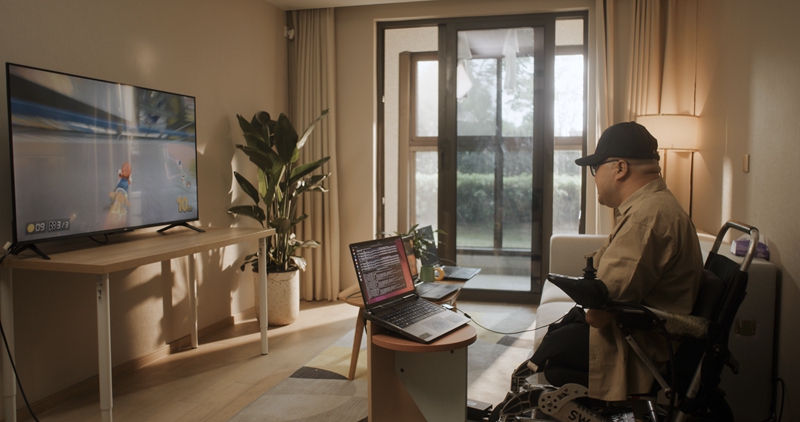
A man plays a racing video game via a brain-computer interface at his home in Shanghai on April 30, 2025 (XINHUA)
A look at the future
“BCI technology will reshape human life across multiple dimensions,” said Han from BrainCo, which launched with a mission to help people wearing prosthetics. “In China alone, over 20 million people have limb disabilities, including roughly 5 million-6 million who have undergone hand or foot amputations,” Han told Xinhua News Agency. “We want non-invasive BCI technology to reach this group first.”
A powerful demonstration of this goal came at the 2023 Asian Para Games in Hangzhou City. Chinese swimmer Xu Jialing, who lost her left forearm, used a BrainCo-developed intelligent prosthetic arm to smoothly grasp the torch and light the cauldron—all controlled by her thoughts.
“The core of our work over the past decade has been developing a ‘super sensor’ to monitor neural signals,” Han said. “Brain signals are incredibly faint—detecting them is like trying to hear a mosquito’s wings from 50 km away. As this sensor improves, we can tackle more real-world problems, step by step.”
Han’s vision extends far beyond prosthetics. He envisions that within five to 10 years, BrainCo’s technology will benefit 1 million individuals with limb disabilities and 10 million patients dealing with Alzheimer’s, autism and insomnia.
This expansive future, however, hinges on overcoming bottlenecks. “Universities and research institutes are still the main force in tackling core challenges,” said Pan Gang, Director of the State Key Laboratory of Brain-Machine Intelligence at Zhejiang University, at the second Chinese Conference on Brain-Machine Intelligence held in Hangzhou on December 11, 2025. “But in the next five to 10 years, as the industry scales, enterprises will become increasingly crucial.”
Scale requires capital. Yin Zhixin, an associate research fellow with the Chinese Academy of Science and Technology for Development, identifies cost as the primary barrier to mass production. “The costs for clinical trials, facility construction, and research and development are enormous,” Yin told newspaper Science and Technology Daily. “Bringing a single product to market can require hundreds of millions of yuan (tens of millions to 100 million U.S. dollars) with a long payback period, a high barrier that limits the number of domestic players.”
Concurrently, the sector faces a severe talent shortage. BCI’s interdisciplinary nature—spanning neuroscience, materials science and AI—demands a new breed of composite experts, yet the training pipeline remains underdeveloped. In response, Tianjin University made a landmark move in the fall of 2024 by launching the nation’s first undergraduate major in BCI.
Yin views this as a foundational first step. “It is conservatively estimated that demand for specialized talent will exceed 200,000 by 2030,” he said. “Cultivating and supplying talent for this field remains a long and challenging journey ahead.” –The Daily Mail-Beijing Review news exchange item