
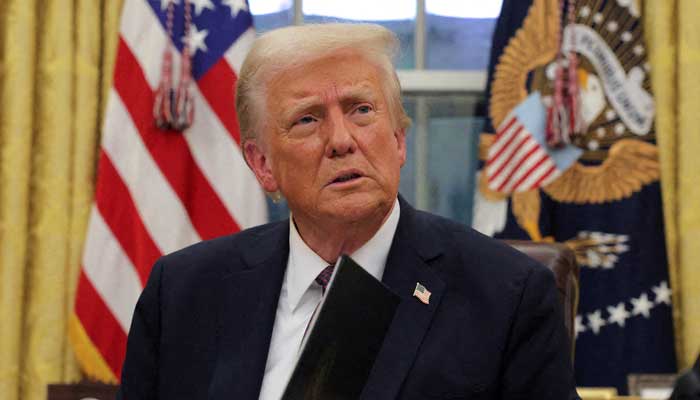
Just as European companies were getting used to last year’s hard-won US trade tariff deals, President Donald Trump has put them back in his crosshairs with an explosive threat to place levies on nations that oppose his planned takeover of Greenland.
Trump on Saturday said he would put rising tariffs from February 1 on goods imported from EU members Denmark, Sweden, France, Germany, the Netherlands and Finland, along with Britain and Norway, until the US is allowed to buy Greenland, a step major EU states decried as blackmail.
On Sunday, European Union ambassadors reached broad agreement to intensify efforts to dissuade Trump from imposing those tariffs, while also readying a package of retaliatory measures should the duties go ahead, EU diplomats said.
The shock move has rattled through industry and sent shockwaves through markets amid fears of a return to the volatility of last year’s trade war, which was only eased with tariff deals reached in the middle of the year.
“This latest flashpoint has heightened concerns over a potential unraveling of NATO alliances and the disruption of last year’s trade agreements with several European nations,” said Tony Sycamore, market analyst with IG based in Sydney.
EU ponders ‘Anti-Coercion Instrument’
In a post on Truth Social, Trump said additional 10 percent import tariffs would take effect next month on goods from the listed European nations — all already subject to tariffs imposed by the US president last year of between 10 percent and 15 percent.
The EU – which had an estimated $1.5 trillion in goods and services trade with the US in 2024 – looks set to fight back. Europe has major carmakers in Germany, drugmakers in Denmark and Ireland, and consumer and luxury goods firms from Italy to France.
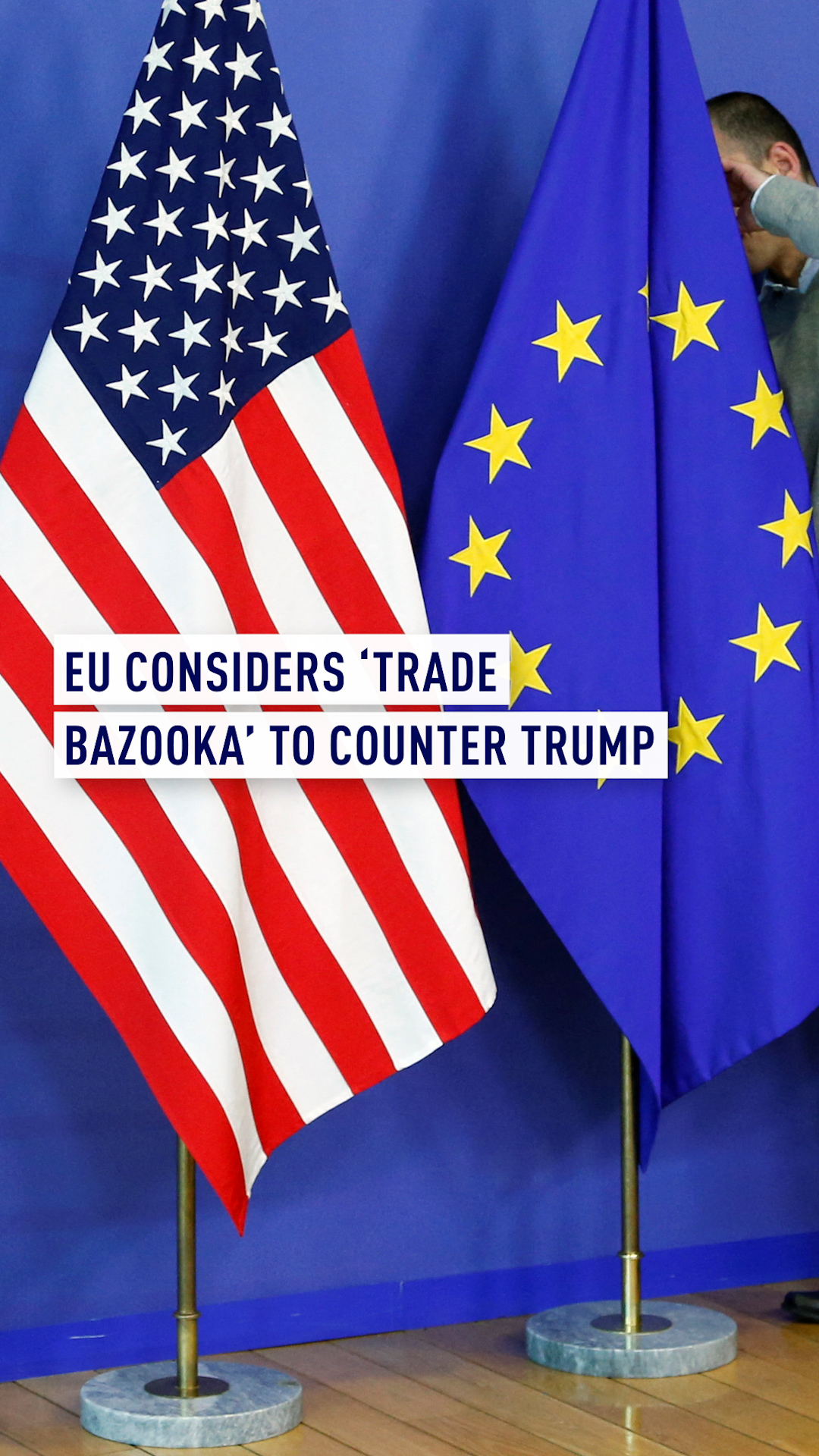
EU leaders are set to discuss options at an emergency summit in Brussels on Thursday, including a $107.7 billion package of tariffs on US imports that could automatically kick in on February 6 after a six-month pause.
The other is the so far never used “Anti-Coercion Instrument” (ACI), which could limit access to public tenders, investments or banking activity or restrict trade in services, in which the US has a surplus with the bloc.
UK PM calls for ‘calm discussion’, not tariff war
By contrast, British Prime Minister Keir Starmer called on Monday for calm discussion. All but ruling out retaliatory levies against the US, Starmer sought to de-escalate the war of words.
Starmer, who has built a solid relationship with Trump and last May became the first leader to secure a deal to lower some tariffs, underlined his approach that being “pragmatic does not mean being passive.”
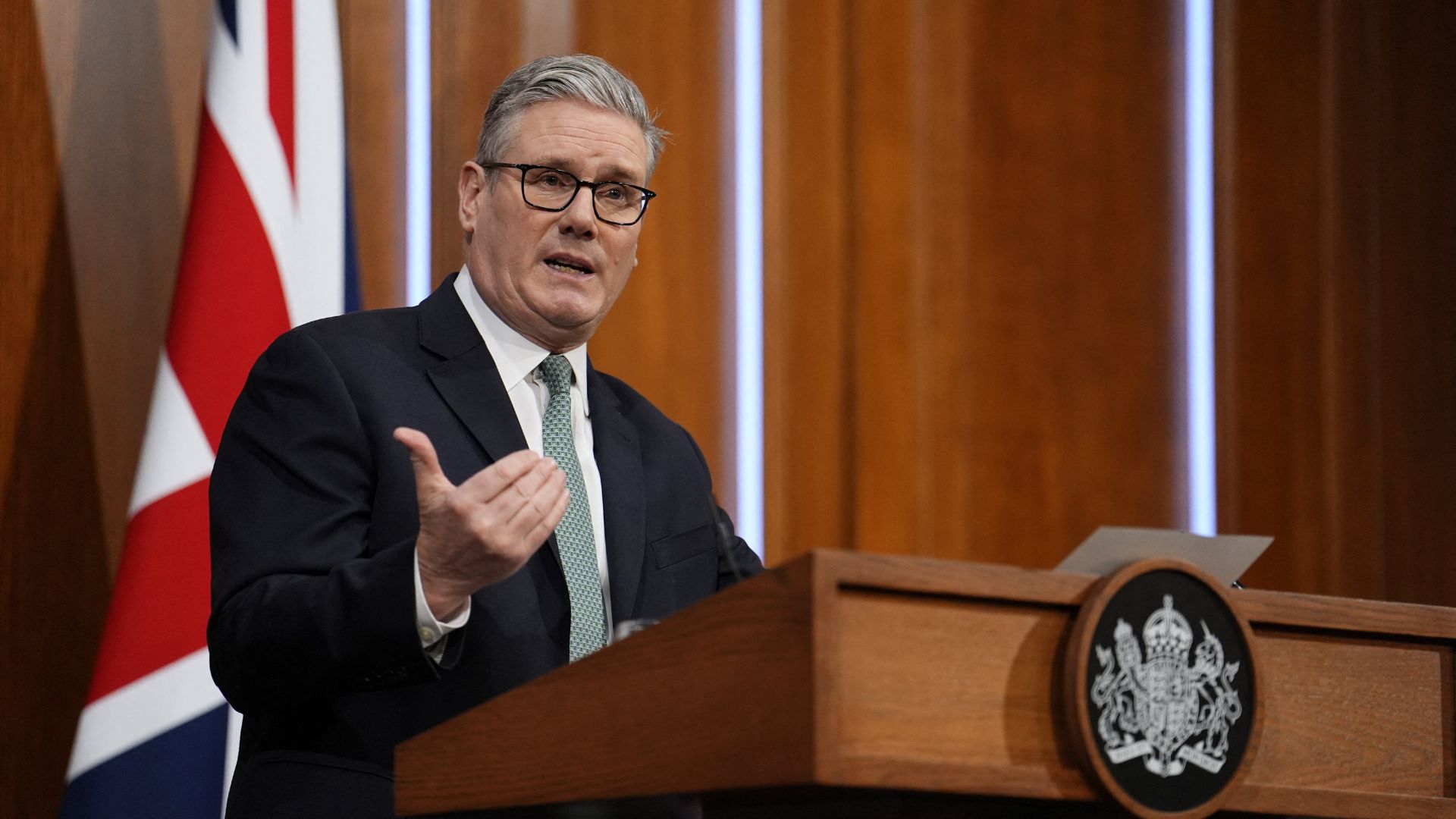
UK PM Keir Starmer speaks to the London media on Monday about Trump’s tariff threats.
After telling Trump on Sunday that his threatened tariffs were wrong, Starmer doubled down to say he would use “the full strength of government” to try to stop the US decision – one, he said, that could only hurt already stretched households.
“Tariffs should not be used against allies in this way,” Starmer said, adding that he was not looking to escalate a tariff war at this point.
“A tariff war is in nobody’s interests, and we have not got to that stage. And my focus, therefore, is making sure we don’t get to that stage.”
French, German ministers say Europe will not be ‘blackmailed’
The German and French finance ministers said on Monday European powers would not be blackmailed and there would be a clear and united response to US threats.
“Germany and France agree: we will not allow ourselves to be blackmailed,” German Finance Minister Lars Klingbeil said at his ministry where he received his French counterpart.
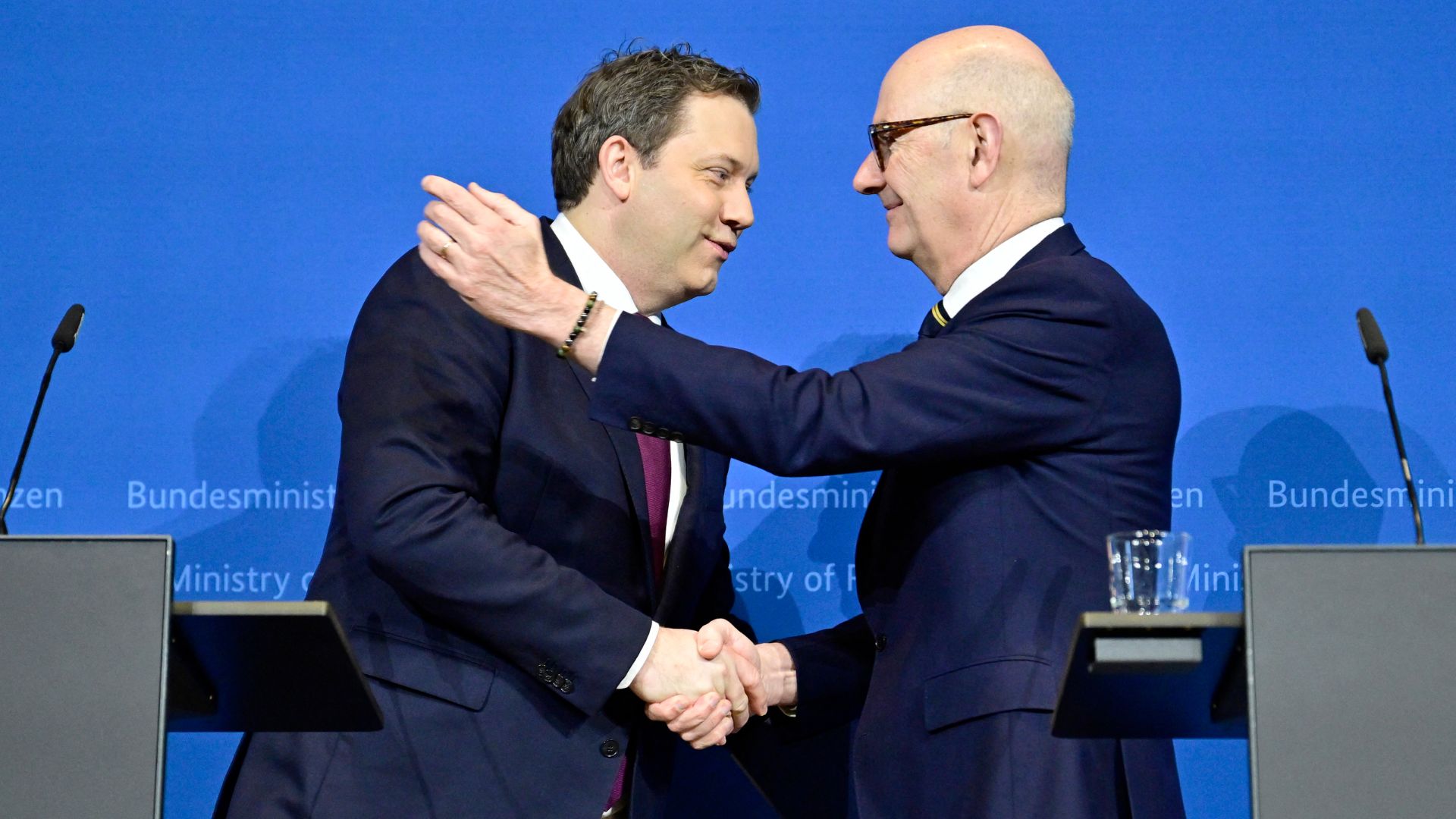
German Finance Minister Lars Klingbeil (L) welcomes his French counterpart Roland Lescure at a joint conference in Berlin. /John MacDougall/AFP
“Blackmail between allies of 250 years, blackmail between friends, is obviously unacceptable,” French Finance Minister Roland Lescure said at the same event.
“We Europeans must make it clear: the limit has been reached,” Klingbeil said. “Our hand is extended but we are not prepared to be blackmailed.”
Lescure added that he hoped the transatlantic relationship will return to being “friendly and based on negotiation, rather than a relationship based on threats and blackmail”.
Analysts say companies will look to trade with ‘less problematic nations’
Analysts said the key question was how Europe responded – with a more “classic” trade war tit-for-tat tariff retaliation, or an even tougher approach.
“The most likely way forward is a return to the trade war that was put on hold in high-level US agreements with the UK and the EU in summer,” said Carsten Nickel, deputy director of research at Teneo in London.
Oliver Burkhard, CEO of German submarine maker TKMS, said the Greenland threat was perhaps the jolt that Europe needed to toughen its approach and focus on developing its own joint programs to be more independent from the US.
“It is probably necessary… to get a kick in the shin to realise that we may have to suit up differently in the future,” he said.
Susannah Streeter, chief investment strategist at Wealth Club, said the new threat created “another layer” of complexity for firms grappling with an already “chaotic” US market. Firms had little capacity to soak up new tariffs, she added.
“A trade war only creates losers,” said Christophe Aufrere, director general of French autos association the PFA.
An official at a French industry association that represents the country’s largest firms added the Greenland issue was turning tariffs into a “tool for political pressure”, and called for the region to reduce its dependency on the US market.
Neil Shearing, group chief economist at Capital Economics, pointed out that some EU countries – Spain, Italy and others – were not on the tariff list, which would likely see “re-routing” of trade within the EU free trade bloc to avoid the taxes.
Analysts added the new tariffs – if imposed – would likely hurt Trump. They would push up US prices and lead to front-loading of exports before the tariffs kicked in, while encouraging companies to seek new markets.
“For Europe, this is a bad geopolitical headache and a moderately significant economic problem. But it could also backfire for Trump,” said Holger Schmieding, London-based chief economist at Berenberg.
“Logic still points to an outcome that respects Greenland’s right to self-determination, strengthens security in the Arctic for NATO as a whole, and largely avoids economic damage for Europe and the US.” –The Daily Mail-CGTN news exchange item