By Ali Imran
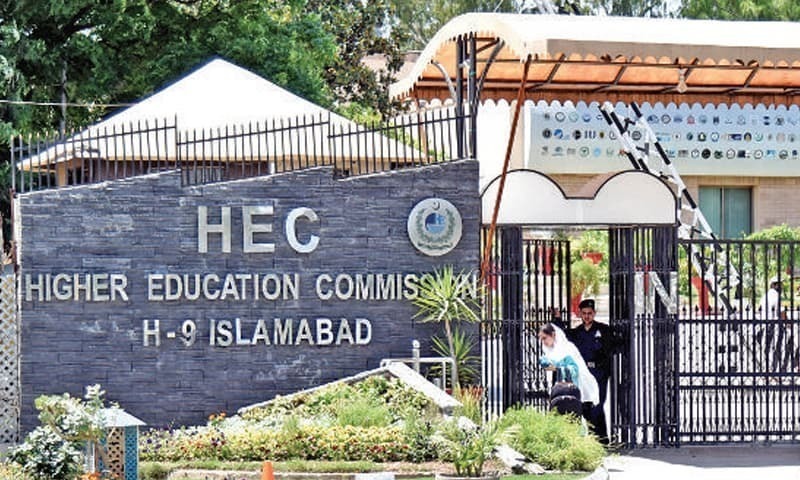
ISLAMABAD: The Higher Education Commission (HEC), has launched an integrated automation suite, MAKTAB, to transform universities by uplifting their core academic, administrative and financial functions.
MAKTAB is an integrated suite comprising SAP–Enterprise Resource Planning (ERP), Student Lifecycle Management System (SLcM), and Blackboard’s Learning Management System (LMS), deployed across 25 public sector universities under the World Bank–funded Higher Education Development in Pakistan (HEDP) project. The HEC has undertaken this flagship digital transformation programme to modernise and standardise academic and administrative operations of Higher Education Institutions (HEIs).
This initiative marks a pivotal transition from fragmented and manual processes to a unified, technology-driven governance ecosystem that enhances efficiency, transparency, and real-time decision-making.
In the first phase, 25 HEIs have successfully been onboarded on SAP-based ERP and customised SLcM solutions that digitize their core functions. Simultaneously, Blackboard LMS has been deployed to enable high-quality online, blended, and hybrid learning with robust analytics and instructional support tools. Collectively, these systems constitute the foundation of Pakistan’s Higher Education Management Information System (HEMIS), a national platform aimed at improving governance, strengthening accountability, and supporting evidence-based policy making.
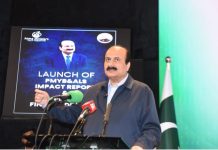
Federal Minister for Planning, Development and Special Initiatives, Ahsan Iqbal Chaudhary, graced the launch ceremony virtually. Minister of State for Federal Education and Professional Training, Wajiha Qamar; Chairman HEC, Nadeem Mahbub; Executive Director HEC Dr. Zia Ul Haq; former Chairman HEC, Dr. Mukhtar Ahmed; Vice Chancellors of participating universities, development partners, and other distinguished stakeholders attended the ceremony held to celebrate onboarding of universities and acknowledging the collaborative institutional efforts.
Addressing the audience, Ahsan Iqbal congratulated the Higher Education Commission and the partner universities on the successful integration of MAKTAB, describing it as a transformative step for Pakistan’s higher education sector.
He noted that this achievement goes beyond the launch of a digital system and reflects a clear national resolve to institutionalize excellence and long-term reform. Emphasizing that robust institutions and a highly skilled human capital base are the true hallmarks of excellence in the 21st century, the Minister remarked that innovation, technology, and competitiveness serve as the core drivers of sustainable national progress.
He further underlined that clarity of priorities, seriousness of intent, and consistency of effort are essential to translating vision into measurable outcomes. Recalling the achievements realized under Vision 2025, the Minister reaffirmed the Government’s steadfast commitment to advancing the strategic pillars of Uraan Pakistan and steering the country towards innovation-driven and inclusive growth.
“Let’s think deeply, act decisively, and act collectively” for development of the higher education system of Pakistan, the Minister stressed.
Wajiha Qamar, Minister of State for Federal Education and Professional Training, described the launch of MAKTAB as a long-cherished milestone and expressed optimism that the initiative would significantly advance digitization, transparency, and quality across the higher education sector.
She underscored the importance of embedding MAKTAB within the Public Sector Development Programme (PSDP) to enable its expansion across the entire sector. Emphasizing the need to keep pace with rapidly evolving global dynamics, she conveyed her confidence that initiatives such as MAKTAB will play a vital role in steering higher education toward sustainable development.
Highlighting HEC’s strategic vision for strengthening the higher education ecosystem, Chairman HEC Nadeem Mahbub expressed his sincere appreciation to all stakeholders and development partners for their continued support.
He commended the HEDP and HEC teams for their dedication, professionalism, and resilience in translating the MAKTAB concept into a fully operational national platform. Stressing the importance of sustained and effective utilization, he urged universities to continuously enhance system adoption, reiterating HEC’s commitment to building a stronger, smarter, and more accountable higher education system for Pakistan.
Executive Director HEC Prof. Dr. Zia ul Haq acknowledged the collective efforts of HEC, development partners, and universities in the successful deployment of MAKTAB. He expressed confidence that the platform would significantly streamline and strengthen critical administrative, academic, and financial processes within universities. While recognizing the implementation challenges inherent in such a large-scale reform, he emphasized that continued collaboration and institutional ownership would be key to sustaining and scaling the initiative.
Syed Naveed Hussain Shah, Project Coordinator HEDP, presented an overview of MAKTAB’s key features and deployment progress, while representatives from the participating universities shared their experiences and perspectives on the system’s impact at the institutional level.
Under MAKTAB, a comprehensive SAP-based Enterprise Resource Planning (ERP) solution has been deployed as the integrated digital backbone for managing core academic, administrative, and financial functions across participating universities and HEC. Built on SAP’s enterprise-grade platform, the ERP system digitises and standardises critical financial operations including budgeting, accounting, payments, receivables, and statutory financial reporting. It also streamlines Supply Chain Management and procurement, covering planning, tendering, purchase orders, invoicing, and vendor management, while Enterprise Asset Management (EAM) enables systematic tracking, maintenance, and lifecycle management of physical assets such as buildings, equipment, and vehicles.
Collectively, these modules introduce uniform processes, real-time data visibility, audit trails, and management dashboards, significantly strengthening financial discipline, operational efficiency, and institutional governance.
The Human Capital Management (HCM) and payroll modules manage the complete employee lifecycle, encompassing recruitment, service records, payroll processing, benefits administration, and leave management. By integrating HR and payroll processes into a single system, MAKTAB enhances transparency, ensures timely and accurate remuneration, and provides decision-makers with reliable workforce data to support planning and accountability.
Complementing the ERP, the Student Lifecycle Management (SLcM) solution offers an end-to-end academic management framework that digitises the entire student journey within a university. From online admissions, merit list generation, enrollment, and course registration to semester planning, attendance, assessments, examinations, grading, and result declaration, SLcM ensures standardized, transparent, and merit-based academic processes while reducing manual interventions and administrative delays.
In addition, the deployment of Blackboard Learning Management System (LMS) provides a centralized digital platform for teaching and learning. The LMS enables faculty to deliver course content, manage assessments, and engage students through online classes, assignments, quizzes, and discussion forums. Seamlessly integrated with SAP SLcM, Blackboard supports blended and online learning, enhances academic continuity, and improves access to learning resources, thereby strengthening instructional effectiveness and student engagement across the higher education sector.