So observed the Ming Dynasty (1368-1644) agronomist Xu Guangqi in his Complete Treatise on Agriculture, capturing the undisputed dominance of east China in sericulture centuries ago. Indeed, for much of imperial history, the Jiangnan region, the area south of the lower reaches of the Yangtze River, with its rapid economic development and skilled artisans, formed the vibrant heart of China’s silk production.
While as early as the Han (206 B.C.-A.D. 220) and Tang (618-907) dynasties, with the expansion of the Silk Road, both overland and maritime, China’s western regions emerged as vital corridors, transporting eastern silk to distant markets across Eurasia. These routes spurred economic growth, fostered ethnic integration and wove China’s western regions into a tapestry of cross-cultural exchange.
Today, that historical dynamic is being reinvented. No longer merely a transit zone, west China is fast becoming a silk-producing powerhouse in its own right, a shift accelerated by the national East Silk, West Consolidation strategy, which aims to rebalance the industry by anchoring high-quality silk production in the country’s central and western regions.
The initiative seeks to rebalance China’s silk industry by leveraging the distinct strengths of its eastern and western regions. In essence, it formalizes a regional specialization: The west will concentrate on the production of high-quality raw silk and the weaving of silk fabric, and the east, long a hub of design, branding, as well as research and development, will focus on turning silk fabric into high-end products.
Shifts and upgrades
The recently introduced strategy is not entirely new. It follows earlier initiatives like Moving Mulberry Farming West and Advancing Silk Production West, which were put forward in 2006 with the aim of shifting raw silk production westward. But what sets this new approach apart is its emphasis on production stability,integration and value adding.
According to the document on the East Silk, West Consolidation strategy released in November by the Ministry of Commerce (MOFCOM) and other related government departments, by 2028, the government aims to build 10 flagship silk companies in the east with revenues exceeding 10 billion yuan ($1.41 billion) each, and establish hubs in China’s central and western regions to supply 75 percent of the country’s premium silk fabric.
“The goal is to anchor the supply chain firmly in central and west China while strengthening coordination with eastern partners—ensuring sustainable, high-quality growth for the silk industry,” a MOFCOM official said at the release of the policy document on November 14.
The industrial relocations are driven by changing production factors, such as higher land and labor costs in east China following its pioneering industrial transformation, Chen Wenxing, an academician of the Chinese Academy of Engineering and President of Zhejiang Sci-Tech University, told newspaper Sichuan Daily.
However, achieving coordinated development of the silk industry in China’s eastern and western regions is no simple task.
“Silk is often regarded as the oriental soft gold. Silk fabrics carry profound historical and cultural significance, distinct regional characteristics and exquisite intangible heritage techniques,” Chen explained.
He further noted that silk weaving and the manufacture of silk products represent a higher-value segment than cocoon and raw silk production, involving creativity in pattern design, color coordination and other aspects of product development. This demands more advanced technology, entails greater difficulty and relies on support from the entire industrial chain.
The powerhouse
This strategic evolution did not occur in a vacuum. It was built upon decades of groundwork laid by the west region including Guangxi Zhuang Autonomous Region and Sichuan Province, where advancements in mulberry cultivation, silkworm rearing, and primary processing have matured to a point where they can now support a more sophisticated and value-added industrial chain.
“Since the launch of the Moving Mulberry Farming West initiative in 2006, central and western regions such as Guangxi and Sichuan have expanded their mulberry growing and silkworm rearing operations, now accounting for over 70 percent of national production. Meanwhile, in eastern regions, rising labor and land costs for downstream processes—including weaving, dyeing and garment manufacturing, have accelerated the impetus for industrial relocation,” a spokesperson for the MOFCOM’s Department of Consumption Promotion told newspaper Workers’ Daily.
For instance, Sichuan now supplies the largest share of high-grade silk material nationwide, with 87,000 tons of cocoon output in 2024 and silk material exports worth $170 million.
What makes Sichuan emblematic of the new policy is its ability to merge tradition with innovation.
Chen Lin, Marketing Director of Sichuan Antai Cocoon and Silk Group Co. Ltd., said the company is planning to further advance in deep processing fields such as printing and dyeing. “The experience of Jiangsu and Zhejiang provinces, and other regions in intelligent and digital production lines is worth learning from,” Chen Lin told Sichuan Daily.
In Gaoxian County, Yibin City of Sichuan, the New Silk Road Cocoon Silk Co. has built a 200-hectare organic mulberry base, combining ancestral farming knowledge with blockchain traceability.
“We’re no longer just selling to Jiangsu or Zhejiang,” Zhang Yuexin, the firm’s deputy general manager, told Gaoxian County Media Center. “Now, 80 percent of our production goes to Europe. Our silk ends up in Italian fashion houses and Romanian ateliers. The world is recognizing what we’ve always known: Sichuan silk is among the finest.”
“The strategy will also generate new opportunities for Sichuan in building a trillion-yuan (more than $100 billion) industry,” Wu Jinliang, President of the Sichuan Silk Association, told Sichuan Daily. He explained that as more high-quality enterprises, advanced technologies and other resources from the eastern regions accelerate their relocation to the west, Sichuan will further promote industrial upgrading and expand the scale of its industries.
The trend of accelerated integrated development is also becoming increasingly prominent in Sichuan. For instance, the province is speeding up the development of a range of mulberry products, such as mulberry leaf tea and silkworm pupa oil, which can regulate cholesterol or be used as an antioxidant, leveraging innovative products to stimulate fresh consumer demand. Meanwhile, new consumption scenarios and business formats, including silk-themed towns, museums, and cultural and creative bases, are continuously emerging, driving the diversified and integrated growth of the industry.
Just as Sichuan exemplifies the fusion of tradition and technology, Guangxi’s Xincheng County offers another compelling model of how west China is revitalizing the silk industry through grassroots innovation and strategic policy support, and attracting coastal investment in the process.
Policy empowerment has been the “guiding star” for this transformation. Xincheng has rolled out specialized plans and disbursed millions in direct subsidies to households, increasing the monthly average sericulture income of supported families by over 4,000 yuan ($563). Infrastructure has been simultaneously upgraded, with the county government attracting investment of over 100 million yuan ($14 million) in standardized silkworm demonstration bases.
The results are tangible. The county’s sericulture industry now blankets 130 administrative villages, benefiting 276,000 residents and producing 45,900 tons of fresh cocoons in 2024.
Model innovation has opened new pathways. By utilizing spaces around homes, Xincheng promotes partnerships between leading enterprises, cooperatives and farmers to ensure high-quality silkworm eggs, technical training and cocoon purchase prices 5-8 percent above market rates, forming a closed-loop industrial chain.
What powers Xincheng growth is its rapid technological leap.
“We moved west from Shenzhen to set up here in Xincheng precisely because of its strong industrial foundation—its 17,333 hectares of mulberry fields and 70,000 silkworm-raising households,” Wei Yichen, Deputy General Manager of Guangxi Tongyi Guosi Development Co. Ltd., the operator of the Xincheng Cocoon Silk Industrial Park, told China News Service.
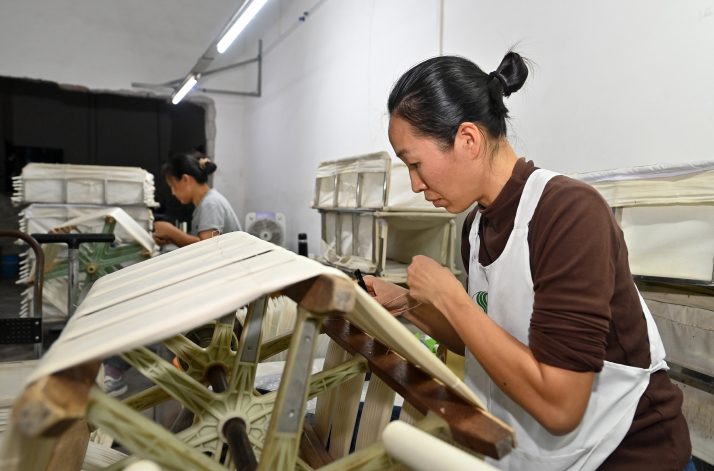
Wei is a witness to the industry’s transformation. “In the past, sericulture was entirely at the mercy of nature, and the county only had primary reeling processing,” Wei explained, adding that the industrial park now also engages in smart silk scouring to remove impurities and smart dyeing. –The Daily Mail-Beijing Review news exchange item