
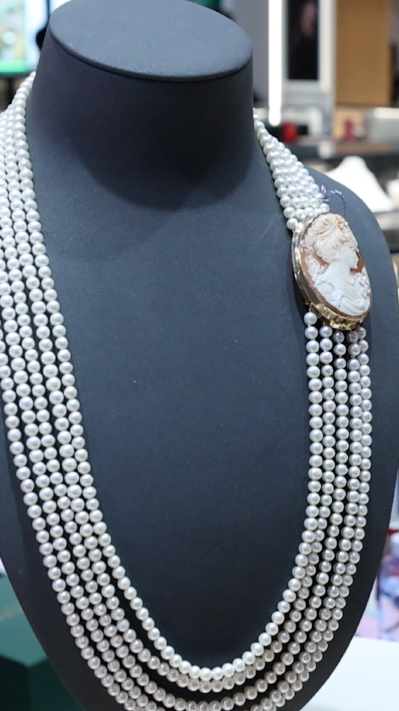
Before bringing his jewelry to China, Marco Russo had a rather different picture of what Chinese consumers might like. As CEO of Italian jewelry company Russo Cammei, he had assumed that a large, elaborate cameo necklace would be too bold for the Chinese market, where he imagined customers would prefer smaller, more delicate designs.
He was wrong.
“Every time we come here, we can sell at least two of these large necklaces,” Russo told Beijing Review at the Ninth China International Import Expo (CIIE), held in Shanghai on November 5-10. The experience taught him a lesson that goes beyond jewelry: A market cannot be understood from a distance. “You really have to come here to understand the market,” he said.
For Russo, the CIIE has provided precisely that opportunity. More than a place to display products and meet potential buyers, it allows exhibitors to observe consumers firsthand and listen to their feedback.
His experience reflects a broader role the CIIE has come to play in international business. Themed New Era, Shared Future, the Ninth CIIE brought together 4,142 overseas exhibitors, with participants from 162 countries, regions and international organizations.
As the world’s first national-level exhibition dedicated to imports, the CIIE continues to offer international businesses a gateway to China’s vast consumer market. Yet its significance increasingly goes beyond trade transactions. It is also a place where companies test assumptions, identify emerging demand, exchange business practices and explore how ideas developed in China can travel further afield.

Beyond the booth
Like Russo, Sheng Wenhao, CEO of Theland Asia Pacific, sees the value of the CIIE as extending well beyond the exhibition hall. For New Zealand dairy brand Theland, the expo has become both a testing ground for new products and a gateway to China’s wider consumer market.
At last year’s expo, Theland launched a new product with 25,000 cans, which sold out on site. Demand has remained strong ever since, with the product continuing to be offered through monthly presales.
“This is the spillover effect of the CIIE,” Sheng said during this year’s expo. He also recalled how a product launched at an earlier edition quickly moved from the exhibition stand to store shelves, reaching major cities and, in less than three months, Mohe in Heilongjiang Province, one of China’s northernmost cities.
Having participated in the expo’s nine editions so far, Theland has also sought to share the opportunities it has discovered with other New Zealand businesses. The company has brought groups of enterprises, including niche industry leaders, to the expo. Three have since gone on to establish independent exhibition spaces of their own.
For Sheng, the CIIE is thus a platform for shared opportunities. This year, Theland participated alongside a delegation of 33 New Zealand companies.
For Swiss-American technology company Logitech, a newcomer to the expo, the appeal lies partly in its ability to bring together businesses and ideas from across the world.
“At the CIIE, exhibitors no longer feel that they are operating in a fragmented global market,” Logitech CEO Hanneke Faber said. The expo, she added, offers a renewed sense of the possibilities for the free flow of goods, production factors and talent across borders—something particularly important to a company with a highly globalized business.
Faber also highlighted the opportunities for public-private cooperation. With governments at the national, provincial and municipal levels participating alongside domestic and international businesses, the expo brings different stakeholders together to explore ways of working together and accelerate progress.
But the CIIE is not just a platform for international brands. It also offers China an opportunity to introduce its stories to the world.
Inside the China Pavilion, a dedicated display highlighted the development of Yiwu in Zhejiang Province, known as the “world’s small commodities capital,” and its role in connecting Chinese manufacturers with global markets.
Chen Haonan, Deputy Director of the Yiwu Municipal Bureau of Commerce, was busy explaining the city’s trading model to international visitors. One innovation that attracted particular attention was the role of the “cargo consolidator.”
“Everyday consumer goods are often low in individual value and purchased in mixed orders from multiple suppliers, making customs procedures more complicated,” Chen explained to Beijing Review. Under Yiwu’s model, a cargo consolidator collects goods from different suppliers at a centralized warehouse, where they are inspected and packed together into containers for export. This streamlines customs procedures, reduces logistics costs and allows overseas buyers to source a wider variety of products in smaller quantities.

Demanding consumers
If the exhibition floor offers a snapshot of international commerce, it also provides a close-up view of one of its most influential forces: Chinese consumers.
Across industries, business executives interviewed by Beijing Review repeatedly described Chinese consumers as “demanding.” Rather than seeing this as a challenge, many regard it as a powerful driver of innovation.
“Chinese consumers are the most sophisticated in the world in our industry,” Faber said. China accounts for a large share of the global gaming market, in which Logitech is a major player, and Chinese gamers are highly engaged, knowledgeable and attentive to performance and detail. Also, gaming is often a shared experience in China, bringing people together in ways less common in other markets.
These distinctive preferences, Faber said, are shaping Logitech’s approach in China while offering insights that can inform its business globally.
Danish LEGO Group has observed a different but equally notable shift: Chinese consumers are increasingly looking for experiences that provide personal satisfaction and emotional value.
Beyond functionality and quality, adults are paying more attention to their interests, self-expression and the opportunity to enjoy activities that allow them to slow down and focus on the present, Sylvia Fu, Vice President and Head of China Sales, the LEGO Group, said.
The company’s product portfolio has consequently expanded across a wider range of themes, including art, racing, sports, architecture and nature. For the LEGO Group, this is not simply about offering more product categories. It is about enabling consumers to express their identities and engage with their passions in their own ways.
The importance of these changing expectations is also evident in China’s automotive market.
Zheng Yi, President of the American Chamber of Commerce in Shanghai, said Chinese consumers, particularly younger generations, increasingly expect a car to offer more than transportation. They want an experience. A vehicle’s dashboard, interactive functions and digital features can make it feel almost like a smartphone on wheels.
For businesses, he added, this means constantly developing new features, products and services to keep pace with changing expectations. In the automotive sector, intense competition between domestic and international manufacturers has made that pressure especially visible.
Nicolas Hieronimus, CEO of French L’Oréal Group, noticed that although fragrance still accounts for a relatively small share of China’s premium beauty market, at around 13 percent, it is growing rapidly.
“Chinese consumers are becoming more knowledgeable about fragrance and increasingly willing to explore the category,” he told the press during the CIIE. “One interesting development is that many Chinese consumers are going directly for high-end, professional fragrances rather than starting with entry-level products.”
The common thread across gaming, toys, automobiles and beauty is that Chinese consumers are no longer satisfied with basic functionality alone. They seek quality, design, individuality, meaningful experiences and value. Their expectations are helping companies rethink everything from product development to customer engagement.
Russo sees another dimension to this sophistication: an appreciation of cultural depth. His cameo jewelry is not simply a matter of design or craftsmanship. Each piece carries a history and an emotional story. He believes that Chinese consumers, with their deep historical and cultural heritage, are particularly capable of understanding and appreciating these elements.
“China is the most important market for us, both now and in the future,” he said, adding that the connection he has found with Chinese consumers through the CIIE has further strengthened his commitment to the market.

From China to the world
For other international companies, that commitment is taking shape through long-term investment, local partnerships and innovation with global reach.
This year is the 80th anniversary of American Estée Lauder Companies. Stéphane de La Faverie, the company’s President and CEO, made his first appearance at the CIIE this year, describing the visit as an opportunity to reaffirm the group’s long-term commitment to China.
“China is now one of the world’s most dynamic and sophisticated beauty markets, offering important lessons for the group’s next stage of development,” De La Faverie said.
Having operated in the country for more than three decades, the company sees the Chinese market as an important source of insight and innovation.
That commitment also extends to technology partnerships. Estée Lauder is working with Alibaba Cloud Intelligence Group, e-commerce giant Alibaba’s cloud-computing and AI arm, to combine its expertise in prestige beauty and consumer insights with the Chinese technology company’s capabilities in data and large language models. The aim, according to the group, is to turn technological advances into practical benefits for consumers and drive further innovation in products and experiences.
Other companies are making similar moves. In September, Logitech announced plans to establish a research and innovation center in Shanghai in early 2027. The center will focus on emerging areas including cloud gaming, edge AI, generative AI and intelligent video collaboration.
Its strategy is built around the principle of “in China, for China, for the world:” translating the needs of Chinese consumers and gamers into product and experience innovation, while contributing insights and practical solutions to the company’s global business.
For the LEGO Group, long-term engagement means becoming more closely connected with local communities. During this year’s expo, the company signed a memorandum of understanding with Shanghai’s Xuhui District Commerce Commission and Hunan Road Subdistrict. Through art installations, pop-up stores and themed events, the partnership intends to bring more creative experiences into the city’s neighborhoods and enrich local cultural and consumer activities.
L’Oréal sees China’s contributions to its global business extending well beyond the domestic market.
A particularly tangible example is the group’s intelligent operations center in Suzhou, Jiangsu Province. During this year’s Double 11 shopping season, China’s largest online shopping festival centered on November 11, the facility was processing millions of parcels. As L’Oréal’s most advanced intelligent operations center globally, it is expected to serve as a model for similar facilities in other parts of the world.
Hieronimus also pointed to the group’s collaboration with China’s startup ecosystem as an important source of innovation. Its laboratory in Shanghai’s Pudong New Area works closely with local startups, with the aim of developing technologies and products that can serve both Chinese consumers and international markets.
At this year’s CIIE, L’Oréal presented its story under the theme The Beauty Odyssey, describing a journey across time, geography and evolving ideas of beauty.
Hieronimus explained that an odyssey is a journey of exploration. L’Oréal’s began in France more than a century ago and has since taken the company across markets, cultures and beauty categories, with each new destination bringing fresh ideas and innovations.
Next year, L’Oréal will mark 30 years in the Chinese market. For Hieronimus, the milestone is an opportunity not only to look back, but also to keep investing and exploring what lies ahead.
He also offered a playful reference to the upcoming Year of the Goat. In English slang, GOAT stands for Greatest of All Time, reflecting the company’s aspiration for its future in China.
“We can look back on the past 30 years, but what matters even more is investing in the future,” Hieronimus said. “Investing in China is investing in the future.” –The Daily Mail-Beijing Review News exchange item