

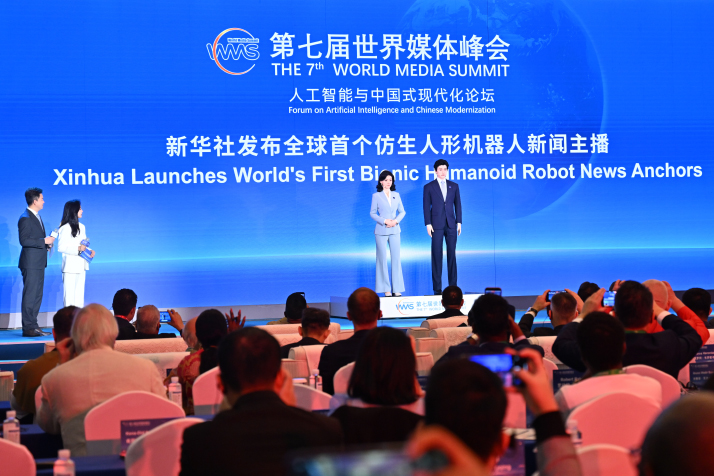
When “she” stepped onto the stage and greeted hundreds of global media leaders in fluent English, the room caught a vivid glimpse into journalism’s next chapter.
Designed under the artistic direction of acclaimed filmmaker Zhang Yimou and co-developed by Xinhua News Agency and Chinese humanoid robotics pioneer UBTECH, the world’s first bionic humanoid robot news anchorwoman made her debut in Beijing on November 5, during a forum at the Seventh World Media Summit (WMS). Named Xinyan, she was launched together with her male counterpart Xinyu.
This striking debut set the tone for the five-day gathering, which ran through November 9 under the theme Media in the Intelligent Age: From Consensus to Action. This year’s summit brought together nearly 500 delegates from 330 organizations across 112 countries and regions. Co-founded in 2009 by global news heavyweights including Xinhua News Agency, the Associated Press, Reuters, TASS and Kyodo, the event is one of the world’s major platforms for the international press to navigate the new AI-driven era together.
Navigating the AI frontier
As AI swiftly evolves into a powerful tool in human history, it has confronted the global journalism industry with existential questions. Throughout the summit, delegates explored the evolving role of the press in the intelligent age and how newsrooms can navigate the technological disruptions ahead.
At the core of the debate is the threat to original reporting and information integrity. Speaking at the opening ceremony and subsequent dialogues, Fabrice Fries, Chairman and CEO of French international news agency Agence France-Presse (AFP), warned that without original journalism rooted in verified facts, AI risks trapping itself in a closed loop, generating synthetic content endlessly fed by other synthetic content. He also voiced deep concern over blurred attribution and the erosion of fact-checking in AI-driven workflows. Echoing these worries, Paul Bascobert, President of British news agency Reuters, pointed to the perils of unchecked AI misuse and “hallucinations.” Looking ahead, Bascobert stressed that news organizations must learn to effectively harness the very machines consuming their journalism and figure out how public trust can be built and maintained through them.
This tension between algorithmic speed and journalistic rigor was a recurring theme. Media leaders and creators concurred that while algorithms can synthesize polished text and convincing deepfakes in seconds, professional reporters still spend hours or days on the ground verifying the truth. Kamel Mansari, Editor in Chief of Algeria’s Le Jeune Indépendant newspaper, warned that algorithms are optimized to boost engagement and amplify specific narratives rather than pursue truth, calling for strict human oversight and real-time global verification networks. Similarly, Sergey Koroteyev, editor-in-chief of Russian broadsheet Izvestia, noted that safeguarding the information ecosystem requires anchoring public trust in established media institutions and forging direct, intermediary-free cross-border partnerships.
The dilemma resonates acutely across today’s shifting digital landscape. A Shanghai-based political commentator known online as Zephyr, who is host of the current-affairs channel Boston Round Face, highlighted a painful reality for serious content creators: High-cost and in-depth reporting often loses the race for virality to sensationalist or fabricated material. Worse yet, the flood of AI-generated synthetic media has made separating fact from fabrication increasingly difficult. For established outlets, publishing a single piece of synthetic misinformation can destroy credibility built over decades.
This prompted a critical, open question from the panel: When AI produces misleading content, who bears ultimate responsibility—the creator, the publishing newsroom, the distribution platform or the tech vendor? Acknowledging that no single gatekeeper can shoulder the blame alone, participants agreed that professional judgment, critical thinking and ethical standards must serve as indispensable filters against digital deception.
To withstand these shocks, unified global governance is imperative. Andrei Mokhar, Director General of the Belarusian Telegraph Agency, the country’s national state-owned news agency, noted that tech giants evolve far faster than national legislation, urging the global press to establish harmonized standards to label synthetic content, safeguard copyrights, and ensure equitable access to AI tools across all regions.
Yet, amid algorithm-driven distribution, how can journalism truly connect with younger generations who increasingly bypass traditional outlets? Mexican content creator Diego Ruzzarin argued that the answer lies beyond institutional branding, resting instead in lived experience and cultural resonance.
He noted that on every trip to China, he brings four to five fellow content creators from the Global South to experience the country firsthand, demonstrating that sipping tea and conversing face to face with locals fosters an unshakeable trust no algorithm can replicate.
Citing his viral analyses of ancient Chinese military general Sun Tzu’s The Art of War and Japanese anime television series Dragon Ball Z (inspired by Sun Wukong from the Chinese classic novel Journey to the West), he showed how shared cultural motifs can bridge divides. Ultimately, while technology continues to reshape the medium, human empathy and critical integrity remain journalism’s true anchor.
Bridging divides
Beyond navigating ethical dilemmas, a central mission of the Beijing gathering was ensuring that technological progress narrows rather than widens the global information gap.
Speaking at the November 7 opening ceremony, Xinhua President Fu Hua urged the industry to pool technical know-how and practical insights so that journalists everywhere have an equal shot at harnessing AI’s potential. This vision was codified in the Seventh World Media Summit Beijing Consensus, a joint declaration pledging to promote inclusive, responsible AI adoption that uplifts newsrooms across all countries, regardless of their stage of development.
For media leaders from developing nations and small island states, closing this technological divide is urgent. Aminath Namza, Chairperson of state broadcaster Public Service Media in the Maldives, observed that most AI models are trained on data skewed toward heavily digitized societies, often leaving smaller nations’ languages, cultures and lived realities on the margins. Global governance, she argued, must ensure developing countries are not merely passive consumers, but active contributors who help write the rules for AI.
Echoing that concern, Abdul Hakim, President of Antara News Agency, the national news agency in Indonesia, noted that in the race toward digital transformation, no nation or voice can afford to be left behind.
For many delegates from the Global South, bridging the tech gap goes hand in hand with reclaiming their own narratives. Ali Mohammed Ali, Managing Director of the News Agency of Nigeria, pointed out that developing nations have long been boxed into pre-set Western storylines, making it vital to break free from one-way reporting and present a fuller, truer portrait of their societies. Attending the summit for the second time, Patricia Villega, President of Venezuela’s Telesur television network, added that authentic coverage requires boots on the ground to grasp local history and capture a region’s true complexity, supported by tighter South-South media solidarity.
Across Africa, newsrooms are looking for practical pathways to modernize and collaborate. Abdishakur Ali Ahmed, Director of Communication Strategy at Somalia’s Ministry of Information, Culture and Tourism, noted that the forum offered a timely space to tackle digital transformation, a cornerstone of Africa’s growth, while witnessing China’s technological strides up close. Similarly, Luis Alves do Rosario Canhemba, Senior Director of Mozambique’s Information Office, emphasized that cross-border technical exchange and joint safeguards against AI risks are essential to moving forward together.
Ultimately, technology is only as meaningful as the stories it helps tell. As Agnes Kalekye Nguna, CEO of state-owned public broadcaster Kenya Broadcasting Corp., put it, amplifying the voice of the Global South begins when its own storytellers take the mic. By joining forces to chronicle tangible realities, from tackling climate change to driving trade and local livelihoods, media outlets across the developing world are not just adapting to the intelligent age; they are actively shaping a fairer, more balanced global conversation. –The Daily Mail-Beijing Review News exchange item