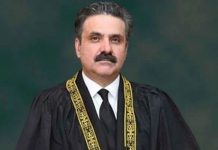
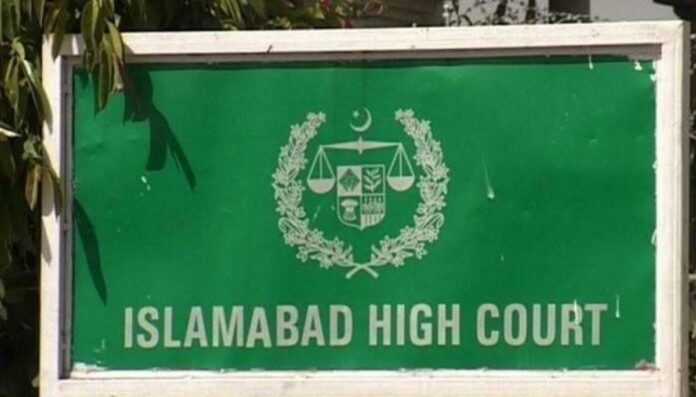
ISLAMABAD: The Islamabad High Court (IHC) on Tuesday declared a petition seeking the verification of Justice Tariq Mehmood Jahangiri’s degree maintainable and directed the judge, along with other respondents, to submit their replies within three days.
A division bench comprising IHC Chief Justice Sardar Muhammad Sarfraz Dogar and Justice Muhammad Azam Khan conducted the hearing on the petition filed by Advocate Mian Dawood.
The case centres on a controversy regarding Justice Jahangiri’s LLB degree, which was cancelled by the University of Karachi.
According to the university’s notification dated September 25, the university syndicate, in its meeting on August 31, 2024, approved “Resolution No 06” in compliance with the competent authority’s decision, upholding the recommendation of the Unfair Means Committee (UFM).
The notification stated: “Justice Jahangiri was found guilty of using unfair means and has been barred for three years from admission to any university or college, as well as from appearing in any university examination.”
Furthermore, the University of Karachi clarified that Justice Jahangiri had never been enrolled as a student at Islamia Law College, Karachi, in 1989.
It may be noted that the same bench of the IHC had restrained Justice Jahangiri from performing judicial duties until the Supreme Judicial Council’s (SJC) decision on Mian Dawood’s petition.
However, five IHC judges, including Justice Jahangiri, approached the Supreme Court against the divisional bench’s order, which was later suspended by the apex court.
The SC, while allowing Justice Jahangiri to continue judicial work, directed the petitioner of the initial plea to remove objections of maintainability before further proceeding with the case in the IHC.
During the following hearings, the IHC divisional bench sought relevant records from the Higher Education Commission (HEC) regarding the law degree of Justice Jahangiri.
The replies from the HEC and the University of Karachi were placed on record in today’s hearing.
A large number of bar office-bearers and lawyers gathered at the rostrum, prompting the Chief Justice Dogar to instruct them to sit down, saying the court would first hear arguments on the maintainability of the petition.
Mian Dawood began his arguments, saying that under Article 193 of the Constitution, a high court judge must be a qualified advocate. He said a newspaper report had highlighted the issue, adding that the Karachi University controller of examinations had confirmed the authenticity of a letter declaring the judge’s degree fake.
He argued that the question before the court was whether a petition against a high court judge could be heard by the same court, saying the plea was a writ of quo warranto challenging the judge’s eligibility as both advocate and judge.
He maintained the judge should simply clarify whether the degree was genuine, and said that under Article 209, allegations arising after a judge takes the oath fall within the Supreme Judicial Council’s remit.
He also referred to the Justice Mazahir Ali Akbar Naqvi case, arguing the burden now lay on Justice Jahangiri to prove his degree authentic.
After the completion his Dawood’s arguments, the court asked Barrister Zafarullah to assist the court on the matter.
However, the lawyers from the Islamabad Bar insisted on being heard first.
Representing around 8,000 lawyers, the Islamabad Bar’s lawyer argued that the petition was filed by the Islamabad District Bar Association. At this, the petitioner’s lawyer objected to the bar becoming a party.
The bar’s counsel said that the petitioner was not an aggrieved party and should have approached the bar council if he believed an issue existed.
He argued that 10 years’ experience of advocacy is required for appointment as a high court judge, and it is the Bar Council’s role to issue licences and verify qualifications. If the judge’s qualifications as an advocate were in doubt, he said, the proper forum was the bar council.
He noted Justice Jahangiri had first practised as a lawyer and was later elevated by the Judicial Commission, which had duly issued his appointment notification. He maintained that decisions related to degrees and credentials must be made by the bar council, not by the court.
The lawyer argued that if anyone questioned Justice Jahangiri’s 10 years of advocacy, they must approach the bar council. As for examining the matter as one involving a judge, he said the high court could not undertake fact-finding, and such matters should go to the Supreme Judicial Council.
The Islamabad Bar’s lawyer opposed declaring the petition maintainable, arguing the case fell under the jurisdiction of the Supreme Judicial Council, not the high court. He asked the court not to interfere in the Bar Council’s powers, adding that no complaint against the judge had been filed with the council and that bar councils were independent bodies.
The bar requested that the petitioner be directed to approach the council first.
When asked by CJ Dogar whether the bar was seeking to stop the case, the lawyer said the court could not issue a fact-finding report or decision. They added that the high court consisted of the chief justice and its judges, and urged the bench not to treat their colleague as a subordinate.
Later, the court declared Dawood’s petition admissible and directed all parties to submit their responses on the matter within three days. –Agencies