
By Adnan Rafique
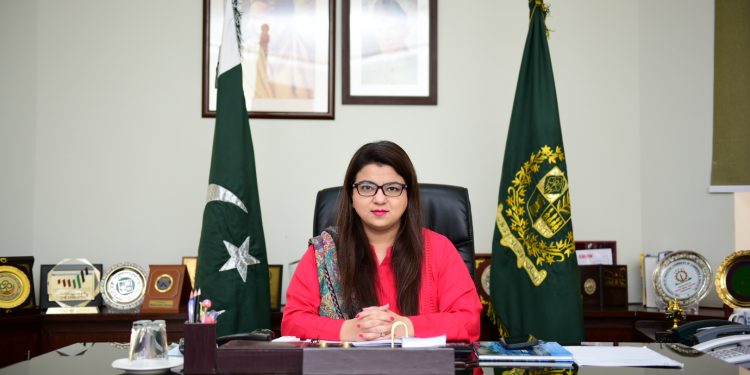
ISLAMABAD: Federal Minister for Information Technology and Telecommunication, Shaza Fatima Khawaja on Friday acknowledged persistent internet speed issues across country, attributing the problem to a severe shortage of available spectrum, and announced major policy steps aimed at improving connectivity, including a new spectrum auction and preparations for the country’s first-ever 5G roll-out.
Addressing a press conference in Islamabad, the minister said Pakistan is currently operating its entire mobile internet network on just 274 megahertz of spectrum for a population of nearly 240 million, describing the situation as “trying to run four-lane traffic on a two-lane road.”
“This is the fundamental reason why internet speeds are slow,” she said, adding that Pakistan has one of the lowest spectrum availability levels in the region. By comparison, she noted, Bangladesh — with a smaller population — has nearly 600 megahertz of spectrum available.
Shaza Fatima stated that the federal cabinet has approved the framework for a major spectrum auction, through which approximately 600 megahertz of additional spectrum will be made available to telecom operators. The auction is expected to take place within the next few weeks.
She said the auction will include seven spectrum bands, five of which are being auctioned in Pakistan for the first time. According to the minister, this expansion will significantly improve 3G and 4G services within three to four months of the auction, while 5G services are expected to be launched within six months in provincial capitals, including Islamabad.
“Our goal is not just faster internet, but future-ready connectivity,” she said, adding that the government is working closely with the Pakistan Telecommunication Authority (PTA) and international consultants to ensure global best practices are followed.
The IT minister stressed that internet connectivity is no longer a luxury but a foundational infrastructure critical for economic growth, national security, education, healthcare, agriculture, and exports.
“Without reliable internet, progress in today’s world is impossible,” she said, highlighting that Pakistan is currently the fourth-largest freelancing economy globally, with the IT sector growing at around 20 to 21 percent annually.
She credited the prime minister and the finance ministry for supporting reforms in the telecom sector, including removing right-of-way charges across federal departments and several provinces, a move she said had reduced costs and encouraged investment in fiber infrastructure.
The minister also announced that the cabinet has approved the Mobile Virtual Network Operator (MVNO) policy, paving the way for new mobile brands to enter the Pakistani market without building their own networks.
Under the policy, MVNOs will purchase network capacity in bulk from existing operators and offer services under their own brands, increasing competition and potentially lowering prices for consumers.
“This will bring more choice, better packages, and improved affordability for users,” she said, adding that global experience shows MVNO’s improve market health and attract foreign investment.
In another major development, Shaza Fatima said the PTA has approved district-level ISP licenses, allowing local cable operators and small companies to legally provide internet services in villages, small towns, and under-served areas.
“This will democratize fiberization and expand legal internet access beyond major cities,” she said, addressing long-standing complaints from rural communities.
The minister also highlighted improvements in Pakistan’s international internet connectivity, noting that the country has become part of the world’s longest submarine cable system (SMW-6), with two more undersea cables expected to go live this year.
She said these developments would reduce Pakistan’s reliance on limited routes and minimize disruptions caused by international cable cuts, such as those recently reported in the Red Sea region.
Responding to questions about internet restrictions, the minister clarified that any temporary shutdowns are carried out strictly on security directives from the Interior Ministry, not as a policy decision of the IT Ministry.
“Human lives are more important than connectivity,” she said, adding that such measures are taken only in extreme situations.
Shaza Fatima expressed confidence that following the spectrum auction, users would experience a visible improvement in internet quality within three to four months, calling the reforms “transformational” for Pakistan’s digital future. “These policies are not just for the next year, but for decades to come,” she said.